
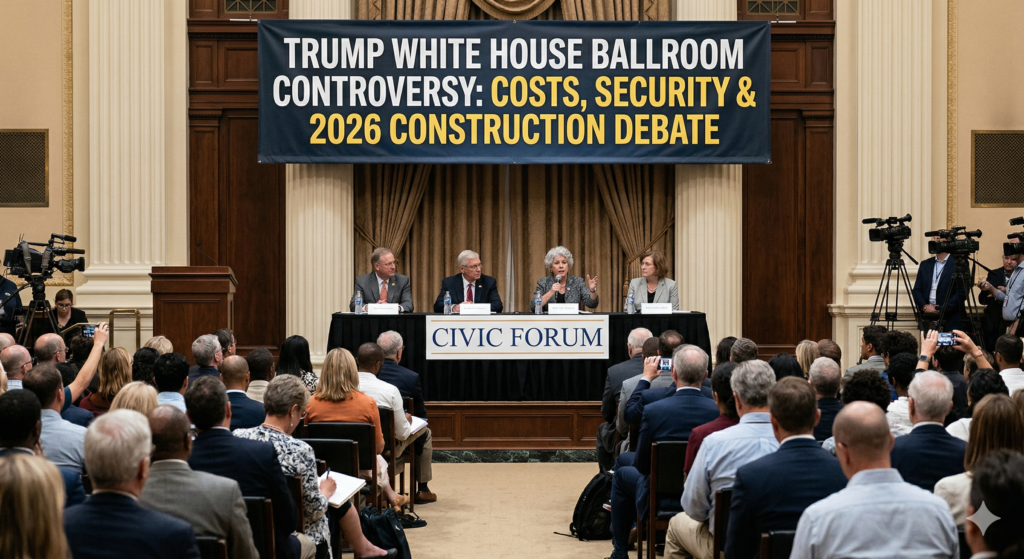
Trump’s vision of the ballroom was more than aesthetics. He framed the space as a “America‑first” venue for diplomatic gatherings, state dinners, and large‑scale rallies. In a 2023 interview with Fox News, he claimed the renovated ballroom would “reflect the strength and grandeur of this great nation.”
Timeline and budget allocations
| Year | Milestone | Estimated Cost* |
|---|---|---|
| 2023 | Initial design memo signed off by the Office of the President | $12 million |
| 2024 | Contractor bids received; security review initiated | $8 million (contingency) |
| 2025 | Revised scope after fire‑code concerns | $22 million |
| 2026 | Expected completion (now delayed) | $35 million total |
*All figures are drawn from the 2023–2026 White House Construction Appropriations Report (available via the Government Publishing Office).
The escalating cost sheet fed directly into the wider White House construction controversy 2026, a term coined by The Washington Post after a series of budget overruns across multiple renovation projects.
The Controversy Unfolds – Security Concerns and Funding Questions
Trump administration security projects and the secret‑facility debate
Soon after the ballroom plan entered the procurement stage, the US government secret facilities debate resurfaced in the media. Critics argued that the renovation might compromise classified zones, especially the White House bunker located beneath the East Wing.
A former Department of Defense analyst, speaking on NPR’s “All Things Considered,” warned that “any structural work within the wings inevitably raises questions about how we protect the continuity‑of‑government (COG) facilities that are hidden from public view.”
The Trump administration’s push for expedited security upgrades—including hardened doors and enhanced CCTV—was presented as a dual benefit: it would modernize the ballroom and reinforce the bunker’s history and upgrades. However, the coupling of a high‑profile public space with secret COG enhancements amplified public skepticism.
White House construction controversy 2026 – a look ahead
By early 2025, Congress held a closed‑door hearing to examine the burgeoning White House construction controversy 2026. Lawmakers highlighted three core issues:
- Transparency – Whether the administration adequately disclosed the impact on classified areas.
- Fiscal responsibility – The ballooning budget versus other national priorities.
- Oversight – The role of the White House Office of Management and Budget (OMB) in authorizing security‑related construction without external review.
The hearing’s transcript, released in June 2025, noted that the
(GSA) had flagged “potential conflicts with the Continuity of Operations Plan” and recommended an independent security audit.
Inside the White House Bunker – History and Recent Upgrades
The bunker’s origins
The original White House bunker history and upgrades can be traced back to the Cold War. In 1963, under President John F. Kennedy’s direction, a secure underground facility—later dubbed the “Presidential Emergency Operations Center” (PEOC)—was built to protect the president in the event of a nuclear attack.
Since then, each administration has added layers of protection: reinforced concrete, blast doors, independent air filtration, and secure communications. The bunker’s existence is officially acknowledged, but many specifics remain classified to preserve the national security infrastructure USA.
Recent upgrades that intersect with the ballroom plan
In 2022, the Trump administration allocated $4 million for “bunker modernization,” citing outdated ventilation systems. The work included:
- Installation of a secure fiber‑optic link linking the bunker to the West Wing’s secure line.
- Upgraded electromagnetic shielding to protect against electronic surveillance.
- Reinforced structural support beneath the East Wing to accommodate potential heavy‑load equipment for large events.
These upgrades directly overlapped with the ballroom’s structural load analysis, forcing engineers to recalculate the foundation’s capacity. The overlap is a core reason why the Trump White House ballroom controversy quickly became a security dispute as much as a design dispute.
Impact on National Security Infrastructure USA
How the debate reflects broader US government secret facilities discussions
The ballroom controversy has become a case study in the US government secret facilities debate. It raises three perennial questions that policy makers grapple with:
- Visibility vs. secrecy – Should the public be informed about construction that may affect classified spaces?
- Budget integration – How can “public” renovation funds be merged with “secret” security dollars without creating loopholes?
- Accountability mechanisms – What independent oversight bodies can examine projects that straddle both realms?
Think tanks such as the Brookings Institution have published papers arguing that a joint oversight board—including members from the OMB, GSA, and the Department of Homeland Security—could provide the necessary checks.
Potential policy changes and oversight reforms
Following the 2025 hearing, a bipartisan group of senators drafted the White House Renovation Transparency Act (H.R. 4983). If passed, the bill would:
- Require a public summary of any construction that could impact continuity‑of‑government facilities.
- Mandate an annual audit by the Government Accountability Office (GAO) of all security‑related upgrades.
- Create a classified annex within the GAO’s audit process to protect sensitive details while still ensuring fiscal responsibility.
Although the act is still pending, the conversation signals a shift toward more rigorous scrutiny of projects that intertwine public spectacle with covert security imperatives.
What This Means for Future White House Renovations
Lessons for transparency and budgeting
The ballroom saga teaches future administrations that clear communication is as critical as concrete. When a high‑profile renovation touches any classified zone, a dual‑track reporting system—one public, one classified—can preempt the backlash that fueled the current controversy.
From a budgeting standpoint, integrating contingency funds for potential security-related adjustments early in the planning phase can reduce the risk of cost overruns that plague the White House construction controversy 2026.
Public expectations and political implications
Americans expect the White House to be both a symbolic venue for statecraft and a secure command center. When those expectations clash, the political fallout can be significant. Polls conducted by Pew Research in late 2025 found that 57 % of respondents believed the government should be “more transparent about renovations that could affect national security,” while 41 % prioritized “strict secrecy to protect the president.”
Officials must therefore navigate a delicate balance: honoring the national security infrastructure USA while honoring democratic openness.
FAQ:
Q1: What exactly is the Trump White House ballroom controversy?
Answer: It is the public and congressional dispute that arose after President Trump ordered a major renovation of the White House’s East Wing ballroom, which raised concerns about security impacts on the underground bunker, escalating costs, and a lack of transparency.
Q2: How does the ballroom renovation affect the White House bunker?
Answer: The renovation required structural changes to the East Wing’s foundation, which supports the bunker. Engineers had to reassess load‑bearing capacities and reinforce the bunker’s protective layers, linking the two projects in budget and security reviews.
Q3: What is the White House construction controversy 2026?
Answer: It refers to a series of budget overruns and oversight questions across multiple White House renovation projects slated for completion in 2026, of which the ballroom upgrade is the most high‑profile component.
Q4: Are there any new laws being introduced because of this controversy?
Answer: Yes, the proposed White House Renovation Transparency Act (H.R. 4983) aims to require public summaries of any construction affecting classified facilities and to mandate GAO audits of related security spending.
Q5: Will future presidents be able to renovate the White House without security concerns?
Answer: Any major renovation will still need to consider the national security infrastructure USA. However, clearer guidelines and oversight mechanisms can help streamline the process and reduce controversy.
Why the Debate Still Matters
The Trump White House ballroom controversy is more than a story about chandeliers and décor; it is a litmus test for how America balances symbolic public spaces with the hidden layers that keep the nation’s leadership safe. By understanding the intersections of design, security, and fiscal responsibility, citizens can better assess future proposals for the White House and other federal facilities.
For More Information
Related Article
Who Is Braylon Mullins? The Rise of College Basketball’s Newest Star
Warriors vs Nuggets Odds: Denver Covers as Nuggets Win 116–93
MAGA Iran War Anxiety: Why Trump’s Base Is Turning Against the Conflict
Pentagon Draws Up Ground Operation Plans for Iran as Thousands of US Troops Flood the Middle East
2 thoughts on “Trump White House Ballroom Controversy: Costs, Security & 2026 Construction Debate”