
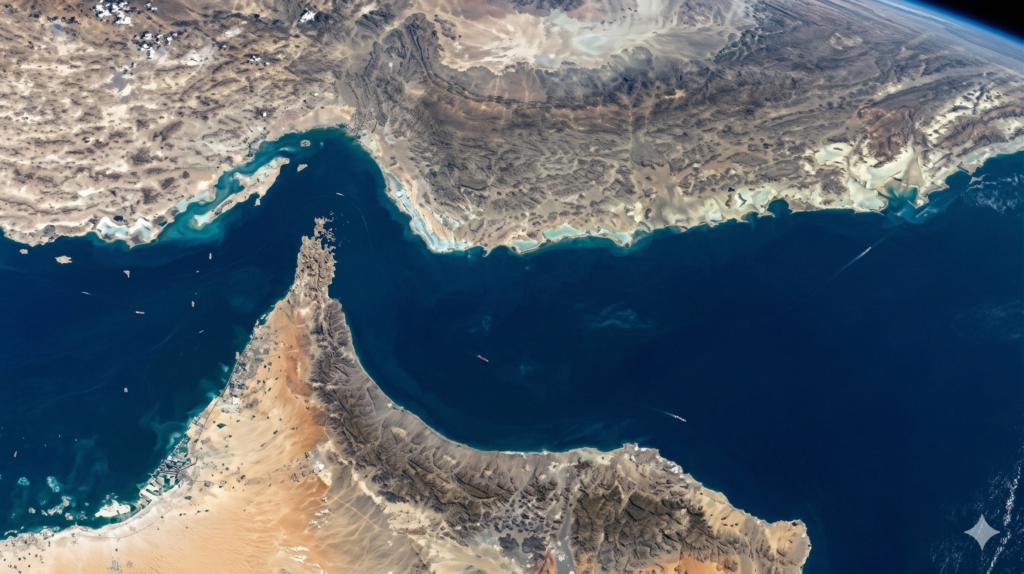
The Strait of Hormuz is a narrow passage of water — roughly 21 miles across at its tightest point — positioned between Iran to the north and Oman and the United Arab Emirates to the south. Despite how unassuming it appears on a map, this waterway is arguably the single most consequential stretch of ocean on Earth when it comes to the global energy supply.
Somewhere between 20 and 21 percent of the world’s total oil output passes through this strait every single day. That includes crude oil shipped out of Saudi Arabia, Iraq, Kuwait, the UAE, and Qatar — some of the largest oil-producing countries on the planet. On any given day, roughly 17 million barrels of oil make that passage, along with enormous volumes of liquefied natural gas.
To put that into perspective: if the Strait of Hormuz were suddenly shut down, nearly one-fifth of the world’s entire oil supply would be frozen in place almost overnight. There is no rapid alternative route capable of absorbing that volume. Other options, such as the Suez Canal or overland pipeline systems, can handle a portion of the traffic — but nowhere near enough to make up the difference.
Iran War Hormuz Tensions
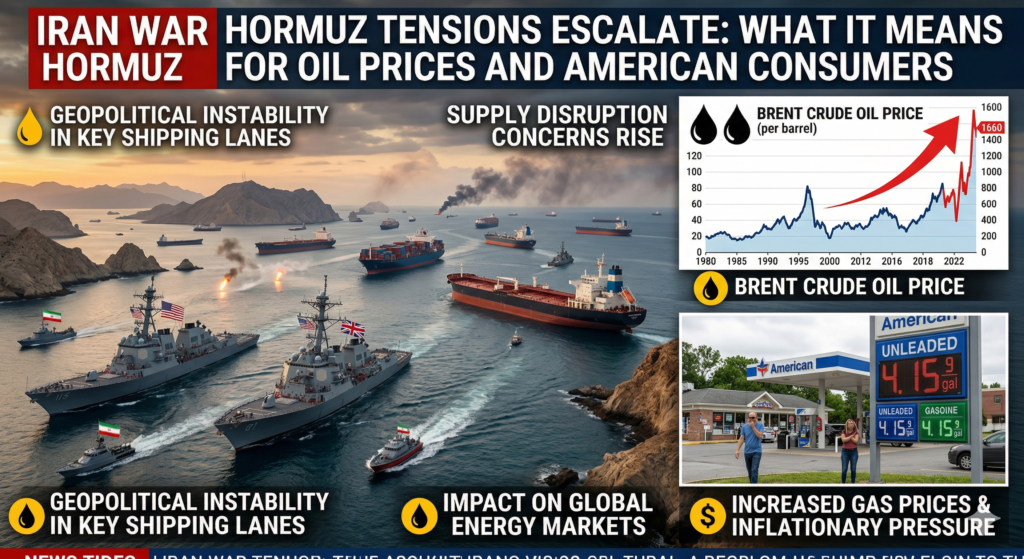
The relationship between the United States and Iran has been tense and unpredictable for decades. During periods of heightened military strain — whether tied to disputes over Iran’s nuclear ambitions, regional proxy conflicts, or direct confrontations at sea — the status of the Hormuz strait moves immediately to the forefront of global concern.
Iran has threatened on multiple occasions to close or significantly restrict access to the Strait of Hormuz as a direct response to Western sanctions or military pressure. Iran’s Islamic Revolutionary Guard Corps regularly stages naval exercises in the Persian Gulf, and the country controls both islands and stretches of coastline that sit right alongside the main shipping lanes.
Key Flashpoints That Raise Hormuz Concerns
- US sanctions that cut into Iranian oil revenues and exports
- Military strikes targeting Iranian nuclear sites or affiliated proxy forces
- Iranian forces seizing or harassing oil tankers in Gulf waters
- Escalation of conflicts in Yemen, Iraq, or Syria involving Iranian-backed groups
- Increased US naval deployments to the Persian Gulf
Each of these scenarios raises the same fundamental question: would Iran use the Strait of Hormuz as a pressure point? That could mean physically blocking ships or simply generating enough instability that insurance premiums and shipping rates climb sharply — which alone can disrupt global markets.
What Would Happen If Iran Blocked Strait of Hormuz Oil Shipments?
A complete closure of the Strait of Hormuz by Iran would deliver an economic shock unlike almost anything the modern world has experienced. Here is what most energy analysts and strategic experts expect would unfold in the short term.
Immediate Impact on Global Oil Prices
Global oil prices would almost certainly spike within hours of a confirmed blockade. Oil markets are extraordinarily sensitive to supply disruption signals — even the credible threat of a closure has historically triggered price surges of five to ten percent within just a few days. A confirmed, extended blockade could push the price of a barrel of oil toward $150, $200, or beyond, depending on how long it persisted.
For context, the last time oil prices climbed anywhere near those levels — back in 2008 — Americans were paying over four dollars per gallon at the pump. A Hormuz blockade would most likely push prices well past that benchmark.
US Gas Prices Would Climb Fast
Even though the United States has dramatically expanded its domestic oil production over the past decade — making it the world’s largest producer — American gas prices are still determined by global market dynamics. Because oil is traded on international markets, a worldwide supply shock hits US consumers just as hard as anyone else.
Analysts estimate that a sustained Hormuz blockade could add anywhere from $1.50 to $2.50 per gallon to fuel prices across the country. For the average American household, which already spends thousands of dollars annually on gasoline, that kind of increase would represent a significant and immediate financial burden.
Broader Economic Consequences
- Airlines and freight companies would face sharply higher fuel costs, pushing up ticket prices and shipping fees
- Industries like manufacturing and agriculture — which depend heavily on fuel and petrochemicals — would see rising operating costs
- Inflation could accelerate as transportation expenses ripple outward through supply chains
- Stock markets, particularly in energy and aviation sectors, would likely experience extreme volatility
Could Iran Actually Block the Strait?
Iran possesses a meaningful capacity to disrupt — and potentially close — the Strait of Hormuz. The IRGC operates a fleet of fast attack boats, anti-ship missiles, submarines, and sea mines that could pose a serious threat to commercial tanker traffic. Iranian forces have already shown a willingness to detain vessels, as demonstrated in a series of tanker incidents in recent years.
However, sustaining a complete closure is an entirely different challenge. The United States maintains a formidable naval presence in the region, most notably through the US Fifth Fleet based in Bahrain. Any scenario in which Iran attempted a full blockade would quickly escalate into a direct military confrontation — one that would carry severe consequences for Iran itself.
Most defense analysts conclude that Iran is more likely to use the threat of Hormuz disruption as a bargaining chip in negotiations rather than follow through with a full closure. That said, accidents, miscalculations, and rapid escalation spirals have a way of changing that calculus, sometimes very quickly.
How the US Government and Its Allies Might Respond
The United States has long considered keeping the Strait of Hormuz open to be a core national security interest. In a serious conflict scenario, several responses would likely come into play.
- Providing naval escorts for commercial tankers transiting the strait
- Drawing on the US Strategic Petroleum Reserve to stabilize domestic fuel supplies
- Coordinating reserve releases with International Energy Agency member nations
- Applying diplomatic pressure on OPEC member states to increase output
- Potential military action to force the strait back open if it were physically blocked
The US has tapped its Strategic Petroleum Reserve before — most recently in 2022 during the conflict in Ukraine — as a short-term tool to help cool gas prices domestically. The reserve has its limits, however, and any prolonged crisis would require a more comprehensive and sustained international response.
FAQ:
Q: Does Iran have the legal right to close the Strait of Hormuz?
Under international law, the Strait of Hormuz is classified as an international waterway, meaning all nations hold the right of transit passage under the United Nations Convention on the Law of the Sea (UNCLOS). Iran disputes this interpretation, but it has failed to gain broad international backing for its position. The overwhelming consensus among legal experts and international bodies is that any unilateral blockade would constitute a clear violation of international maritime law.
Q: How would a Strait of Hormuz crisis affect gas prices in the US specifically?
Because oil is priced on global markets, US gas prices would rise regardless of America’s domestic production levels. Estimates vary depending on the severity and duration of the disruption, but a significant, sustained blockade could add $1.50 to $2.50 per gallon at the pump. In the most severe scenarios, national average prices could potentially climb to $5 or $6 per gallon.
Q: Are there alternative routes if the Strait is closed?
Yes, but their capacity is limited. Saudi Arabia operates the East-West Pipeline, which can carry some crude oil westward to Red Sea ports for export. The UAE also has a pipeline designed to bypass the strait entirely. However, these alternatives can handle only a fraction of the volume that normally flows through Hormuz on any given day. A genuine blockade would still cause a substantial global supply shortfall, even with those pipelines running at full capacity.
Q: What can ordinary Americans do to prepare for higher gas prices?
While no one can fully shield themselves from the effects of a global energy disruption, there are practical steps worth considering. Keeping your vehicle well maintained improves fuel efficiency. Carpooling and using public transit where available can reduce your direct fuel expenses. If you are in the market for a new vehicle, fuel economy deserves serious weight in your decision. On a household budgeting level, building a modest financial cushion for potentially higher energy costs is a reasonable precaution during any period of significant geopolitical uncertainty.
Q: How long has the Strait of Hormuz been a strategic concern?
The Strait of Hormuz first emerged as a major international flashpoint during the Iran-Iraq War of the 1980s, when both sides attacked oil tankers in the Persian Gulf in what came to be known as the Tanker War. The US Navy ultimately intervened to escort Kuwaiti tankers safely through the region. Ever since the Islamic Revolution of 1979, the strait has remained a recurring and sensitive pressure point in the broader relationship between the United States and Iran.
Why Every American Should Be Paying Attention to Iran-Hormuz Tensions
The Strait of Hormuz may be thousands of miles from American soil, but what happens there is directly connected to what you pay at the gas pump, what you spend at the grocery store, and the overall health of the US economy. The Iran-Hormuz dynamic is not merely a foreign policy abstraction reserved for diplomats and defense analysts — it is a kitchen-table issue that touches ordinary households in very real ways.
Understanding the stakes helps you make sense of the headlines when tensions inevitably escalate. Whether the situation moves toward diplomatic resolution or slides into broader conflict, the Strait of Hormuz will remain one of the world’s most closely monitored waterways for the foreseeable future.
Stay informed by following credible energy and foreign policy news sources, monitoring US State Department updates, and consulting the US Energy Information Administration (EIA) for reliable data on oil supply and price trends. In a volatile geopolitical environment, staying well-informed is genuinely one of the most useful things you can do.
For More Information
Related Article
BREAKING: México – Portugal Ends 0-0 — Full Time Result & Highlights From Estadio Azteca
UFC Fight Night Results: Joe Pyfer Shocks the World with Stunning KO Win Over Adesanya
Spurs vs Bucks Last Game Recap: San Antonio Wins Again as Giannis Sits Out — March 28, 2026
Third No Kings Protests: Millions of Americans Push Back on the Trump Administration in 2026
4 thoughts on “Iran War Hormuz Tensions Escalate: What It Means for Oil Prices and American Consumers”