
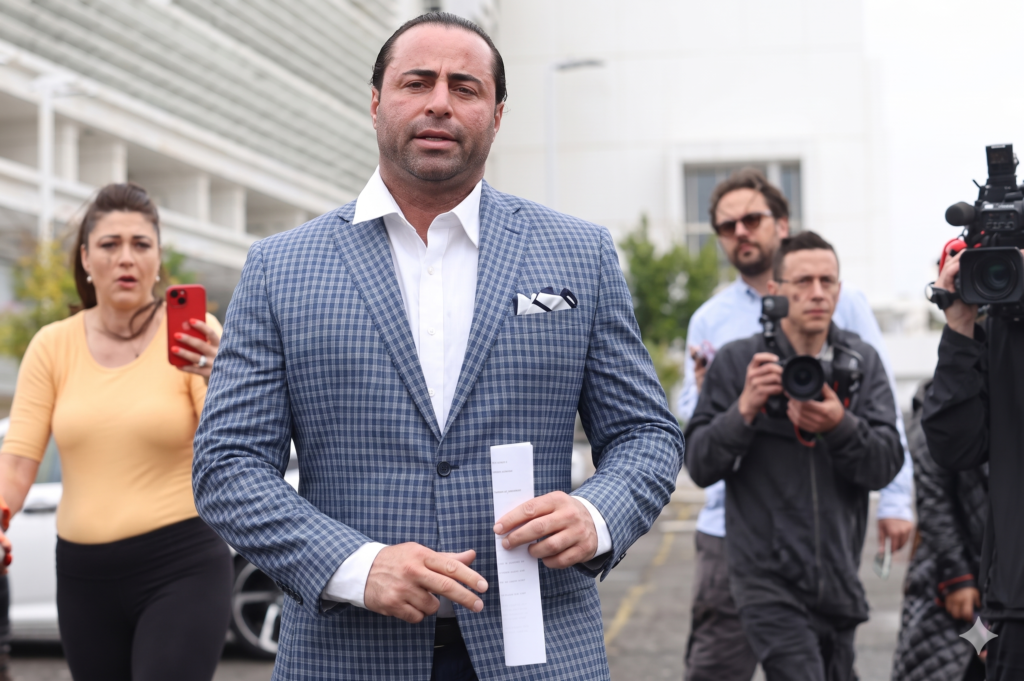
Before diving into the charges, it helps to understand who Carmine Agnello actually is and how he fits into one of America’s most famous criminal dynasties.
Carmine Jr. is the son of Victoria Gotti, the eldest daughter of the late John Gotti. Victoria became something of a celebrity in her own right — a bestselling novelist, a longtime columnist for the New York Post, and later a reality television star. Her father, of course, was John Gotti, the flamboyant boss of the Gambino organized crime family who was convicted in 1992 on charges including murder and racketeering and spent his remaining years in federal prison.
Carmine Jr.’s father is Carmine “The Bull” Agnello Sr., a reputed Gambino crime family associate who also served federal prison time — nearly a decade — after being convicted on racketeering and arson charges. Victoria and Carmine Sr. divorced in 2003 while he was still locked up.
Growing up with that kind of family history is not easy. But Carmine Jr. appeared to handle it with a certain public grace. As a teenager, he starred alongside his mother and two brothers on the A&E reality series “Growing Up Gotti,” which ran in 2004. The show gave viewers an unexpected look at the Gotti household — chaotic, loving, and constantly shadowed by the family’s mob reputation. Carmine Jr. became a fan favorite and even appeared on But Can They Sing? in 2005, making it to the show’s final round.
By adulthood, he had stepped away from television and thrown himself into business. He ran Crown Auto Parts & Recycling, an auto salvage operation based in Smithtown, Long Island — a seemingly unremarkable enterprise that would eventually sit at the heart of a federal fraud investigation.
The COVID Fraud Scheme: Breaking Down What Happened
The charges against Carmine Agnello center on a federal relief program that was created with genuinely good intentions — and that became, for some, an opportunity to steal from the public.
What Was the EIDL Program?
When COVID-19 hit the United States in early 2020, Congress moved quickly to protect small businesses from economic collapse. Among its tools was the expansion of the Economic Injury Disaster Loan (EIDL) Program, administered by the U.S. Small Business Administration. Through this program, qualifying small business owners could receive low-interest emergency loans to cover operating costs — payroll, rent, supplies — that they could no longer meet because of pandemic disruptions.
The program was built on trust. Applicants self-reported their business details, employee counts, and intended use of funds. Federal investigators later discovered that this self-reporting system was badly abused.
What Did Agnello Do, Exactly?
According to court documents and the U.S. Attorney’s Office for the Eastern District of New York, between April 2020 and November 2021, Carmine Agnello submitted at least three separate EIDL applications for his business, Crown Auto Parts & Recycling. Those applications, taken together, resulted in loan disbursements totaling roughly $1.1 million.
The problem was that nearly everything on those applications was false. Here is what prosecutors say he lied about:
- His criminal history. Agnello certified that he had no criminal record — a standard requirement for EIDL eligibility. In reality, he had been convicted of a misdemeanor in 2018.
- His workforce. He overstated the number of employees at his company, which would have inflated the amount of relief he was entitled to receive.
- How he planned to use the money. The loans were intended for legitimate business expenses. Instead, Agnello used the funds largely for personal benefit — including routing approximately $420,000 into a cryptocurrency investment.
His defense would later argue that the crypto spending was not calculated theft but rather the result of a cryptocurrency trading addiction he has since received treatment for. Prosecutors were not persuaded.
The Guilty Plea That Started the Clock
On September 26, 2024, Carmine Agnello stood before U.S. District Judge Nusrat J. Choudhury in Central Islip federal court and entered a guilty plea to wire fraud. He was 38 years old at the time and was released on bond. The sentencing, originally set for months later, would be delayed multiple times before finally landing on April 20, 2026.
The Sentencing Battle: Prosecutors vs. the Defense
The John Gotti grandson prison sentence has been a subject of debate ever since that September 2024 guilty plea. Both sides have filed extensive memorandums laying out their arguments, and they paint very different pictures of the same man.
The Government’s Position
Federal prosecutors in the Eastern District of New York are asking Judge Choudhury to sentence Agnello to between 33 and 41 months in federal prison, paired with approximately $1.25 million in restitution and a fine of up to $2.2 million. Their argument is straightforward: Agnello deliberately lied on multiple government applications, pocketed more than a million dollars in taxpayer-backed funds, and used that money for his own personal benefit while legitimate small businesses struggled to survive.
Wire fraud, technically, carries a maximum prison term of 30 years. Given the plea agreement and the specific circumstances, however, prosecutors are seeking a sentence in the lower three-to-four-year range.
The Defense’s Counterargument
Agnello’s legal team has pushed back hard. His attorney submitted a sentencing memorandum arguing that the cryptocurrency investment — however reckless — was the product of an addiction, not cold-blooded greed. The filing also emphasized that Agnello did not dispute making false statements on the loan applications, but urged the court to weigh his personal character alongside his mistakes.
In a letter filed with the court, his attorney noted that Carmine grew up with a name that followed him everywhere, that he had genuinely tried to build a legitimate business life, and that he had demonstrated extraordinary character in the months leading up to sentencing — character made visible in a way few defendants could claim.
The Kidney Donation: When a Fraud Case Became a Human Story
No aspect of the Carmine Agnello COVID fraud case generated more attention — or more heartbreak — than the medical crisis that upended his sentencing timeline entirely.
Victoria Gotti’s Fight for Her Life
In early 2026, Victoria Gotti, now 63, revealed publicly that she had been diagnosed with end-stage chronic kidney disease. Without a transplant, her options were bleak: permanent dialysis — which requires multiple sessions per week and carries a five-year survival rate of only about 40 percent — or death.
Doctors determined she needed a kidney donor. Carmine stepped forward without hesitation. According to court filings, he was found to be a compatible match and may well be the only viable living donor within the family. He agreed to undergo surgery to give one of his kidneys to his mother.
A Mother’s Letter to the Judge
The situation prompted Victoria to write a deeply personal letter to Judge Choudhury, pleading that her son be sentenced to probation rather than prison. She described Carmine as her “Miracle Child” and spoke of his generosity not as something performed for a judge but as simply the kind of person he has always been.
“He is there to help anyone,” she wrote. “He is kind and generous to a fault. He is giving me the GIFT OF LIFE.”
She also maintained that Carmine had not deliberately committed fraud, arguing that the loan applications had been handled by a third-party professional and that her son had not fully understood what was being submitted on his behalf.
His defense attorney made the medical stakes even more explicit, writing that sending Carmine to prison would “effectively foreclose the only viable path to preserving his mother’s life.” Post-transplant recovery requires careful, ongoing medical monitoring — something the Bureau of Prisons is poorly equipped to provide.
How the Court Responded
The court denied the defense’s request to skip sentencing altogether. The kidney transplant surgery reportedly went ahead on March 30, 2026, with Carmine serving as the donor. By the time April sentencing preparations were underway, Agnello had also switched legal representation and dropped the formal request for a sentence reduction based on the kidney donation — though his new attorney made clear the court should still recognize that act as a reflection of Carmine’s moral character.
The request for leniency remains on the table. The final call belongs to the judge.
The Bigger Picture: COVID Relief Fraud Across America
It would be a mistake to look at the Carmine Agnello COVID relief fraud case as an isolated event. Across the country, thousands of individuals exploited the EIDL program and the related Paycheck Protection Program (PPP), both of which distributed hundreds of billions of dollars in emergency funds with minimal initial verification.
Federal agencies — including the FBI, the U.S. Postal Inspection Service, and the SBA’s Office of Inspector General — have been working through an enormous backlog of fraud investigations ever since. People charged range from small-time opportunists who grabbed a few thousand dollars to sophisticated operators who stole millions across dozens of fraudulent applications.
What separates the Agnello case from the hundreds of similar prosecutions is, frankly, the name. The Gotti connection turned a fairly typical COVID fraud case into national news. But strip away the famous grandfather, and the mechanics of what Agnello allegedly did are nearly identical to what prosecutors see in courtrooms across the country every week: false certifications, inflated numbers, and loan money spent on anything but business.
John Gotti Family Latest News: Where Everything Stands Today
As of April 20, 2026 — the morning of sentencing — here is the current state of play:
- Carmine Agnello is scheduled to appear at 10 a.m. before Judge Nusrat J. Choudhury at the federal courthouse in Central Islip, Long Island.
- Prosecutors are recommending 33 to 41 months in prison, plus restitution exceeding $1.25 million.
- Victoria Gotti underwent a kidney transplant on March 30, reportedly receiving a kidney from her son. The full medical outcome has not been publicly disclosed.
- The defense is asking for leniency, pointing to Carmine’s kidney donation and his acknowledgment of wrongdoing as reasons the court should consider a sentence below the recommended range.
- Carmine changed attorneys before sentencing. His new counsel, in a letter to the judge, confirmed that Agnello does not dispute that the loan applications contained false statements.
FAQ:
Q.1. What exactly did Carmine Agnello plead guilty to?
Ans: Carmine Agnello pleaded guilty to wire fraud. Between April 2020 and November 2021, he submitted fraudulent loan applications through the federal Economic Injury Disaster Loan program, obtaining roughly $1.1 million by misrepresenting his criminal history, his business’s workforce, and how he intended to use the funds.
Q.2. How long could John Gotti’s grandson go to prison?
Ans: Federal prosecutors are recommending a sentence of 33 to 41 months — or roughly three to three and a half years — in federal prison. Wire fraud technically carries a 30-year maximum, but the plea agreement and individual circumstances bring the expected sentence down significantly.
Q.3. Why did Victoria Gotti ask the judge to spare her son?
Ans: Victoria Gotti was diagnosed with end-stage kidney disease and needed a transplant to survive. Carmine Agnello offered to donate one of his kidneys and was reportedly the only compatible donor in the family. His mother wrote to the judge arguing that imprisonment would endanger his health after such major surgery and would leave her without her only viable donor.
Q.4. Did the judge agree not to sentence him?
Ans: No. The judge denied the defense’s motion to forego sentencing entirely. The kidney transplant reportedly went ahead on March 30, 2026. Agnello’s team later withdrew the formal request for a sentence reduction tied to the donation, though they continued to argue it demonstrates his character.
Q.5. Who was John Gotti, and how is Carmine Agnello connected to him?
Ans: John Gotti was the boss of the Gambino crime family in New York — arguably the most recognizable mob figure in American history. Known as the “Dapper Don” and the “Teflon Don” for his flamboyant style and repeated acquittals, he was finally convicted in 1992 and died in federal prison in 2002. Carmine Agnello Jr. is his grandson through Gotti’s daughter, Victoria Gotti.
A Name, a Crime, and a Question Only the Judge Can Answer
There is no clean way to summarize the John Gotti grandson COVID fraud case, because it resists simple framing. Carmine Agnello is not a mob boss. He is not, by all accounts, a career criminal in the mold of his grandfather or his father. He is a man who made serious, deliberate choices to defraud a federal program during a national crisis — and who also, separately, made what his family describes as the most selfless choice of his life.
Judge Choudhury now has to reconcile those two realities. The law has clear expectations. The facts are not in dispute. But sentencing has always been as much about human judgment as legal calculation.
For More Information
Related Article
Shamar Elkins: The Louisiana Father Who Killed 8 Children in Shreveport
8 Children Dead: Shreveport Louisiana Mass Shooting 2026 — Full Story & Latest Updates
Iran War Negotiations in Pakistan: Why the Islamabad Talks Failed and What Comes Next
Kevin Durant Injury Update Today: KD Ruled Out for Game 1, Return Timeline & Rockets Impact
3 thoughts on “John Gotti’s Grandson Sentenced for $1.1 Million COVID Fraud Case”