
When crude oil prices broke past the $100-per-barrel mark for the first time in four years during March 2026, global energy markets were caught off-guard. The catalyst was Iran’s de facto shutdown of the Strait of Hormuz in the wake of US-Israeli military strikes on the country. For Japan — an island nation that sources more than 90 percent of its crude oil from Middle Eastern producers — this was not a distant geopolitical event. It was an immediate threat to the functioning of the national economy, affecting everything from petrol stations to supermarket supply chains.
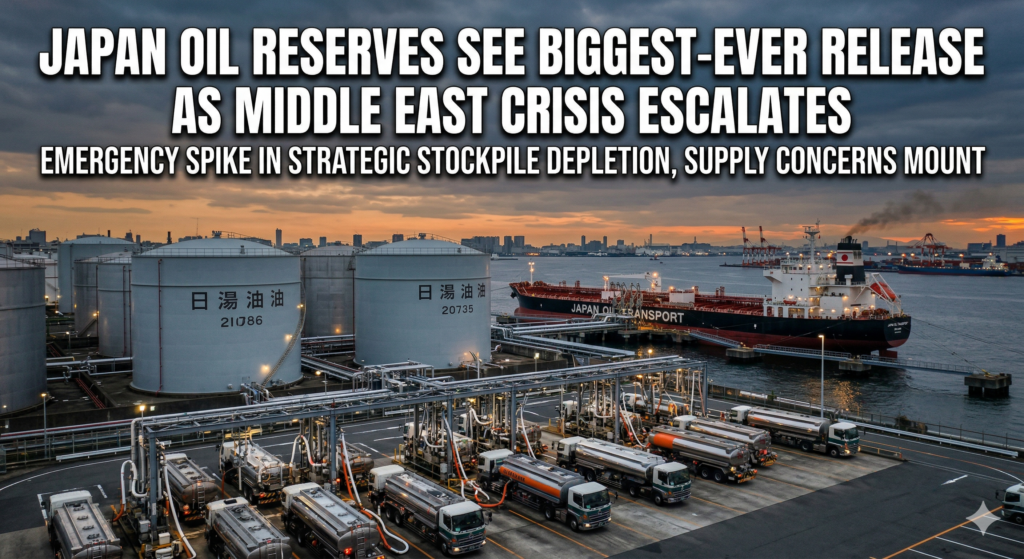
On March 11, 2026, Prime Minister Sanae Takaichi unveiled an extraordinary measure: a unilateral drawdown of 80 million barrels from Japan’s national strategic petroleum reserves. It was the largest such release since the reserve framework was established nearly five decades ago, in 1978. The drawdown commenced five days later, on March 16.
This article examines the full scope of what has unfolded: the chain of events that led to Japan’s historic decision, the scale of the country’s oil stockpile, how Japan’s reserves compare with those of other major economies, and the broader implications for energy security around the world.
What Prompted Japan’s Record-Breaking Oil Reserve Drawdown?
The Closure of the Strait of Hormuz
The proximate cause of the crisis was Iran’s decision to block passage through the Strait of Hormuz — a strategically vital waterway linking the Persian Gulf to the Gulf of Oman. On any given day, approximately 20 million barrels of crude oil pass through this corridor, representing close to one-fifth of global daily oil consumption. Following US and Israeli airstrikes on Iranian territory on February 28, 2026, Tehran responded by effectively shutting down the passage, leaving more than 150 fully laden tankers trapped within the Persian Gulf.
The repercussions for Japan were immediate and severe. Data from Japan’s Ministry of Economy, Trade and Industry confirmed that 95.1 percent of the country’s crude oil imports originated from the Middle East as of January 2026, with 73.7 percent of those shipments transiting the Strait of Hormuz. In concrete terms, the blockade put roughly two-thirds of Japan’s entire crude oil supply at risk.
International Coordination Through the IEA
Japan’s announcement arrived just days before the International Energy Agency orchestrated a historic coordinated response — a combined release of 400 million barrels of oil across 32 member countries. This was more than double the volume released in the wake of Russia’s invasion of Ukraine in 2022, and the largest such collective action in the IEA’s history. Japan’s 80-million-barrel contribution stood as one of the biggest individual national commitments within that coalition.
The sheer magnitude of the coordinated response speaks volumes about how gravely the international community regards the current supply disruption.
How Large Are Japan’s Oil Reserves?
Japan’s Strategic Stockpile: Key Figures
Japan operates one of the most disciplined and well-maintained strategic petroleum reserve programmes among industrialised nations. As of December 31, 2025, the country’s total emergency oil holdings stood at approximately 470 million barrels — sufficient to cover 254 days of national consumption at prevailing demand rates.
The composition of that stockpile is as follows:
- Government-held reserves: covering 146 days of domestic consumption
- Private-sector reserves: covering 101 days of domestic consumption
- Reserves stored jointly with oil-producing nations: covering 7 days of domestic consumption
The 80-million-barrel release executed in March 2026 accounts for roughly 45 days of supply, or between 17 and 20 percent of the nation’s total stockpile. While it buys valuable time, it does not eliminate the underlying supply threat: so long as the Hormuz blockade persists, Japan has no mechanism to restock what it draws down.
The Origins of Japan’s Reserve System
Japan established its national petroleum reserve infrastructure in 1978, a direct policy response to the economic devastation wrought by the 1973 oil embargo. That earlier crisis had crippled Japanese industry and exposed the vulnerability of an economy almost entirely dependent on imported energy. In the decades since, successive administrations have treated strategic stockpiling as a cornerstone of national economic resilience. The physical storage network comprises ten coastal government facilities, with one of the most significant installations situated at Shibushi in Kagoshima Prefecture on the southern island of Kyushu.
Oil Reserves by Country: Where Does Japan Stand Globally?
Placing Japan’s strategic reserves in an international context helps clarify both the significance of its actions and the nature of its energy vulnerabilities relative to other major economies.
United States Oil Reserves
The United States Strategic Petroleum Reserve is widely regarded as the world’s largest emergency oil stockpile under government control, with a storage capacity of approximately 714 million barrels. Crucially, the US is also a prolific domestic oil producer — a fact that gives Washington a dual layer of protection against external supply shocks that oil-importing nations such as Japan simply cannot replicate. The US joined the IEA’s coordinated 400-million-barrel drawdown but faces considerably less existential exposure to disruptions in Middle Eastern supply chains.
China Oil Reserves
China presents a more opaque picture: Beijing does not disclose official figures for its crude oil inventories, which complicates direct comparisons. That said, energy intelligence firm Vortexa has estimated that China’s onshore crude stocks climbed to a record 1.13 billion barrels by the close of 2025. China had been absorbing more than 80 percent of Iran’s crude exports throughout 2025, but as the conflict in Iran has intensified, Chinese state-owned firms including Sinopec have reportedly begun seeking authority to access national reserves, while Beijing has indicated it will step back from Iranian oil purchases for the duration of the current conflict.
Japan versus Other Asian Economies
Among Japan’s regional neighbours, South Korea holds reserves equivalent to roughly 180 days of domestic supply and pledged a 30-day drawdown to the IEA’s joint effort. India, whose reserves cover approximately 87 days of demand, committed a more modest 15-day release. On a days-of-supply basis, Japan maintains the deepest strategic buffer among major Asian economies — and has responded most decisively to the current crisis.
What Does This Crisis Mean for Japan’s Oil Prices and Economy?
Immediate Pressure on Consumer Fuel Costs
Even with the reserve release partially cushioning the supply shock, Japanese consumers are feeling the financial strain. Government subsidies are currently keeping retail petrol prices within a band of approximately 161 to 165 yen per litre. Without that state support, industry analysts estimate prices would surge to the 185-to-200-yen-per-litre range. Should crude oil sustain above $120 to $130 per barrel over a prolonged period, Nomura Research Institute projects Japan’s GDP growth for 2026 could contract by 0.6 percent. In a worst-case scenario — a blockade extending across a full calendar year — some energy economists forecast petrol prices breaching 328 yen per litre, which would translate into an additional annual fuel burden of approximately 36,000 yen for a typical household.
Broader Economic Knock-On Effects
The downstream consequences of elevated Japan oil prices are already rippling through the industrial economy. At least one major domestic refinery has cancelled its scheduled March exports of petrol, jet fuel, and diesel, redirecting all available output toward meeting home-market demand. Energy-intensive sectors — including chemicals, heavy manufacturing, and logistics — are absorbing rising input costs. The agricultural and food distribution sectors face parallel pressures, given that fuel expenditure underpins the movement of produce from farms and ports through to retail distribution networks.
The Shadow Over GDP Growth
Energy is the foundational input cost for Japan’s entire productive economy. Should the Hormuz blockade persist for weeks or months rather than days, the strategic reserve drawdown will eventually exhaust its ability to provide a meaningful buffer. Prime Minister Takaichi herself has publicly acknowledged this risk, indicating that Japan may be forced to implement energy consumption controls if a serious supply shortfall materialises — a scenario reminiscent of the mandatory rationing measures introduced during the 1970s oil shocks.
Japan’s Long-Standing Energy Vulnerability: A Structural Challenge
The 93.5 Percent Dependency Problem
Japan’s reliance on Middle Eastern crude oil was recorded at 93.5 percent in 2025 — a proportion that has remained largely unchanged despite three decades of official diversification policy. Following Japan’s decision to curtail Russian energy imports after the Ukraine invasion, that dependency actually increased, climbing to approximately 96 percent. This degree of geographic concentration in energy sourcing is remarkable by the standards of any advanced economy.
LNG: A More Secure Part of the Energy Mix
Not every component of Japan’s energy import profile carries the same level of risk. For liquefied natural gas, the supply picture is considerably more stable. Japan’s principal LNG exporters — Australia at 39.7 percent, Malaysia at 14.8 percent, and Russia at 8.9 percent — all ship their cargoes via routes that bypass the Strait of Hormuz entirely. Japan’s LNG supply chain therefore remains largely insulated from the present disruption, offering a partial counterweight to the acute vulnerability in crude oil supply.
Renewables: The Gap Japan Cannot Afford to Ignore
The current crisis has intensified long-running criticism of Japan’s comparatively slow uptake of renewable energy. Analysts and policy advocates have argued for years that Japan’s reluctance to commit decisively to solar, wind, and other clean energy sources has left the country disproportionately exposed to fossil fuel supply disruptions. This episode may ultimately serve as the catalyst that drives a more urgent national commitment to the energy transition.
The Wider Picture: A Global Energy Infrastructure Under Strain
Japan’s record petroleum reserve release is unfolding as part of a far larger global emergency response. The coordinated 400-million-barrel drawdown across 32 IEA member states is the largest collective intervention in the history of the organisation. Oil prices have surpassed $100 per barrel. The world’s most critical oil shipping lane remains closed to normal traffic. And the diplomatic pathway to resolving the underlying conflict remains deeply uncertain.
For economies like Japan, which constructed their post-war industrial prosperity on the foundation of affordable, reliable hydrocarbon imports, this moment represents a fundamental challenge. Emergency reserves provide a bridge — but not an indefinite one. The longer the Hormuz closure continues, the more urgently the question arises: what choices remain when the bridge runs out?
Much will hinge on whether the Iran conflict can be resolved diplomatically, how quickly alternative shipping routes can be established, and whether Japan can accelerate its shift away from Middle East oil dependency at a pace that outstrips the rate at which this crisis depletes its reserves.
FAQ:
How many barrels of oil has Japan released from its national reserves?
A: Japan has authorised and begun releasing 80 million barrels of oil from its strategic national stockpile, with the drawdown commencing on March 16, 2026. This volume represents approximately 45 days of domestic oil supply and accounts for close to 20 percent of the country’s total emergency holdings — making it the single largest release in the history of Japan’s reserve programme.
Why is Japan so heavily dependent on Middle Eastern oil?
A: Japan produces virtually no crude oil domestically and depends on imports for approximately 80 percent of its total energy consumption. The Middle East — encompassing major suppliers such as Saudi Arabia, the UAE, Kuwait, Iraq, and Qatar — has historically offered Japan consistent access to large volumes of crude at globally competitive prices, delivered via well-established maritime trade routes. Over successive decades, this reliance deepened to exceed 93 percent, despite periodic government pledges to diversify the energy supply base.
How do Japan’s oil reserves compare with those held by the US and China?
A: The United States holds the world’s largest government-managed emergency petroleum reserve, with a maximum capacity of around 714 million barrels, while also producing substantial quantities of oil domestically. China’s crude oil inventory levels are not officially disclosed but are estimated by industry analysts to be very large — possibly exceeding one billion barrels. Japan’s reserve, equivalent to 254 days of domestic supply, is robust on an international comparison basis; however, unlike the US, Japan has no domestic production capacity with which to replenish drawn-down stocks.
What is the Strait of Hormuz, and why is it so significant?
A: The Strait of Hormuz is a narrow maritime passage situated between the Persian Gulf and the Gulf of Oman, measuring roughly 33 kilometres across at its most constricted point. Approximately 20 million barrels of crude oil are transported through the strait each day, representing around one-fifth of total global oil production. It serves as the sole maritime export corridor for oil produced by the major Gulf states. Any restriction or closure of this passage therefore carries immediate consequences for global oil supply and pricing.
Will Japan’s remaining oil reserves be sufficient to weather the crisis?
A: The answer depends entirely on how long the current supply disruption persists. Following the 80-million-barrel release, Japan’s residual strategic reserves would cover in the region of 200 additional days of consumption under normal demand conditions. The critical constraint, however, is that the reserves cannot be replenished while the Hormuz blockade prevents tankers from exiting the Persian Gulf. A prolonged closure lasting several months would place the country under mounting pressure to introduce formal energy usage restrictions.
A Crisis That Calls for Long-Term Structural Answers
Japan’s decision to release 80 million barrels from its national oil reserves reflects both the gravity of the current energy crisis and the value of the long-term investment that successive Japanese governments have made in strategic stockpiling. The reserve system is performing precisely the function it was designed for: buying the economy time when external supply routes are disrupted. Nevertheless, this episode also exposes with uncomfortable clarity how exposed Japan remains as a nation that sources the overwhelming majority of its crude oil from a single, geopolitically unstable region.
The fundamental lesson here — applicable not only to Japan but to energy policymakers worldwide — is that strategic reserves are a contingency tool, not a long-term energy strategy. The harder and more consequential task is engineering an energy system that is genuinely less dependent on any individual supply corridor, any specific producing region, or any single category of fuel. Whether the severity of this crisis translates into the political will required to drive that transformation forward is the defining energy question of the coming decade.
For now, Japan is drawing on decades of careful preparation — and counting on it being enough to see the country through.
For More Information
Related Article
Valerie Perrine Cause of Death, Net Worth, Husband & Legacy Explained
Heavy Snow Warning Map UK 2026: What It Means & How to Stay Safe
Who Wins Karolina Muchova vs Eala at Miami Open 2026? Our Full Prediction
Did Alexandra Eala Reject Elon Musk? Here’s the Truth Behind the Viral Claim
4 thoughts on “Japan Oil Reserves See Biggest-Ever Release as Middle East Crisis Escalates”