
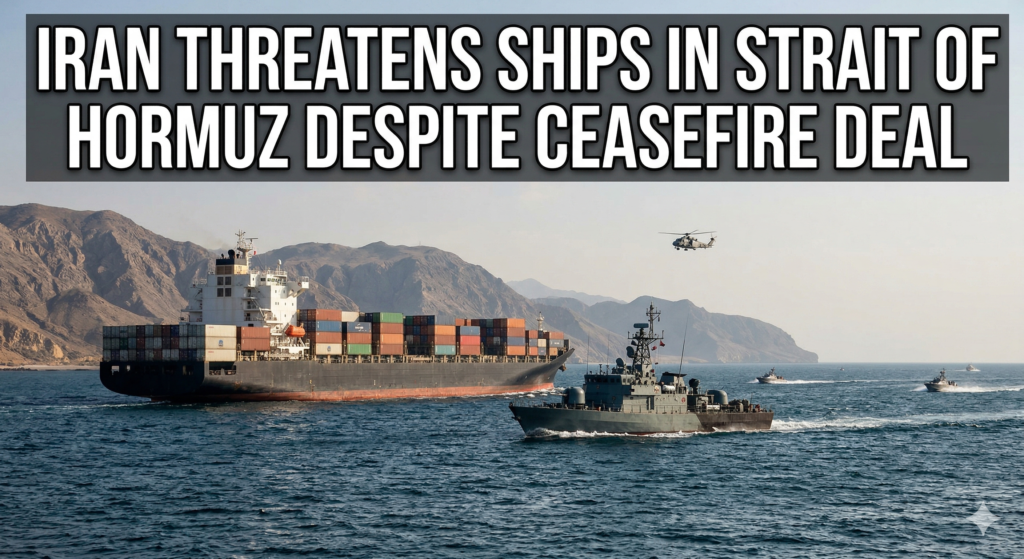
On April 7, 2026, President Donald Trump announced a two-week ceasefire with Iran, brokered with the help of Pakistani Prime Minister Shehbaz Sharif. The core condition was explicit: Iran had to agree to the complete, immediate, and safe opening of the Strait of Hormuz. In exchange, the U.S. would suspend its military strikes.
Trump framed it as a military success, writing on Truth Social: “We have already met and exceeded all Military objectives” and that a 10-point proposal from Iran provided a “workable basis” for long-term peace negotiations.
Iran’s Supreme National Security Council Accepts — With a Warning
Iran’s Supreme National Security Council confirmed acceptance of the ceasefire, but their statement left no room for optimism. In a message obtained by the Associated Press, they wrote that the agreement does not signify the termination of the war and that their hands remain upon the trigger.
That wasn’t just political posturing. Within hours of the ceasefire announcement, an IRGC (Islamic Revolutionary Guard Corps) naval official warned ships attempting to transit the Strait of Hormuz without Iranian permission that they would be destroyed. No ambiguity, no diplomatic softening — a direct military threat on an international waterway.
Why the Strait of Hormuz Matters to Every American
You might be wondering why a narrow strip of water between Iran and Oman — about 21 miles wide at its tightest point — should matter to someone in Ohio or Texas or California. The answer is simple: energy and money.
- Roughly 20% of the world’s daily oil supply flows through the Strait of Hormuz.
- Significant volumes of liquefied natural gas (LNG), used in home heating and manufacturing, also pass through here.
- Brent crude oil surpassed $100 per barrel on March 8, 2026, for the first time in four years — and peaked at $126 per barrel at the height of the crisis.
- Global commodity experts have called this the largest disruption to the energy supply since the 1970s oil embargo.
- Fertilizer, aluminum, and even helium markets have been rattled by the Strait of Hormuz crisis.
In short, if the Iran Strait of Hormuz ship threat ceasefire situation deteriorates further, American families could see higher gas prices, more expensive grocery bills, and tighter supplies of manufactured goods — all ripple effects from a strait thousands of miles away.
The Strait of Hormuz Crisis: How We Got Here in 2026
The road to the 2026 Strait of Hormuz crisis was years in the making. Tensions between the U.S., Israel, and Iran had been simmering since failed nuclear negotiations in Geneva and a prior 12-day air conflict in 2025. Here’s the fast version of what happened:
- February 28, 2026: The U.S. and Israel launched coordinated airstrikes on Iran under Operation Epic Fury, targeting military infrastructure, nuclear sites, and — fatally — Supreme Leader Ali Khamenei.
- March 4, 2026: Iran officially declared the Strait of Hormuz closed. IRGC officials warned that anyone attempting to pass would face the Revolutionary Guards.
- March 8, 2026: Oil crossed $100 per barrel. The U.K. Maritime Trade Operations Centre confirmed 10 attacks on ships. Five crew members had already been killed.
- March 19, 2026: U.S. Armed Forces began a military campaign to force the strait open.
- March 27, 2026: The IRGC announced the strait was closed to any vessel traveling to and from the ports of the U.S., Israel, and their allies.
- April 6–7, 2026: Trump set a deadline for Iran to reopen the strait or face new strikes. Iran rejected a 45-day ceasefire proposal but countered with its own conditions.
- April 7, 2026: A two-week ceasefire was announced. Iran accepted but maintained the war was not over.
- April 8, 2026: An IRGC official warned ships they would be destroyed without permission to transit.
Iran Warns Ships Will Be ‘Destroyed’ — Even During the Ceasefire
This is the detail that should grab every shipping executive’s, energy analyst’s, and policymaker’s attention: Iran is still threatening ships even after agreeing to a ceasefire.
The IRGC’s demand is clear — any vessel attempting to pass through the Strait of Hormuz must first obtain permission from the Iranian Sepah (IRGC) navy. No permission, no passage. Violations will result in the ship being destroyed.
This effectively means Iran is attempting to establish permanent control over an international waterway — something U.S. Secretary of State Marco Rubio explicitly said will never be allowed to happen. Rubio stated that Iran was trying to set up a system in the strait where they decide who goes through, adding this would never be permitted.
What the Trump Administration Is Doing — and What It’s Threatening
President Trump has been anything but subtle in his approach to this crisis. Here’s a summary of where U.S. policy currently stands:
Military Pressure
The U.S. launched Operation Epic Fury in February 2026 alongside Israel, targeting Iran’s military capacity, nuclear program, and leadership. On March 19, a follow-up military campaign was initiated specifically to force the Strait of Hormuz open. As of the ceasefire, Trump has declared those military objectives met.
Economic and Infrastructure Threats
Trump warned Iran repeatedly that Tuesday, April 8 would be ‘Power Plant Day and Bridge Day’ if Iran didn’t reopen the strait. He also threatened to destroy Iran’s desalination plants, oil wells, and Kharg Island. Legal experts noted these threats potentially crossed into war crimes territory under international law. Trump dismissed those concerns directly when asked by reporters.
The Ceasefire Terms
Trump’s ceasefire is contingent on Iran’s complete, immediate, and safe opening of the Strait of Hormuz. He also floated the idea that the U.S. — not Iran — should impose a toll on ships using the waterway, a suggestion that would represent a dramatic shift in the maritime governance of the region.
Global Fallout: Allies, Oil Markets, and Diplomatic Pressure
The Iran Strait of Hormuz ship threat ceasefire situation isn’t playing out in a vacuum. It’s reshaping global alliances, energy markets, and diplomatic relationships in real time.
Oil and Energy Markets
With 20% of global oil and a significant share of LNG normally transiting the strait, the disruption has been severe. Saudi Arabia cranked up use of its East-West Pipeline to full capacity — 7 million barrels per day — in an effort to reroute supply. Still, Brent crude peaked at $126/barrel, and energy analysts have warned sustained disruption could push prices even higher.
Allied Nations Under Pressure
Countries like the UAE, Qatar, Oman, and Kuwait have all been affected — with Kuwait taking some of the worst physical damage to its power and desalination infrastructure. The UAE has publicly called for an end to the conflict while warning against a ceasefire that creates continuous instability.
Diplomatic Channels Remain Open
Egypt, Oman, and Qatar have all been actively involved in back-channel diplomacy. Egyptian officials told NPR that Iran was open to a 45-day ceasefire guaranteeing a permanent end to hostilities — but only if the war would truly be over, not just paused. Iran wants guarantees, not a two-week window it views as a trap.
European Council President António Costa also made direct contact with Iranian President Masoud Pezeshkian to urge restraint and protect global energy security. India, Spain, and Norway are among the nations calling for negotiations through Qatar’s mediation efforts.
FAQ:
Q1: Is the Strait of Hormuz open right now?
As of April 8, 2026, the strait is partially functional but highly dangerous. Iran has accepted a two-week ceasefire but continues to demand that ships obtain permission from the IRGC navy before transiting. Major shipping firms have largely suspended operations. Iran says it is open to vessels from countries that negotiate safe passage — except those allied with the U.S. or Israel.
Q2: How does the Hormuz crisis affect gas prices in the U.S.?
Directly. The Strait of Hormuz carries roughly 20% of the world’s daily oil supply. When shipping traffic halts or becomes unpredictable, global oil prices rise sharply — and American consumers feel that at the pump within days. Oil prices have already spiked from under $80/barrel to over $126/barrel since the conflict began in late February 2026.
Q3: Does Iran have the legal right to close the Strait of Hormuz?
No. Under international maritime law, the Strait of Hormuz is an international waterway subject to transit passage rights. All vessels — civilian and military — have the right to pass through without seeking permission. Iran’s actions have been widely condemned as a violation of the UN Convention on the Law of the Sea.
Q4: What does the ceasefire actually mean for ships?
Very little in practice. While the ceasefire pauses U.S. and Israeli airstrikes on Iranian territory, Iran has explicitly stated that it does not consider the war over. The IRGC still controls the strait militarily and is actively requiring ships to seek permission before passing — threatening to destroy any vessel that doesn’t comply.
Q5: Could this escalate further despite the ceasefire?
Yes — and significantly so. Iran has threatened to close the Bab al-Mandeb strait (connecting the Red Sea to the Gulf of Aden) in addition to Hormuz. If both chokepoints are blocked simultaneously, a quarter of the world’s energy supply would be cut off. The two-week ceasefire window is being used to negotiate a permanent settlement, but both sides remain deeply distrustful of the other.
A Ceasefire Under Pressure — What Happens Next
The Iran Strait of Hormuz ship threat ceasefire dynamic is one of the most consequential foreign policy situations the United States has faced in a generation. Yes, there is a ceasefire on paper. But Iran’s military is still threatening to destroy ships. Oil prices remain dangerously elevated. And the two sides have just two weeks to reach a deal that has eluded diplomats for decades.
For Americans, the stakes couldn’t be more personal: energy costs, inflation, supply chains, and the safety of U.S. military personnel in the region are all directly tied to how this plays out in the coming days. This isn’t a distant conflict — it’s one that arrives at the gas station, the grocery store, and the nightly news.
The next two weeks are critical. Watch for whether Iran fully reopens the strait, whether the IRGC backs down on its permission-or-destruction demand, and whether Trump’s team can convert a 10-point Iranian proposal into an actual lasting agreement.
For More Information
Related Article
Strait of Hormuz Ceasefire: Trump’s Iran Deal for 2026 Confirmed
Euphoria Season 3 Premieres April 12, 2026 on HBO — Cast, Plot & What to Expect
Aubrey Plaza Pregnant: Expecting First Baby with Christopher Abbott, Due Fall 2026
Rapper Offset Shot at Florida Casino: Stable Condition, 2 Suspects Detained
3 thoughts on “Iran Threatens Ships in Strait of Hormuz Despite Ceasefire Deal”