
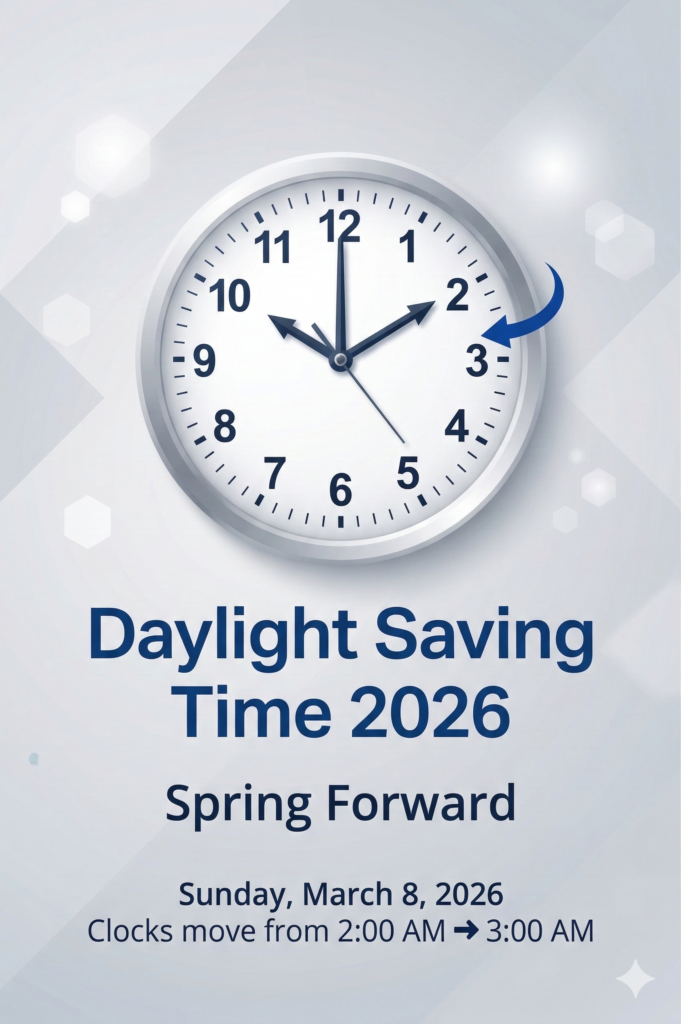
If you woke up on Sunday, March 8, 2026 and felt a little more tired than usual, there is a very specific reason for that. The daylight saving time clocks change arrived right on schedule, and with it came the annual ritual of confused microwave displays, missed alarms, and groggy Monday mornings. You are far from the only one dealing with it — this happens to tens of millions of Americans every single spring.
This guide covers everything worth knowing about the 2026 daylight saving time change: the exact date and time it happened, whether clocks moved forward or backward, how many hours were lost, which states sit the whole thing out, and what you can do to shake off the fatigue faster. Let us get into it.
When Is Daylight Savings Time Spring 2026? The Key Date and Time
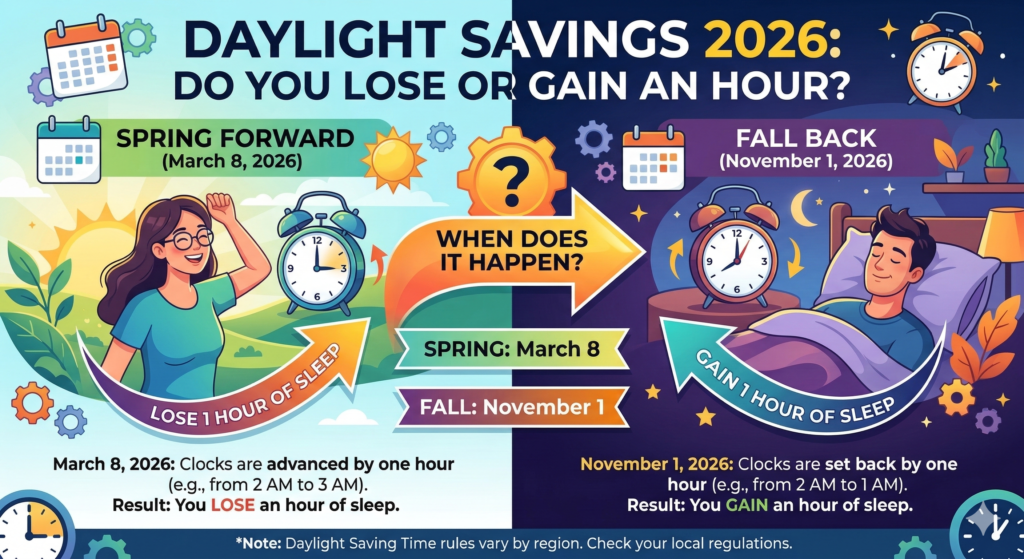
Daylight saving time for spring 2026 started on Sunday, March 8, 2026 at 2:00 a.m. local time. That specific date is not random — U.S. law anchors the spring start to the second Sunday of March every year. Congress locked in that schedule through the Energy Policy Act of 2005, which shifted the start roughly three weeks earlier than it used to be under the old first-Sunday-in-April rule.
As for the mechanics: when the clock struck 2:00 a.m. on March 8, time immediately jumped ahead to 3:00 a.m. Your smartphone and any device connected to the internet almost certainly handled that switch automatically. However, wall clocks, battery-powered alarm clocks, car dashboard displays, and older kitchen appliances still needed a manual nudge.
Daylight Savings 2026 Forward or Back? Here Is the Straight Answer
In spring 2026, clocks moved forward by one hour. That is it. If there is one phrase worth memorizing to keep this straight for life, it is: spring forward, fall back. March means forward. November means back. The confusion usually comes from people mixing up which direction applies to which season, so that four-word phrase is genuinely worth holding onto.
Did We Lose an Hour This Weekend?
Yes, and the math is straightforward. When clocks leaped from 2:00 a.m. to 3:00 a.m. on March 8, that entire 60-minute block ceased to exist for the day. A person who would normally sleep from 10:00 p.m. to 6:00 a.m. effectively got only seven hours, even if they stayed in bed until what the clock called 6:00. The body had only experienced five hours since what it still felt was 5:00 a.m.
The good news: this is temporary. When daylight saving time wraps up on November 1, 2026, clocks roll back one hour and everyone reclaims that lost sleep. Think of it as a loan you take out in March and collect on in November.
Daylight Savings 2026 Lose or Gain — What the Change Means Day to Day
To be direct about it: in spring, you lose an hour. The days surrounding March 8 tend to feel heavier than normal for this reason. Sleep researchers have documented that the spring clock change triggers a measurable drop in sleep quality, focus, and emotional steadiness for anywhere from two to seven days after the switch.
Here is a practical breakdown of what the spring 2026 clocks change actually shifts in your daily routine:
- Sunrise arrives roughly one hour later compared to the day before the change.
- Sunset also lands about one hour later, stretching usable evening daylight significantly.
- Your circadian rhythm — the internal 24-hour clock governing your sleep and wake cycles — may need up to a week to fully realign.
- Young children and household pets follow biological schedules, not calendars, so expect a few days of schedule friction.
- Early morning commuters and school-run parents may temporarily find themselves leaving the house before sunrise again.
Do We Lose an Hour on March 8? What Actually Happens at 2 a.m.
Short answer: yes, one hour was lost on March 8, 2026. The moment clocks hit 2:00 a.m., they were pushed ahead to 3:00 a.m. That 60-minute window simply does not appear anywhere on the calendar for that date. If you scheduled something at 2:30 a.m. on March 8 — unlikely, but theoretically — it would have never occurred.
This means Sunday, March 8, 2026 contained only 23 hours. Come November, the calendar balances out: Sunday, November 1, 2026 will stretch to 25 hours when clocks fall back, and that extra hour typically lands right in the middle of the night where most people can enjoy it as bonus sleep.
Practical Tips for Adjusting After the Time Change
A few straightforward strategies can help your body adapt more quickly:
- Shift your bedtime 15 to 20 minutes earlier for two or three nights leading up to the change — your body will thank you on Monday.
- Cut off caffeine intake by mid-afternoon on Saturday and avoid alcohol in the evening, both of which interfere with sleep quality.
- Step outside for natural light within an hour of waking up on Sunday and Monday — sunlight is the most powerful signal for resetting your body clock.
- Keep the first Monday after the change light on high-stakes meetings or critical decisions if you have the flexibility to do so.
Which States Do Not Observe Daylight Saving Time?
The overwhelming majority of U.S. states participate in the daylight saving time clocks change, but two states have opted out entirely. Arizona — with the notable exception of the Navajo Nation, which does follow DST — keeps its clocks fixed all year. Hawaii also stays on standard time regardless of the season.
Beyond the 50 states, several U.S. territories are also clock-change-free: Puerto Rico, Guam, the U.S. Virgin Islands, and American Samoa all maintain a consistent time throughout the year. If you are traveling to or communicating with people in any of those locations, keep in mind that the time offset between your location and theirs just changed on March 8.
The broader conversation about eliminating the time change altogether is still very much alive at the federal level. A number of states have already voted to make daylight saving time permanent if Congress greenlights a national standard, but as of 2026, no legislation has crossed the finish line to change what most Americans experience twice a year.
When Does Daylight Saving Time End in 2026?
Having moved the clocks ahead in March, the next scheduled change is the fall rollback. Daylight saving time officially ends on Sunday, November 1, 2026. At 2:00 a.m. that morning, clocks will rewind one hour to 1:00 a.m.
For most people, the November change is far more welcome than the March one — it means an extra hour of sleep rather than a shorter night. The trade-off, though, is a swift shift in the evenings: sunsets that had been landing around 7:00 or 8:00 p.m. will push back toward 5:00 p.m. almost overnight, which can make the end of the workday feel oddly dark for the weeks that follow.
2026 Daylight Saving Time: Quick Reference Summary
Spring Forward: Sunday, March 8, 2026 — Clocks advance 1 hour at 2:00 a.m.
Fall Back: Sunday, November 1, 2026 — Clocks rewind 1 hour at 2:00 a.m.
FAQ:
1. When is daylight saving time spring 2026?
Ans. Spring 2026 daylight saving time began Sunday, March 8, 2026 at 2:00 a.m., when clocks jumped forward to 3:00 a.m.
2.Do we lose an hour this weekend — March 7 to 8?
Ans. Yes — clocks moved from 2:00 a.m. to 3:00 a.m. on March 8, shortening Sunday to 23 hours.
3. Is daylight savings 2026 forward or back?
Ans. Spring 2026 was forward. Remember: spring forward, fall back.
4. Do we lose or gain an hour?
Ans. You lost an hour on March 8 (spring) and will gain it back November 1, 2026 (fall).
5.Does every U.S. state observe the time change?
Ans. No — Arizona (outside the Navajo Nation), Hawaii, and U.S. territories including Puerto Rico, Guam, the Virgin Islands, and American Samoa do not observe DST.
Making Sense of the 2026 Daylight Saving Time Clocks Change
Twice a year, the daylight saving time clocks change reshapes daily life in ways that feel both minor and surprisingly significant. For the spring 2026 edition, the essential facts come down to this: clocks moved one hour forward on March 8, Sunday became a 23-hour day, and mornings are temporarily darker in exchange for longer, brighter evenings.
Most people find their rhythm again within a week. Sticking to a consistent sleep schedule, catching morning sunlight, and dialing back screen time in the evenings are the three things that tend to make the biggest difference in how quickly the body adjusts.
If you are already looking ahead, set a reminder now: November 1, 2026 is when clocks fall back and that lost hour from March finally comes home. Until then, enjoy the extra evening light while it lasts.
Found this helpful? Share it with a friend, family member, or coworker who is still trying to figure out why their schedule feels off this week. And bookmark this page for November 1, 2026 — when it will be time to fall back and finally catch up on that sleep.
For More Information
Related Article
Wrexham vs Chelsea Live Stream: How to Watch the FA Cup Free in the USA (2026)
Tornado Union City Michigan: Deaths, Damage & What Really Happened on March 6, 2026
What Happened to Stephanie Buttermore? A Full Tribute to Jeff Nippard’s Beloved Fiancée
UFC 326 Predictions: Holloway vs Oliveira 2 Fight Card, Odds & Best Bets Tonight