


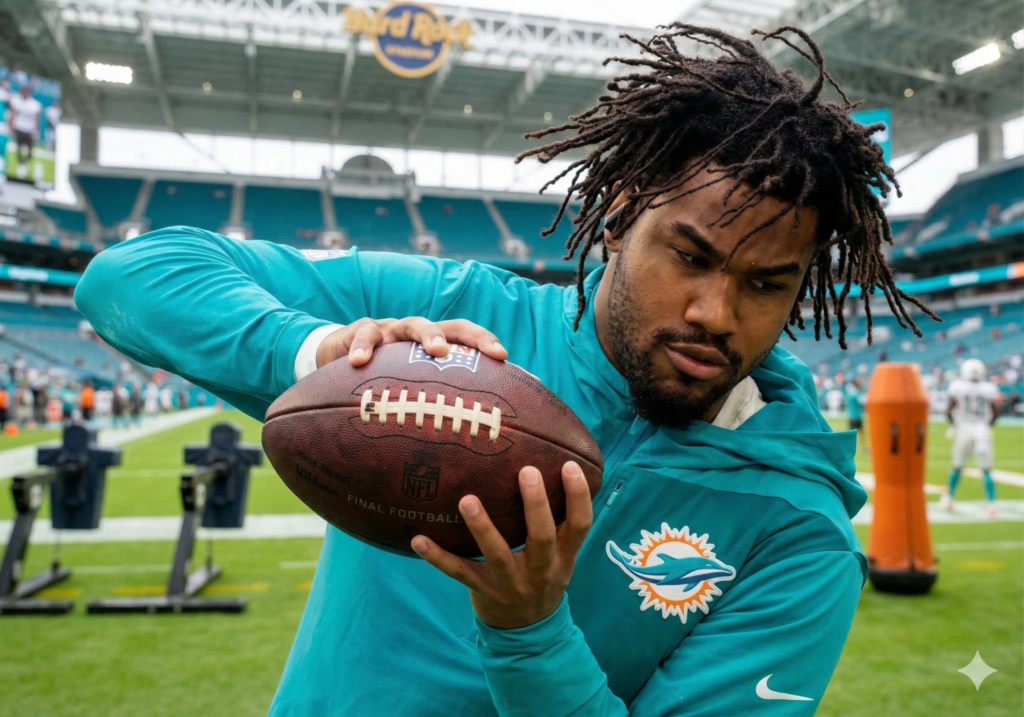
On March 17, 2026, the Denver Broncos announced the most consequential roster move of the entire NFL offseason: a trade bringing wide receiver Jaylen Waddle to Mile High from the Miami Dolphins. The acquisition came after a surprisingly quiet opening stretch of free agency, during which Denver was the only team among the league’s serious contenders to go an entire week without signing a single outside player. That patience turned out to be deliberate.
The price is substantial. Denver is sending a 2026 first-round pick, a third-rounder, and a fourth-rounder to South Florida in return for Waddle and a Miami fourth-round selection. It is the kind of move a team makes when it genuinely believes its championship window is open right now — and given that the Broncos went 14 and 3 during the regular season, secured the top seed in the AFC, and reached the doorstep of the Super Bowl before a quarterback injury ended their run, that confidence is not misplaced.
This article walks through every element of the deal — which picks changed hands, the full breakdown of the Jaylen Waddle contract now on Denver’s books, how Waddle slots into Sean Payton’s offense alongside Courtland Sutton, what the Broncos still hold heading into the draft, and what all of this reveals about the direction this franchise is taking.
Broncos Waddle Trade
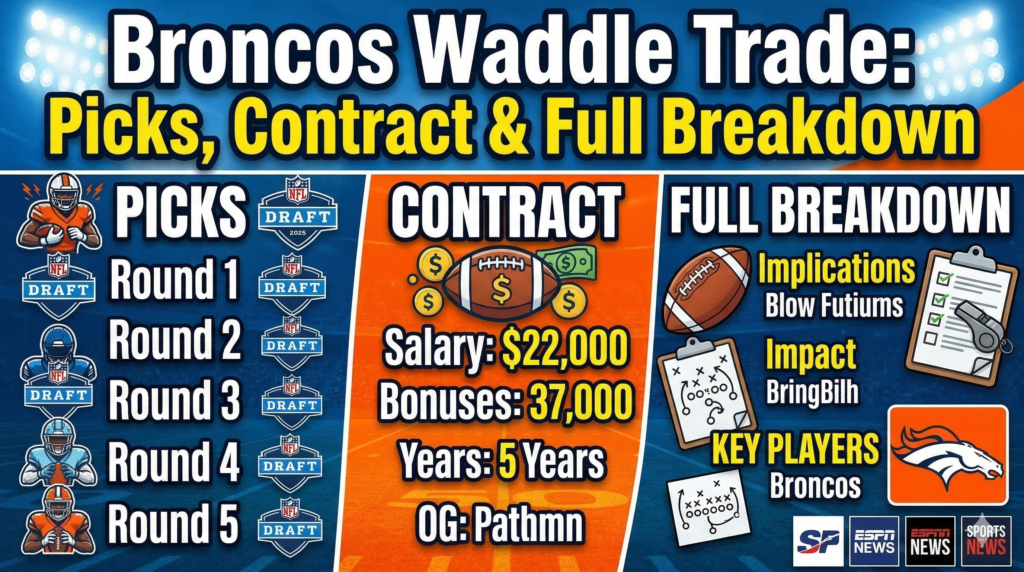
At a Glance: Denver receives WR Jaylen Waddle and Miami’s 2026 fourth-round pick (No. 111 overall). Miami receives Denver’s 2026 first-round pick (No. 30), third-round pick (No. 94), and fourth-round pick (No. 130).
The following details were confirmed by ESPN, NFL Network, CBS Sports, and the Denver Post on March 17, 2026. Here is precisely what each side walked away with:
- Denver RECEIVES: WR Jaylen Waddle plus the Dolphins’ 2026 fourth-round selection (No. 111 overall)
- Miami RECEIVES: Denver’s 2026 first-round pick (No. 30 overall)
- Miami RECEIVES: Denver’s 2026 third-round pick (No. 94 overall)
- Miami RECEIVES: Denver’s 2026 fourth-round pick (No. 130 overall)
Stripping it back to its essence, Denver traded three picks — one in each of the first, third, and fourth rounds — and received one pick in return at pick 111, plus the player. The net cost is three selections for a 27-year-old receiver who has already proven himself at the highest level of the sport. That is an aggressive price, and it is one the Broncos front office clearly felt was justified by the circumstances.
According to multiple reports, conversations about a possible trade actually began several months earlier, around last season’s trade deadline. Talks continued across the offseason even as Miami underwent a front-office transition, with new general manager Jon-Eric Sullivan arriving to oversee a broader rebuild. Denver’s persistence ultimately produced an agreement when the new league year opened in March.
Who Is Jaylen Waddle?
For Broncos supporters who have not tracked the AFC East closely in recent years, here is a thorough introduction to the player Denver just made a significant investment to acquire.
Jaylen Waddle was born on November 25, 1998, and entered the NFL as the sixth overall selection in the 2021 draft after a celebrated college career at Alabama. His time with the Crimson Tide was marked by exceptional playmaking ability until a fractured ankle cut short his junior season. He returned to full health before the draft and was universally regarded as one of the most dynamic receiving prospects in that class, combining elite straight-line speed with sharp route-running instincts.
Waddle’s NFL Numbers: 373 receptions | 5,039 receiving yards | 26 touchdown catches | Five seasons in Miami | 2025 output: 64 catches, 910 yards, 6 touchdowns
His debut season set a tone that few rookies have managed to match. Waddle hauled in 104 passes in 2021, establishing a new benchmark for receptions in a first year. The 2022 campaign, however, was the one that cemented his standing among the league’s top receivers. He finished with 1,356 yards and eight touchdowns, ranking fifth across the entire NFL in yards per route run — ahead of nearly everyone apart from a small group of established stars. A 1,014-yard follow-up in 2023 confirmed that the 2022 performance was not an anomaly.
Production dipped in 2024, a season Waddle himself has acknowledged was not up to his standard. He responded with a solid 2025 — 64 catches, 910 yards, and six scores — which would have placed him second on Denver’s own receiving depth chart behind only Sutton. His yards-per-target figure of 9.2 in 2025, which ranked eighth in the league, is the kind of efficiency number that tells a more complete story than raw yardage totals alone.
Waddle and Tyreek Hill: How the Comparison Holds Up
The Waddle-Hill comparison has been a fixture of NFL discussion since both receivers shared a huddle in Miami, and it is relevant again now that they are on separate paths. Hill departed South Florida earlier this offseason when the Dolphins chose to release him in a salary-cap manoeuvre tied to their rebuild. Waddle, who played alongside Hill for three seasons, now moves to a very different situation in Denver. The central question is whether he can operate as a genuine number one target with a developing signal-caller, rather than benefiting from the defensive attention that Hill consistently drew in Miami.
Jaylen Waddle Contract: Every Dollar Denver Is Now Responsible For
Trading draft capital is one dimension of this deal. Taking on a significant long-term contract is the other, and it carries its own set of implications for how the Broncos will manage their salary cap over the next several years.
Waddle agreed to a three-year extension with Miami in May 2024, a deal worth $84.75 million in total value. It runs through the 2028 season and includes $76 million in injury guarantees, with $36 million of that sum fully guaranteed at the point of signing. Denver inherits the full remaining financial commitment.
Annual Cap Hits Heading Into Denver’s Roster-Building Cycle
- 2026 season: approximately $4.9 million against the cap. Miami absorbed the majority of the 2026 guaranteed money prior to the trade, leaving Denver with a figure that is, by modern wide receiver standards, genuinely affordable.
- 2027 season: approximately $27.1 million. This is where the contract becomes a meaningful line item in Denver’s cap structure and will require careful planning.
- 2028 season: approximately $30.5 million. At this level, Waddle would rank among the highest-paid receivers in the league — a figure that is reasonable if he performs at his ceiling, and a burden if he does not.
The 2026 cap number is a genuine advantage for Denver this offseason. Under $5 million for a receiver of Waddle’s calibre allows the front office to address other positional needs without the constraint that a top-of-market deal would normally impose. The 2027 and 2028 numbers are where the organisation will need to exercise discipline — both in deciding whether to extend Waddle before those seasons arrive and in balancing his contract against the impending extension for Bo Nix, who is approaching the end of his own rookie deal.
Waddle to Broncos: How He Fits Alongside Sutton, Nix and the Denver Offense

Understanding whether this trade makes Denver better requires a clear look at the offensive situation Waddle is walking into and the specific problem he solves.
Through the 2025 season, Courtland Sutton served as Denver’s unambiguous receiving leader — a 6-foot-4 possession receiver with strong hands, reliable route running, and the physicality to win contested catches at the boundary. He was the only pass-catcher on the Broncos’ roster who appeared among the league’s top 48 players in receptions of 20 or more yards last season. Behind him, Denver’s receiver room consisted largely of younger, unproven contributors in Pat Bryant, Troy Franklin, and Marvin Mims. None of them had established themselves as the kind of dependable second option that Super Bowl-calibre passing offences require.
Waddle addresses that gap in a direct and complementary way. His physical profile is essentially the opposite of Sutton’s. At 5 feet 10 inches and built for speed, Waddle thrives in space, separates consistently against press coverage, and is a legitimate threat to score on any target whether he is catching a short crossing route or running a go route down the sideline. The two receivers pose categorically different challenges for opposing cornerbacks and linebackers, which is precisely the kind of pairing offensive coordinators design schemes around.
The Effect on Bo Nix’s Growth as a Quarterback
Bo Nix led the entire NFL in pass attempts during the 2025 season. He was an effective and improving quarterback, but the foundation of Denver’s passing game relied heavily on short and intermediate throws rather than the sort of explosive downfield plays that separate good offences from genuinely dangerous ones. Outside of Sutton, the Broncos lacked a receiver who could credibly threaten defences vertically. Waddle changes that calculus. His presence forces opposing safeties to respect the deep ball, which in turn opens up the short and intermediate areas where Nix has already shown comfort and competence. The cumulative effect should make Denver’s entire passing attack harder to defend.
Broncos Draft Picks 2026: What Denver Still Holds After the Trade
Any trade involving a first-round pick and additional selections naturally raises questions about a team’s ability to replenish its roster through the draft. Here is an honest assessment of where Denver’s pick inventory stands following the Waddle deal.
Denver no longer holds a first-round selection in the April 2026 NFL Draft. Picks 94 and 130 have also departed. The fourth-round pick received from Miami at No. 111 partially compensates for one of those losses, but on net, Denver has shed two meaningful picks from its draft board. The Broncos retain their second-round pick and whatever day-three selections remain in their possession beyond what was traded to Miami.
General manager George Paton has been transparent about the philosophy driving these decisions. The team’s defensive roster is already built to championship standard. Bo Nix remains on an affordable rookie contract for at least one more season. The combination of those two factors creates a window that is genuinely open right now, and Paton has made clear that he intends to maximise it rather than accumulate draft capital for a future that may or may not be as promising. Trading a late first-round pick and two mid-round selections to add a proven playmaker is a logical application of that thinking.
Miami Dolphins Perspective
No trade analysis is complete without considering the motivations and outcomes for both parties. Miami’s decision to move Waddle is not driven by dissatisfaction with the player — it is the product of a calculated, organisation-wide commitment to starting over.
The Dolphins released Tyreek Hill earlier this offseason as part of a cap restructuring tied to their rebuilding strategy. Trading Waddle now completes the dismantling of a receiving corps that was once among the most exciting in the conference. What Miami gains in return is substantial draft firepower. The organisation now controls two first-round picks in the upcoming draft — its own selection at No. 11 and Denver’s at No. 30 — along with a total of seven picks within the first three rounds. That collection gives the Dolphins one of the most formidable draft arsenals in the entire league heading into April.
- Miami’s confirmed 2026 draft picks following the trade: 11 total selections, anchored by first-rounders at No. 11 and No. 30.
- Starting quarterback for 2026: Malik Willis, operating on a short-term contract as a bridge option during the transition period.
- Remaining skill-position talent: running back De’Von Achane, whose own status in Miami remains uncertain, and receiver Tutu Atwell.
The new leadership group in Miami — general manager Jon-Eric Sullivan and head coach Jeff Hafley — appears committed to a multi-year project rather than a quick turnaround. Several analysts have noted that the Dolphins may be positioning themselves to target a high-value quarterback prospect in the 2027 draft class, using the accumulated picks from trades like this one as the foundation for that effort.
FAQ:
Q: What did the Denver Broncos give up in the Waddle trade?
Denver surrendered three draft picks: a 2026 first-round pick at No. 30 overall, a 2026 third-round pick at No. 94, and a 2026 fourth-round pick at No. 130. In return, the Broncos received Jaylen Waddle and Miami’s 2026 fourth-round pick at No. 111.
Q: What does Jaylen Waddle’s contract look like in Denver?
Waddle is under contract through the 2028 season on an extension originally signed with Miami valued at $84.75 million over three years. Denver has assumed the full remaining obligation. The 2026 cap charge is approximately $4.9 million — a bargain by current wide receiver market standards — rising to around $27.1 million in 2027 and $30.5 million in 2028.
Q: Will the Broncos have a first-round pick in the 2026 NFL Draft?
No. Denver’s first-round selection at No. 30 overall was included in the trade package sent to Miami. The Broncos will not hold a first-round pick in April 2026. Their earliest selection in the upcoming draft is their second-round pick.
Q: How does Jaylen Waddle measure up against Tyreek Hill?
The comparison is a natural one given that both players spent time together in Miami and share a similar style of play — explosive speed, crisp route running, and the ability to create separation at multiple levels of the field. In 2022, Waddle ranked fifth in the NFL in yards per route run, directly behind Hill. Hill carries the stronger reputation as a number one receiver based on his longer track record, but Waddle at 27 is firmly in the prime of his career, and his efficiency metrics from 2025 indicate that he has returned to the level of play he demonstrated in his best Miami seasons.
Q: Does this trade make Denver a Super Bowl favourite for 2026?
It unquestionably makes Denver a more complete team on both sides of the ball. The Broncos already possessed a defence regarded as one of the two or three best in the AFC, and a quarterback in Bo Nix who demonstrated meaningful progress throughout 2025. What they lacked was a second receiving threat capable of punishing defences that chose to focus their attention on Sutton. Waddle fills that role directly. Whether the Broncos ultimately win a championship will depend on health, execution, and playoff performance, but the roster as currently constructed is among the most well-rounded in the conference.
Denver Has Made Its Position Clear
The Broncos Waddle trade removes any remaining uncertainty about what this organisation intends to do with its current window of opportunity. This is not a team managing toward a future rebuild or hedging its bets by preserving draft capital. Denver has looked at its roster, assessed where it stands in the conference, and decided that the time to act boldly is right now.
Jaylen Waddle is not a depth piece or a developmental gamble. He is a 27-year-old receiver who has already produced at the elite level, who carries one of the most favourable short-term cap numbers available for a player of his standing, and whose skill set fills the precise gap in Denver’s offensive construction that held the team back from a Super Bowl appearance last January. Alongside Courtland Sutton, he gives Bo Nix a pair of legitimate threats that opposing defensive coordinators will need to account for every single snap.
The financial and draft commitments involved are real, and they will require smart management from the front office in the years ahead. However, championship teams are built through calculated risks taken at the right moment — and by every available measure, this is that moment for the Denver Broncos. Watch for Waddle’s introductory press conference, his first practice sessions with Nix, and the downstream moves Denver makes with what remains of its offseason budget.
For More Information

Related Article
Breaking: Joe Kent Resigns — The Letter, the Reason, and What Happens Next
Kiki Shepard Death: Is She Really Dead? Truth Behind the Viral Rumors
Cuba’s National Electric Grid Collapses, Leaving Millions Without Power