


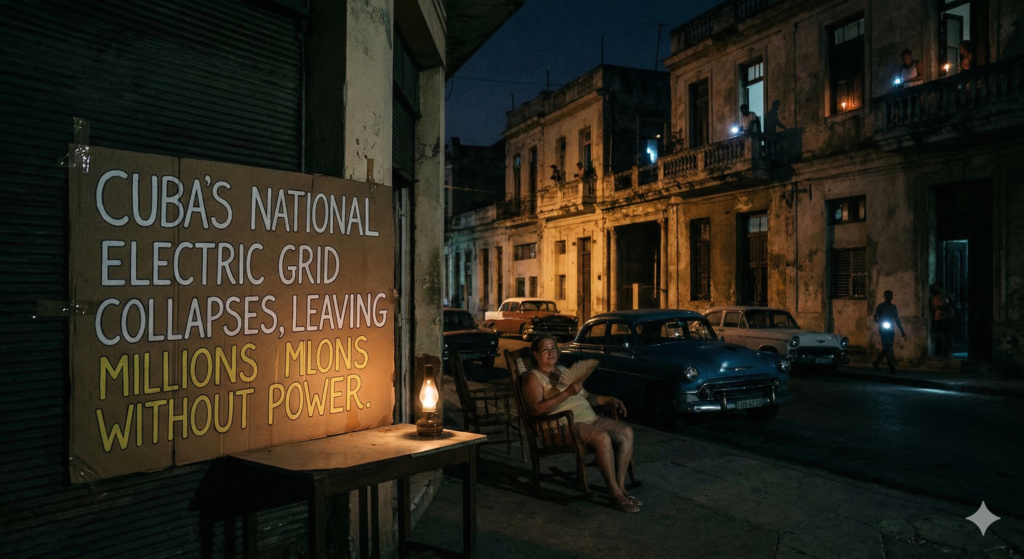
On March 16, 2026, the lights went out across Cuba. The island’s national electric grid suffered a total collapse, stripping roughly 10 million people of electricity in what has become one of the most severe energy crises in the Caribbean nation’s modern history. This was no ordinary power cut. It marked the third nationwide blackout in just four months — and it came directly on the heels of a U.S.-led campaign that has effectively shut off Cuba’s fuel supply.
If you’ve been scanning the headlines and trying to make sense of what’s happening — why the grid failed, how American policy fits into the picture, and what President Trump actually means when he talks about ‘taking Cuba’ — this article lays it all out in straightforward terms.
What Exactly Happened to Cuba’s Electric Grid?
Cuba’s state-run grid operator, Unión Nacional Eléctrica de Cuba (UNE), declared a full national shutdown on the morning of March 16, 2026. In an official social media post, UNE said it was looking into the causes behind the cuba grid collapse and — notably — stated that none of the electrical generating units in active operation had shown any faults at the moment the system went down.
That distinction is important. When operating generators show no signs of failure immediately before a blackout, it typically points to a problem in the transmission network rather than in generation itself. In plain terms, it was not a single power plant tripping offline that brought the country to a halt — it was a failure somewhere in the web of cables, transformers, and substations that distributes power across the island.
By late Monday evening, repair crews had managed to restore electricity to approximately five percent of Havana — around 42,000 households — along with a handful of hospitals. Even so, officials cautioned that these small, isolated circuits could break down again without warning.
How Bad Is Cuba’s Electrical Infrastructure?
The honest answer is: very bad, and the situation has been getting worse for years. William LeoGrande, a Cuba specialist and professor at American University, has described the country’s energy infrastructure as having long exceeded its useful operational life. The thermoelectric plants that power much of the island have been burning heavy, high-sulfur crude oil — a fuel that gradually corrodes equipment from the inside out. Compounding this is a persistent shortage of foreign currency, which has left authorities unable to purchase the replacement parts or carry out the upgrades that the aging system desperately needs.
The March 2026 collapse was not Cuba’s first major power failure, nor even its first in recent weeks. At least six nationwide outages were recorded in the previous twelve months alone. Earlier in March 2026, approximately two-thirds of the island lost power for more than a day following a breakdown at the Antonio Guiteras thermoelectric plant, Cuba’s largest generating facility.
The Cuba Blockade 2026: How U.S. Policy Is Making Things Worse
The Cuba blackout of March 2026 did not emerge in isolation. It unfolded against the backdrop of the most aggressive U.S. pressure campaign targeting Cuba in recent decades — a coordinated economic squeeze that analysts have begun referring to as the Cuba blockade 2026.
The sequence of events began in early January 2026, when the United States detained Venezuelan President Nicolás Maduro. Venezuela had long served as Cuba’s most vital foreign energy partner, delivering the oil shipments the island depends on to keep its power plants operating. With Maduro out of the picture, those deliveries came to an abrupt halt.
The Trump administration then went a step further. President Trump threatened to impose tariffs on any nation that continued supplying oil to Cuba, citing the island’s alignment with what the White House described as ‘hostile countries and malign actors.’ The move effectively placed Mexico and Russia — two of Cuba’s remaining fuel suppliers — in a difficult position, forcing them to weigh their trade relationships with Washington against their ties to Havana.
How Severe Is Cuba’s Oil Shortage?
The fuel shortage is, by any measure, extreme. Cuban President Miguel Díaz-Canel publicly confirmed on Friday, March 14, that the island had not received a single oil shipment in the three months prior to his statement. Ship-tracking records from LSEG support this: across all of 2026, only two fuel-carrying vessels entered Cuban waters — a small tanker from Mexico in January and a liquefied petroleum gas carrier from Jamaica in February.
Satellite imagery reviewed by TankerTrackers.com showed no import activity whatsoever at Cuba’s major fuel reception hubs — the ports of Matanzas, Moa, Havana, and Cienfuegos — for well over a month. On the black market, petrol prices have surged to the equivalent of roughly nine U.S. dollars per litre. At that rate, filling an ordinary car’s fuel tank would cost more than $300 — a sum that exceeds the monthly earnings of the average Cuban worker.
Why Trump Wants Cuba ?
The energy crisis deepened at the same time that U.S. rhetoric toward Cuba was reaching an unusual pitch. On March 16 — the very day the grid failed — President Trump told White House reporters that he believed he would have the honour of ‘taking Cuba.’ He went on to suggest that he could do as he pleased with the island, which he characterised as a deeply weakened nation.
So why has Trump’s focus on Cuba become such a prominent topic, and what does he actually mean by ‘taking’ it?
Trump had previously floated the idea of a so-called ‘friendly takeover’ of Cuba. When read alongside the broader policy picture, these statements appear to form part of a deliberate pressure strategy: squeeze Cuba economically through the oil blockade, stoke conditions for domestic unrest, and then push for a negotiated political transition away from the current communist-led government. The Trump administration has publicly said it wants President Díaz-Canel removed from power, while U.S. officials have simultaneously clarified that the goal is not to bring the Cuban government to a complete collapse, but rather to engineer a managed transition toward political openness and free-market reform.
There are signs that Havana is at least listening. Díaz-Canel confirmed that Cuba and the United States had begun talks. Cuba’s Deputy Prime Minister for Foreign Trade also stated publicly that the island is willing to engage in trade with the U.S. A fragile diplomatic process appears to be taking shape, even as the country’s electricity supply continues to crumble.
Life on the Ground: How Cubans Are Coping
Strip away the politics and the policy debates, and what remains is a story about millions of ordinary people navigating a daily hardship. Dayana Machin, a 26-year-old Havana resident, told Reuters that the most recent blackout came as no surprise to her. Her practical advice to neighbours and fellow Cubans: stock up on wood-burning stoves, invest in solar panels where possible, store water, and put aside whatever fuel they could find.
Mercedes Velazquez, 71, described the quiet indignity of watching a fresh pot of soup spoil because she had no way to refrigerate it. Tomás David Velázquez Felipe, 61, put it more bluntly, saying that the unrelenting outages made him feel that those who had the means to leave the country would be wise to do so.
The frustration boiled over publicly in the days before the collapse. Residents of Morón, a city in central Cuba, took to the streets to protest both the power cuts and widespread food shortages. In a separate incident, demonstrators set fire to a local Communist Party office. In the days leading up to the collapse, videos spread across social media showing residents of Havana banging pots and pans in what is known as a ‘cacerolazo’ — a form of public protest with deep roots in Latin American political culture. In Cuba, where open dissent carries significant personal risk, these demonstrations signal a population that has been pushed to its limit.
President Díaz-Canel also disclosed that the energy crisis has had a direct and severe impact on the healthcare sector: tens of thousands of surgical procedures have been deferred because hospitals cannot reliably maintain power.
Can Cuba Recover ?
Whether Cuba can recover — and how quickly — hinges almost entirely on what unfolds diplomatically and economically in the weeks ahead.
The island does have some domestic energy resources. Cuba produces roughly 40 percent of its own petroleum and has been drawing on solar panels, natural gas, and thermoelectric generation to partially compensate for the loss of Venezuelan oil. That domestic capacity, however, falls well short of meeting national demand. LeoGrande has suggested that if Cuba aggressively curtails consumption and accelerates a pivot toward renewable energy — potentially with financial and technical assistance from China — it could sustain itself without fuel imports. But, as he has cautioned, such a scenario would entail prolonged suffering for ordinary Cubans and would risk eventually triggering full economic collapse and mass migration.
Some progress on power restoration was reported by Monday evening, with state-run media confirming that engineers had brought several small local circuits back online across the country. Yet given the underlying condition of the infrastructure, a full and stable restoration of the national grid remains a formidable challenge.
Perhaps the most cautiously optimistic development is the diplomatic one: the fact that both governments have openly acknowledged that talks are underway suggests that a negotiated path out of the crisis — however narrow — has not yet closed.
FAQ:
What caused Cuba’s national electric grid to collapse in March 2026?
Cuba’s grid operator UNE announced a complete national shutdown on March 16, 2026. Officials noted that none of the generating units running at the time had registered any faults prior to the failure, which points to a problem in the transmission network rather than in the power plants themselves. The collapse reflects years of deferred maintenance and outdated infrastructure, now severely compounded by an acute shortage of fuel resulting from U.S.-led restrictions on oil shipments to the island.
How is the U.S. oil blockade connected to the Cuba blackout?
Following the U.S. detention of Venezuelan President Maduro in January 2026, the oil shipments that Venezuela had been sending to Cuba were immediately halted. President Trump subsequently threatened economic penalties against any country continuing to supply Cuba with fuel, which effectively deterred Mexico and Russia from doing so. Because Cuba’s power stations are predominantly oil-fired, three consecutive months without a meaningful fuel delivery left the grid with almost no margin before total failure.
What did Trump mean when he said he would ‘take’ Cuba?
Trump’s remarks are widely interpreted as part of a broader strategy of economic and political pressure. The Trump administration’s stated objective is for President Díaz-Canel to relinquish power and for Cuba to embrace democratic and market reforms. References to ‘taking Cuba’ most likely describe a managed political transition rather than any form of military action, though the President’s language was intentionally ambiguous. Despite the combative rhetoric, both sides have now confirmed that diplomatic dialogue is under way.
Is there a risk of a Cuba earthquake or other natural disaster worsening the crisis?
Cuba is situated within a seismically active zone of the Caribbean, and a significant earthquake occurring amid the current infrastructure crisis would compound the damage considerably. That said, the 2026 emergency is overwhelmingly the product of human and political factors — decades of underinvestment, fuel scarcity, and geopolitical pressure — rather than any natural disaster. What the Cuba earthquake risk does underscore, however, is how little resilience the grid currently has: virtually any additional stress on the system, whether from extreme weather or equipment failure, could trigger yet another collapse.
Who is Cuba’s president and what is he doing about the crisis?
Miguel Díaz-Canel has served as Cuba’s president since 2018. He has been candid about the severity of the energy emergency, publicly confirming both the three-month absence of oil deliveries and the opening of diplomatic talks with Washington. His government has also signalled a readiness to pursue trade with the United States, suggesting a pragmatic shift in Havana’s posture. Human rights organisations, meanwhile, have called on external parties not to deliberately deepen Cuba’s hardship as a means of engineering political change.
A Crisis With No Easy Exit
Cuba’s national electric grid collapse on March 16, 2026, is far more than an infrastructure failure — it is a humanitarian emergency and a geopolitical flashpoint rolled into one. The Cuba blackout has left between 10 and 11 million people scrambling to preserve food, access medical care, and manage daily life in a country where electricity has become an unreliable luxury.
The Cuba electric grid’s deterioration is the physical consequence of decades of chronic underinvestment, now accelerated by the most severe external pressure campaign Cuba has faced in a generation. Two questions will shape the island’s near-term future: can the diplomatic back-channel between Havana and Washington produce a deal that relaxes the fuel embargo, and will the crumbling grid hold together long enough for any such deal to take effect?
In the meantime, Cubans are doing what they have always done — finding ways to adapt, voicing their frustration in the streets, and waiting to see which way the political winds turn next.
Stay up to date with our ongoing coverage of Latin America and global energy politics for the latest developments on this evolving story.
For More Information

Related Article
SpaceX Launching Today? Exact Times, Sites & How to Watch
Thunderstorm American Idol: Real Name, Story & 2026 Update
Aden Holloway Stats: Complete 2025-26 Season Breakdown, Career Numbers & More