


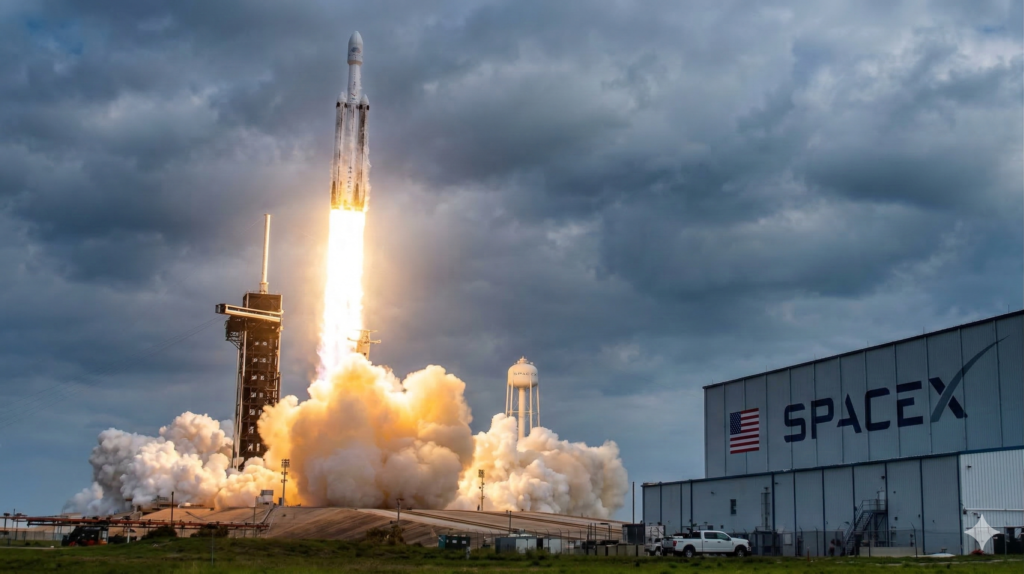
Looking up the SpaceX launch time today puts you in good company. Tens of thousands of people check the schedule every single day, and in 2026 there is almost always something happening within the next 48 hours. SpaceX had already completed its 32nd orbital mission of the year by mid-March — a pace that works out to roughly one rocket leaving the ground every five days. Whether your goal is to watch a night launch glow over California, stay informed about the growing Starlink network, or keep tabs on the company’s highly anticipated stock market debut, this guide gives you everything you need in one place.
What follows covers the confirmed launch times for March 17, 2026, a forward-looking schedule for the rest of the month, practical advice on how to watch from home or in person, a plain-language explanation of what SpaceX is actually putting into orbit, and a clear summary of where things stand with the SpaceX IPO.
SpaceX Launch Time Today and Tonight: What Is Scheduled for March 17, 2026

Quick Answer: Two SpaceX missions are confirmed for March 17, 2026. The first, an early-morning Falcon 9 departure from Cape Canaveral, Florida, has a window that opens at 6:26 AM EDT. The second, a Vandenberg rocket launch from California, is set for 7:42 PM PDT the same evening.
SpaceX is operating at one of the busiest paces in its history, and today reflects that perfectly. Below are the full details for each confirmed mission.
Tonight’s Vandenberg Rocket Launch in California — Starlink Group 6
Scheduled Liftoff: 7:42:20 PM PDT, which corresponds to 10:42:20 PM EDT and 02:42 UTC on March 18.
Launch Pad: Space Launch Complex 4 East, Vandenberg Space Force Base, California.
Payload: 25 Starlink V2 Mini Optimized broadband satellites destined for low Earth orbit.
Booster: B1088, making its 14th flight. Recovery is planned on the drone ship named Of Course I Still Love You, positioned in the Pacific Ocean west of the California coast.
For anyone living along the Southern California or Central Coast corridor, this is one of the better viewing opportunities of the month. Vandenberg missions that track south or southwest over open water are frequently visible from distances of up to 500 miles on a clear night. The exhaust plume catches residual sunlight for several minutes after liftoff, producing a slow-moving, luminous trail against the darkening sky.
This Morning’s Cape Canaveral Launch in Florida — Starlink Group 10-46
Launch Window Opens: 6:26 AM EDT, or 10:26 UTC.
Launch Pad: Space Launch Complex 40, Cape Canaveral Space Force Station, Florida.
Payload: 29 Starlink V2 Mini Optimized satellites heading to low Earth orbit.
Booster: B1090, flying for the 11th time. The first stage will attempt a landing on the drone ship A Shortfall of Gravitas, waiting in the Atlantic Ocean east of Florida.
Weather is currently rated 75 percent favorable for this launch window. Even so, last-minute technical holds and upper-level wind constraints can push a window by minutes or trigger a full scrub. Checking the live SpaceX feed around 30 minutes before the opening is the most reliable way to get a real-time status update.
Upcoming SpaceX Launch Schedule
Today’s two missions are just the start of a busy week and a half for SpaceX. The following dates and windows are either confirmed or expected, subject to the usual weather and technical caveats:
- March 19, 2026 — Falcon 9 carrying 29 Starlink satellites departs Cape Canaveral, with a window opening at 10:35 AM EDT.
- March 20, 2026 — Falcon 9 Starlink mission lifts off from Vandenberg Space Force Base at 9:48 PM PDT.
- March 22, 2026 — Falcon 9 Starlink Group 10-33 launches from Cape Canaveral, window opening at 2:43 PM EDT.
- March 24, 2026 — Another Vandenberg Falcon 9 Starlink mission, targeting an 11:03 PM PDT liftoff.
- March 29, 2026 (No Earlier Than) — A dedicated rideshare flight targeting a sun-synchronous orbit, departing from Cape Canaveral.
Every one of these missions is connected to the continuing expansion of the Starlink satellite network. As of mid-March 2026, the constellation has grown past 9,985 active satellites in orbit — more than any other operator in the history of spaceflight. SpaceX’s ultimate objective is to provide reliable, high-speed internet access to virtually every corner of the planet, and the current cadence makes clear that this goal is being pursued with genuine urgency.
How to Watch the SpaceX Launch Live Tonight
One of the most accessible things about modern spaceflight is how easy it has become to watch. You do not need a ticket, a telescope, or even a clear sky if you are willing to stream online.
The Official SpaceX Live Stream
SpaceX broadcasts every launch at no cost through its YouTube channel and on X, where the company’s handle is @SpaceX. The coverage window typically opens 15 to 20 minutes before liftoff and runs continuously through first-stage booster landing, satellite deployment confirmation, and fairing recovery status. The onscreen commentary is written with general audiences in mind, so even viewers who are new to rocketry will find it easy to follow.
Third-Party Apps and Tracking Websites
If you want real-time push notifications for launch windows, holds, and scrubs, several free tools are worth bookmarking:
- Space Launch Now — available for iOS and Android, it sends countdown alerts and notifies you immediately when a window shifts or closes.
- RocketLaunch.Live — a browser-based calendar with integrated weather forecasts for active launch sites.
- Spaceflight Now — provides detailed written coverage for every mission, including timeline updates during the countdown.
- Space Coast Launches — a more locally focused app, best suited for viewers based in Florida.
Watching the Vandenberg Launch in Person Across California
If you are in Southern California or anywhere along the Central Coast this evening, consider stepping outside around liftoff. Beaches in Santa Barbara, Malibu, Ventura, and the Pismo Beach area consistently rank among the most popular spots for Vandenberg launch viewing. The visual effect is most striking in the 10 to 15 minutes immediately after sunset, when the plume rises above the horizon and reflects sunlight that surface-level observers can no longer see directly. A cloudless sky is the only real requirement — no special equipment needed.
What Is SpaceX Actually Launching?
If you are newer to following SpaceX and have noticed that nearly every launch seems to involve something called Starlink, here is a straightforward explanation of what that means and why it matters.
Starlink is SpaceX’s satellite-based broadband service. Unlike the large, expensive geostationary satellites that power traditional satellite internet services, Starlink uses hundreds of smaller spacecraft positioned much closer to Earth — typically around 550 kilometres above the surface. That proximity is the key advantage: signals travel a shorter distance, which translates into meaningfully lower latency. The result is an internet connection that is fast enough for video calls, online gaming, and applications that older satellite systems struggled to support.
Each Falcon 9 flight carries between 25 and 29 of the latest Starlink V2 Mini Optimized units. These are a significant step up from earlier satellite generations, offering greater transmission capacity per unit and better efficiency overall. With the active constellation now approaching 10,000 spacecraft, Starlink has established itself as the largest operational satellite network ever put into orbit by a considerable margin.
Notable Engineering Milestone: SpaceX’s Falcon 9 first-stage boosters are now routinely flying more than a dozen times each before retirement. Booster B1067 completed its 34th flight in March 2026 — a reuse record that would have seemed implausible just a few years ago, and one that plays a central role in keeping launch costs manageable.
SpaceX IPO News 2026
Alongside the launch schedule, no SpaceX topic generates more discussion in 2026 than the company’s prospective entry into the public stock market. Here is a clear, up-to-date summary of where things stand.
The IPO: Target Valuation and Timeline
SpaceX is widely understood to be working toward an initial public offering that could take place as early as June 2026. Reporting from Bloomberg and the Financial Times, citing people close to the process, suggests that internal targets place the company’s market valuation somewhere in the range of $1.5 trillion to $1.75 trillion. If those figures hold at listing, the offering would represent the largest IPO ever conducted, overtaking the record set by Saudi Aramco in 2019.
The capital raised — potentially as much as $50 billion — would give SpaceX substantial room to push Starship development forward, build out Starlink’s ground-side infrastructure in underserved regions, and invest in longer-term ambitions including crewed Mars exploration. Citigroup is among the financial institutions reported to be involved in preparation, and legal counsel has reportedly been engaged to manage the preliminary filing process on a confidential basis.
The xAI Merger: What It Adds to the Picture
In February 2026, SpaceX absorbed xAI — the artificial intelligence venture founded by Elon Musk — through an all-stock transaction, bringing it in as a wholly owned subsidiary. The merged organisation now spans Starlink’s broadband operations, the Grok AI platform, SpaceX’s core launch business, and a structural connection to the social platform X. The combined entity carries a private valuation estimated at approximately $1.25 trillion.
Market analysts have generally interpreted the xAI integration as a deliberate step taken with the IPO in mind. Grouping multiple high-profile technology assets under a single corporate entity creates a more diverse and arguably more attractive proposition for investors evaluating the offering.
Can Retail Investors Buy SpaceX Stock Right Now?
No. As of March 2026, SpaceX has not filed for a public listing, and its shares are not traded on any exchange accessible to retail investors. Some exposure to SpaceX equity exists through certain institutional funds and late-stage venture vehicles, but these are generally not available to individual buyers. A formal SEC filing, when it comes, will make the terms, structure, and timeline of the offering public. Until that point, prediction markets are pricing the probability of a formal IPO announcement before August 1, 2026 at roughly 81 percent.
SpaceX Launch Cadence in 2026
It can be easy to become accustomed to frequent SpaceX launches without pausing to consider how historically unusual this pace really is. By March 16, 2026, the company had conducted 32 orbital missions in fewer than 11 weeks of the year. That figure exceeds the total annual output of most national space agencies and rivals what the entire global launch industry produced across full calendar years not long ago.
The technological foundation enabling this output is booster reusability. SpaceX retrieves its Falcon 9 first stages on autonomous drone ships deployed in both the Atlantic and Pacific Oceans, then brings them back to the launch site for inspection, refurbishment, and reuse. Each recovered booster eliminates the need to manufacture a new one, compressing turnaround time and reducing per-mission cost substantially. Both boosters flown during the back-to-back Starlink missions on March 16 touched down safely at sea and are currently being readied for their next assignments.
The schedule does not ease up as spring approaches. A cargo resupply mission to the International Space Station — designated CRS-34 — is targeting an April 8 liftoff from Cape Canaveral, and Starlink deployment flights from both coasts are set to continue at their current frequency through April and May.
FAQ:
Q: What time is the SpaceX launch tonight from Vandenberg, California?
The Vandenberg rocket launch on the evening of March 17, 2026 is scheduled for 7:42 PM PDT. The Falcon 9 will place 25 Starlink V2 Mini Optimized satellites into low Earth orbit. Booster B1088 is expected to execute a controlled landing on a drone ship in the Pacific approximately eight minutes after liftoff.
Q: Where can I watch the SpaceX launch live and free of charge?
SpaceX provides a free webcast for every launch through its YouTube channel and on X at the handle @SpaceX. Broadcast coverage opens roughly 15 to 20 minutes ahead of the launch window. Third-party options such as the Space Launch Now app and the RocketLaunch.Live website offer additional real-time tracking and push alert functionality.
Q: Will the Vandenberg launch be visible from Los Angeles or San Diego tonight?
Yes, provided skies are clear. Vandenberg launches travelling south or southwest are routinely observed from across coastal Southern California, including from Los Angeles, San Diego, Santa Barbara, and Ventura County. Visibility is most impressive in the minutes immediately following sunset, when the ascending plume is illuminated against an already-darkened lower atmosphere. Checking local cloud cover forecasts ahead of the window will help you decide whether it is worth heading outside.
Q: What is the current SpaceX IPO date for 2026?
No official listing date has been publicly announced as of March 2026. Financial news sources including Bloomberg and the Financial Times have reported that SpaceX is internally targeting a June 2026 debut at a valuation of $1.5 trillion to $1.75 trillion. Prediction markets currently estimate an 81 percent probability that a formal announcement will come before August 1, 2026. The clearest signal will come when SpaceX submits a registration statement to the SEC.
Q: How many times has SpaceX launched in 2026 so far?
SpaceX recorded 32 successful orbital launches between January 1 and March 16, 2026. That equates to approximately one mission every four to five days. The overwhelming majority of those flights carried Starlink broadband satellites, departing from either Vandenberg Space Force Base in California or Cape Canaveral Space Force Station in Florida.
How to Stay Informed on Every SpaceX Launch
Whether you are watching for the spectacle of a rocket climbing over the California coastline, tracking the steady growth of a satellite network that now blankets most of the globe, or keeping an eye on what would be one of the most significant financial events in recent market history, SpaceX in 2026 offers something worth following. The launches are frequent, the milestones are real, and the IPO story is approaching a conclusion one way or another.
To avoid missing a launch window, the most practical step is to download a free alert app such as Space Launch Now and enable notifications. For deeper reading, Spaceflight Now and the official SpaceX website maintain reliable, up-to-date mission logs. If a Vandenberg launch is coming up on a clear evening and you are anywhere near the California coast, it is genuinely worth going outside — few things in public life offer a visual experience quite like a Falcon 9 climbing silently through a twilight sky.
The pace of activity at SpaceX shows no sign of slowing. Staying informed is as simple as knowing where to look.
For More Information

Related Article
Thunderstorm American Idol: Real Name, Story & 2026 Update
Aden Holloway Stats: Complete 2025-26 Season Breakdown, Career Numbers & More
One of a Kind NYT Crossword Clue Has Solvers Searching for Answers — Here Are 5 You Need