


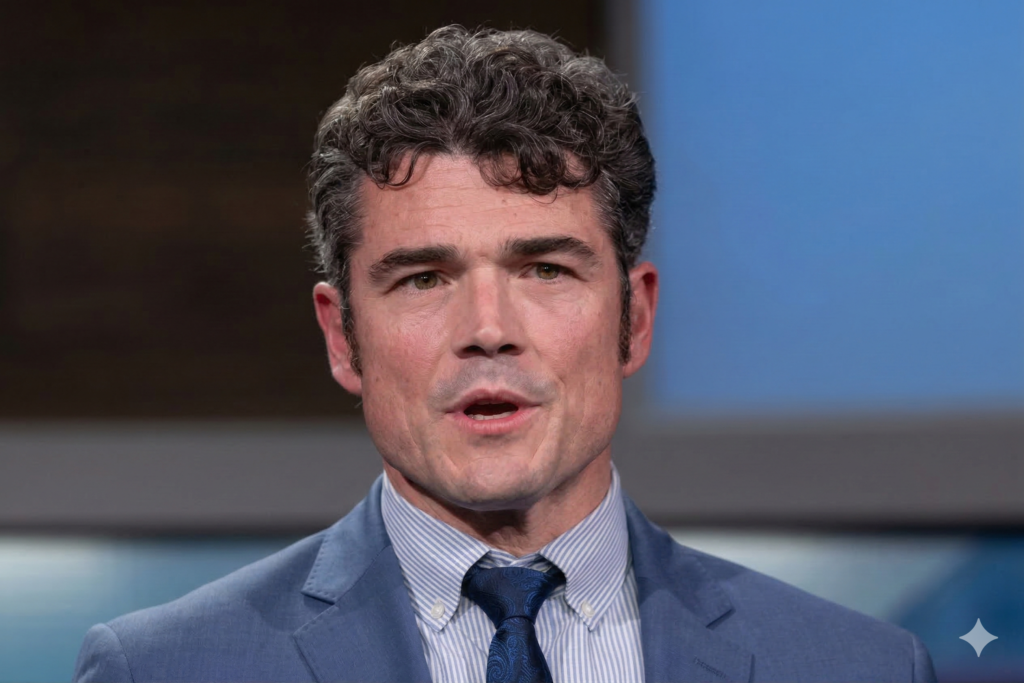
On March 17, 2026, Joe Kent made a decision that few in Washington saw coming. The Director of the National Counterterrorism Center submitted his resignation — not quietly through official channels, but loudly, through a letter shared directly on X. His reason was blunt: he refused to lend his name or his office to a war against Iran that he believed had no legitimate basis in American national security.
The move instantly made Kent the most senior Trump administration figure to publicly break with the president over the Iran conflict. But to understand what this resignation really means, you need to look beyond the politics. This is a story about a combat veteran shaped by personal tragedy, a deep philosophical disagreement over when America should go to war, and a man who ultimately chose his conscience over his career. Here is the full picture.
Who Is Joe Kent?
Joe Kent was born on April 11, 1980, in Sweet Home, Oregon. Over the course of two decades in uniform, he compiled one of the most decorated service records of his generation — 11 combat deployments, most of them in the Middle East, serving first as a Ranger with the 75th Ranger Regiment and later as a Green Beret in Army Special Forces. He earned a reputation among peers as a sharp operator and a deeply committed patriot. After hanging up his uniform in 2018, he transitioned to the CIA’s Special Activities Center, where he worked as a paramilitary officer.
Politics came next. In 2022, Kent launched a Republican bid for Washington’s 3rd Congressional District, campaigning on an America First platform and securing the endorsement of former President Donald Trump. He fell short in a narrow loss to Democrat Marie Gluesenkamp Perez — a result that surprised many — and ran again in 2024, only to fall short once more. Even so, his proximity to Trump and his uncompromising foreign policy stance kept him firmly in the conservative conversation.
When Trump returned to the White House, Kent’s moment arrived. In February 2025, the president nominated him to head the National Counterterrorism Center (NCTC). The Senate voted 52 to 44 to confirm him in July 2025, with not a single Democrat crossing the aisle. Despite a contentious hearing that raised questions about certain past associations, Kent took the helm of one of America’s most sensitive intelligence agencies — a role he held until today.
Why Did Joe Kent Resign?
The answer is both simple and significant. Joe Kent resigned because he could not reconcile the administration’s decision to go to war with Iran with his own assessment of the facts. In his view, Iran was not planning to attack the United States, which meant the foundational justification for the conflict did not hold.
In his resignation letter, published on X, Kent argued that the push toward war was not driven by hard intelligence but by sustained pressure from Israel and its allied voices inside the American media. He accused Israeli officials and select U.S. commentators of running what he called a coordinated misinformation effort — one designed to steer Trump away from the restrained foreign policy posture he had championed throughout his political career.
He also drew a direct line between the Iran conflict and the 2003 invasion of Iraq, suggesting that history was repeating itself: a war manufactured on shaky intelligence, sold to the American public with a sense of inevitability, and likely to result in enormous human and economic costs. Kent urged Trump to step back and reconsider before those costs became irreversible.
Key Points Raised in the Joe Kent Resignation Letter
Kent’s letter, which spread rapidly across X and Reddit within hours of posting, laid out several specific arguments worth examining closely.
On the threat assessment: Kent argued that Iran did not qualify as an imminent threat to the United States under any honest reading of the intelligence. This matters legally, because the term “imminent threat” is the threshold that U.S. law requires before a president can order military action without first seeking authorization from Congress.
On Israeli influence: He alleged that Israeli government officials and their American allies had run a sustained pressure campaign aimed at convincing Trump that a strike on Iran was both necessary and winnable — and that this campaign, not genuine intelligence, drove the final decision.
On Trump’s reversal: Kent noted that, as recently as June 2025 — just before U.S. and Israeli forces struck Iran’s nuclear infrastructure — Trump himself had seemed to understand that military entanglements in the Middle East were historically costly and strategically counterproductive. In Kent’s view, the president had abandoned that instinct under outside pressure.
On personal responsibility: As a Gold Star husband — a man who lost his wife in combat — Kent wrote that he was unwilling to play any role in sending another generation of Americans into a war he believed served no genuine national interest.
Trump and Joe Kent
The administration’s response arrived quickly. During a brief exchange with reporters in the Oval Office, Trump addressed the resignation without much ceremony. He described Kent as a nice enough person but added that he had always considered him weak on national security. He framed the departure as welcome news, suggesting that anyone who doubted the Iranian threat had no business serving in his administration.
White House Press Secretary Karoline Leavitt followed up on social media, directly challenging the substance of Kent’s letter. She called several of his claims false and stated that the president had received strong, compelling intelligence indicating Iran intended to launch a strike against the United States first.
Taylor Budowich, Trump’s former deputy chief of staff, took a sharper tone in his own X post, characterizing Kent as an ego-driven figure who had rarely contributed during his tenure and suggesting the public resignation was a calculated bid for media attention rather than a principled stand.
House Speaker Mike Johnson, a member of the Gang of Eight who receives the most sensitive classified briefings available to Congress, also pushed back. He said Kent was simply wrong about the Iran threat, implying that the full intelligence picture told a very different story than the one Kent had described.
What Happened to Joe Kent’s Wife Shannon — And Why Her Story Still Defines Him
No account of Joe Kent’s worldview is complete without understanding Shannon Kent, and what her death did to the man who loved her.
Shannon Mary Kent, born Shannon Smith, was a U.S. Navy Senior Chief Petty Officer assigned to the Intelligence Support Activity, a secretive JSOC unit. She was fluent in four languages — Arabic, Spanish, French, and Portuguese — and had built a formidable reputation as a skilled analyst and linguist across multiple combat deployments to Iraq and Afghanistan. She married Joe in December 2014, and the couple had two sons, born in 2015 and 2017.
On January 16, 2019, a suicide bomber detonated an explosive device outside a restaurant in Manbij, Syria, while Shannon was deployed on her fifth combat tour. She was 35 years old. Three other Americans were also killed in the attack, which was claimed by ISIS. Shannon became the first female U.S. service member to die in combat in Syria, and the first American woman killed by enemy fire in over three years. She was posthumously promoted and awarded both the Bronze Star and the Purple Heart.
Her death reshaped Joe Kent in ways that have never fully left him. He channeled his grief into politics, emerging as one of the most vocal critics of what he termed endless foreign wars. In his resignation letter, he revisited Shannon’s death directly, describing the Syria conflict that claimed her life as another war manufactured under false pretenses — and drawing an explicit parallel to what he now saw unfolding in Iran.
Joe Kent’s Wife Today: Meet Heather Kaiser
Roughly four years after losing Shannon, Joe Kent found love again. On August 31, 2023, he married Heather Kaiser, a fellow veteran whose background mirrors his own in striking ways. Heather is a graduate of the United States Military Academy at West Point and served as a military intelligence officer, completing deployments to both Iraq and Afghanistan during her time in uniform.
Kent has spoken about her warmly on social media. On Veterans Day 2023, he posted a tribute that described her as genuinely tough and celebrated her service in locations he said he could not publicly name. Heather maintains a private life and keeps no notable public social media presence of her own. She and Joe are raising his two sons from his marriage to Shannon at their home in Yacolt, Washington. Kent has been candid about feeling fortunate to have found a partner who understands his world so deeply, while making clear that Shannon’s memory remains an enduring part of who he is.
Joe Kent’s Net Worth and Career Earnings
No official financial disclosure from Kent has been made publicly available as of his resignation. Based on records from his 2022 and 2024 congressional campaigns, his income has been drawn from a combination of sources: his military retirement pension after 20-plus years of service, earnings from a period working in the private technology sector as a project manager, his salary from the CIA, and most recently his compensation as NCTC Director. Campaign filings from 2021 show he reported roughly $105,000 in private-sector income during that year, alongside his pension.
Academically, Kent holds a Bachelor of Science from Norwich University, where he studied strategic studies and defense analysis. He completed that degree in 2017 while still on active duty — a reflection of the discipline that defined his military career. His combined background in elite special operations, clandestine intelligence work, and national security leadership made him an unusual — and to some, unexpected — choice to run one of the nation’s most critical counterterrorism bodies.
Reactions to the Resignation
Within hours of the letter going live on X, the response was enormous. Political forums on Reddit and X lit up with debate, drawing in voices from across the ideological spectrum. Some readers saw a decorated veteran speaking a difficult truth; others viewed the public nature of the resignation as theater designed to generate attention.
Senator Mark Warner of Virginia, the senior Democrat on the Senate Intelligence Committee, offered a nuanced take. He said he shared Kent’s opposition to the Iran war while being careful to note that he had voted against Kent’s confirmation and still questioned his judgment on other matters. Democratic lawmakers generally took care to distinguish between the anti-war argument — which they largely endorsed — and the messenger, whose past associations remained controversial in their eyes.
Inside the MAGA coalition, the split was notable. Several America First commentators who had been critical of the Iran war, including Tucker Carlson, expressed support for Kent’s stand. At the same time, most rank-and-file Republican voters appear to back Trump’s position, and many elected Republicans were sharply critical. Nebraska Congressman Don Bacon posted a curt “Good riddance” response on social media, while also objecting to what he described as antisemitic undertones in the letter’s framing of Israeli influence.
Pro-Israel advocacy groups and analysts responded with similar concern. Ilan Goldenberg of J Street — himself an opponent of the Iran war — nevertheless argued that Kent’s characterization of Israeli deception leaned on stereotypes he found deeply troubling, even as he agreed with the underlying anti-war message.
FAQ:
Why did Joe Kent resign from his position?
Joe Kent resigned as Director of the National Counterterrorism Center on March 17, 2026, because he opposed the Trump administration’s military campaign against Iran. His resignation letter stated that Iran presented no imminent danger to the United States and that the decision to go to war was shaped by Israeli pressure rather than credible intelligence.
What did Joe Kent’s resignation letter say?
Posted directly to his personal X account, Kent’s resignation letter argued that the Iran war lacked a valid national security justification. He contended that Iranian officials posed no immediate threat, that a coordinated effort by Israeli government figures and their American media allies had pushed the U.S. into conflict, and that the war fundamentally contradicted the America First foreign policy that Trump had promised his supporters. Kent also referenced his personal grief as a Gold Star husband.
What happened to Joe Kent’s wife Shannon?
Shannon Kent was a highly decorated U.S. Navy Senior Chief Petty Officer and intelligence operative. She was killed on January 16, 2019, by an ISIS suicide bomber in Manbij, Syria, during her fifth combat deployment. She was 35 years old and left behind two young sons. Her death became a turning point in Joe Kent’s life and a central driver of his opposition to what he views as unnecessary foreign military engagements.
Who is Joe Kent’s current wife?
Joe Kent married Heather Kaiser on August 31, 2023. She is a West Point graduate, a military veteran, and a former intelligence officer with deployment experience in Iraq and Afghanistan. The couple lives in Yacolt, Washington, and is raising Kent’s two sons from his first marriage to Shannon.
How did Trump respond to Joe Kent resigning?
President Trump told reporters in the Oval Office that Kent’s departure was welcome, saying he had long viewed him as weak on security. The White House rejected the substance of Kent’s letter, with Press Secretary Karoline Leavitt stating that several claims were false and that the administration had solid evidence of an Iranian threat against the United States.
More Than a Resignation — A Statement About the Cost of War
Joe Kent’s resignation will not change the course of the Iran war. It will not reverse a policy decision, alter a military campaign, or shift a majority in Congress. What it does is something quieter but arguably more lasting: it places on record the dissent of a man who has paid more than most for America’s foreign policy choices, and who decided that silence was a price he could no longer afford.
Whether his reading of the intelligence is correct, whether his characterization of Israeli influence is fair, and whether his comparison to Iraq is apt — these are debates that will continue for a long time. But stripped of all the political noise, this is a story about a soldier who watched the woman he loved die in a faraway war, who spent years arguing that such sacrifices deserve the most rigorous scrutiny, and who concluded that he could not be part of yet another conflict that failed that test.
For More Information

Related Article
Kiki Shepard Death: Is She Really Dead? Truth Behind the Viral Rumors
Cuba’s National Electric Grid Collapses, Leaving Millions Without Power