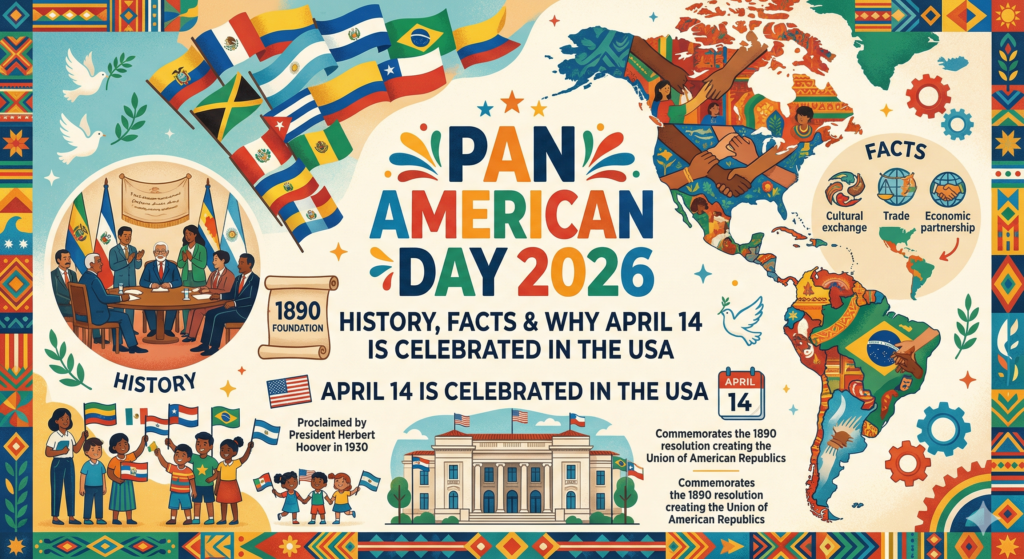
At its core, Pan American Day is an annual observance held on April 14 to mark the founding of the International Union of American Republics — the body that later evolved into the Organization of American States (OAS). Communities across the Western Hemisphere use the occasion to celebrate something that is easy to take for granted: the fact that 35 very different nations have, for well over a century, chosen cooperation over conflict.
Governments, schools, and cultural organizations typically mark the day with ceremonies, exhibitions, and inter-American exchanges. For Americans specifically, it is a reminder that the United States has long been woven into a larger hemispheric story — one that stretches from the Arctic tundra of Canada all the way down to Patagonia.
Pan American Day Facts and History
The First International Conference of American States, 1890
The date April 14, 1890 is not an accident. On that day, delegates from 18 nations convened in Washington, D.C., for the First International Conference of American States. The agenda was practical and forward-looking: build a common framework for peaceful trade, open communication, and diplomatic cooperation across the republics of the Americas.
What came out of that gathering was the International Union of American Republics, along with a permanent secretariat called the Commercial Bureau of the American Republics. It was modest by modern standards, but groundbreaking for its time. No regional body quite like it had existed before. That single conference planted the seed for what would grow into one of the world’s most enduring intergovernmental organizations.
From the Pan American Union to the OAS
Decades later, in 1948, the organization was formally reconstituted as the Organization of American States (OAS). Today it counts 35 member states among its ranks, making it the oldest regional intergovernmental body in the world. Every April 14, Pan American Day honors that founding moment in 1890 and reaffirms the guiding principle that has held the hemisphere together: that dialogue and collaboration will always serve nations better than isolation or rivalry.
Why Is Pan American Day Celebrated?
Pan American Day is not just a historical footnote on the calendar. It serves real, ongoing purposes for the nations and people who observe it. Here are five reasons the celebration still matters:
- To keep the founding spirit alive. April 14, 1890 was the moment 18 republics decided to work together rather than apart. Marking that date each year keeps that spirit visible and relevant for new generations.
- To reinforce democracy and human rights. The OAS Charter formally commits every member state to representative democracy, the protection of human rights, and respect for the rule of law. Pan American Day serves as a public reaffirmation of those commitments.
- To celebrate cultural diversity. The Western Hemisphere is home to hundreds of languages, dozens of Indigenous traditions, and countless cultural expressions. This day encourages both citizens and leaders to appreciate those differences rather than shy away from them.
- To strengthen economic partnerships. Trade ties among the Americas have shaped global commerce for generations. Pan American Day draws attention to the collaborative trade relationships that continue to benefit member nations, particularly in the context of shifting global supply chains.
- To engage and inspire young people. Schools and universities across the United States regularly organize Pan American Day programs that introduce students to the geography, history, and living cultures of the Americas. That investment in awareness pays dividends for future diplomats, educators, and global citizens.
Pan American Day Significance in the US: More Than a Diplomatic Gesture
The United States has a special place in the Pan American story. Washington, D.C. hosted that original 1890 conference, and the OAS still maintains its headquarters on Constitution Avenue — a stone’s throw from the White House. That is not a coincidence; it reflects the central role the U.S. has played in hemispheric diplomacy for well over a century.
Every year, U.S. presidents have traditionally issued formal proclamations recognizing Pan American Day and Pan American Week. These proclamations are more than symbolic — they signal to partner nations that Washington remains invested in inter-American cooperation on trade, security, migration, and climate.
On a human level, Pan American Day carries even deeper meaning. The U.S. shares its southern border with Mexico, maintains some of its closest trading relationships with Canada, Brazil, and a dozen other hemispheric partners, and is home to tens of millions of people with roots throughout Latin America and the Caribbean. For many American families, Pan American Day is not an abstract geopolitical occasion — it is a connection to where they came from.
Pan American Week 2026 USA: Dates, Events, and How to Get Involved
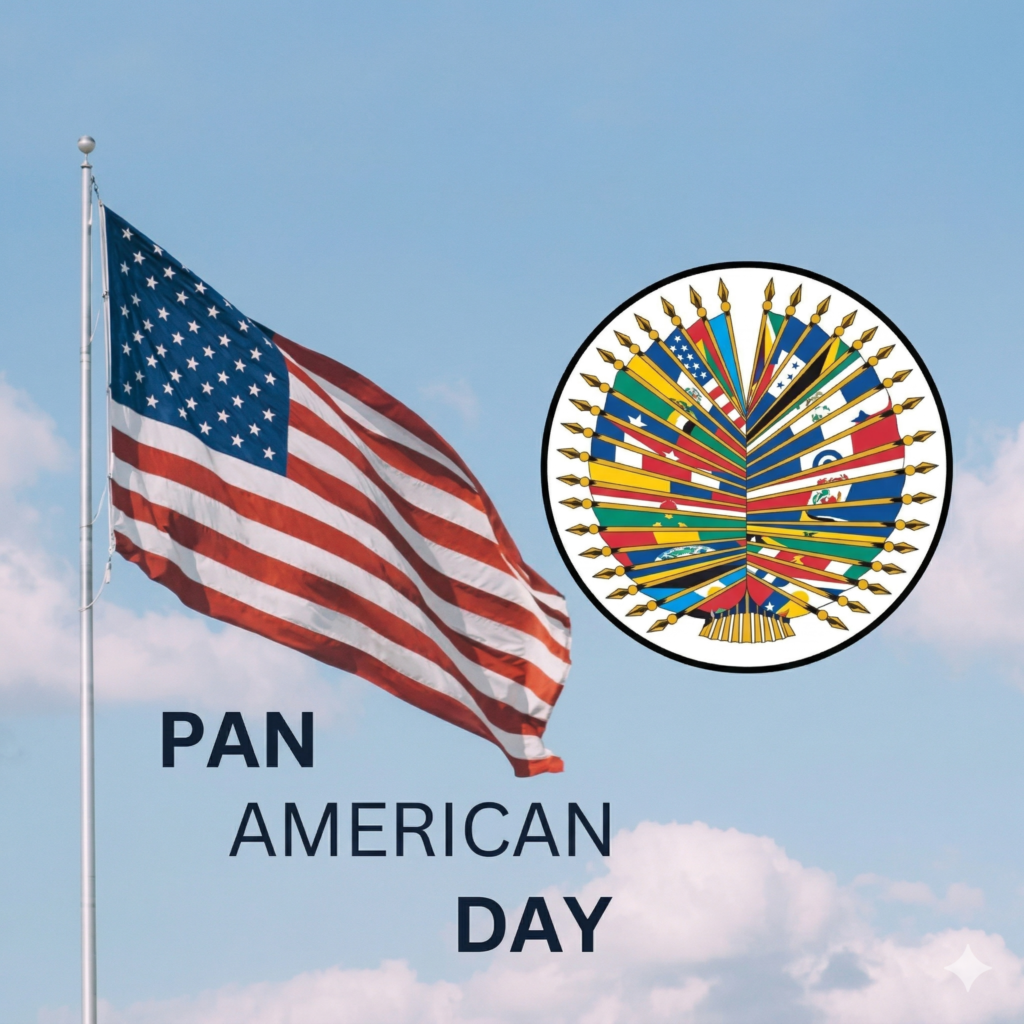
In 2026, Pan American Week runs from Saturday, April 11, through Friday, April 17, with Pan American Day itself landing on Wednesday, April 14. Rather than confining the celebration to a single day, Pan American Week gives schools, government offices, cultural organizations, and local communities a full seven days to engage meaningfully with inter-American themes.
How Pan American Week Is Typically Observed Across the U.S.
- University and school programs spotlighting the history, art, and cultures of Latin America and the Caribbean
- Cultural fairs and exhibits organized by the embassies and consulates of OAS member states
- Flag-raising and wreath-laying ceremonies at government buildings, particularly in Washington, D.C.
- Academic panels and public lectures on hemispheric diplomacy, trade policy, and regional security
- Community events hosted by Latino civic organizations and cultural centers nationwide
- Official proclamations issued by state governors and city mayors affirming inter-American solidarity
Want to attend an event? Your best starting points are local universities with Latin American studies programs, OAS regional offices, and the embassies of OAS member states in your area. Many of these organizations post their Pan American Week 2026 schedules publicly, so a quick search ahead of April 11 should turn up options near you.
Pan American Day 2026: Key Facts at a Glance
| Category | Detail |
| Observed On | April 14 every year |
| Pan American Week 2026 | April 11–17, 2026 |
| Year of Origin | 1890 |
| Founding Event | First International Conference of American States — Washington, D.C. |
| Governing Organization | Organization of American States (OAS) |
| Total Member States | 35 independent nations of the Western Hemisphere |
| OAS Headquarters | Washington, D.C., USA |
| Central Purpose | Promote hemispheric unity, democracy, and cooperative development |
FAQ:
Q.1. Is Pan American Day a federal public holiday in the United States?
No — Pan American Day is not a federal public holiday, so banks, businesses, and most schools stay open on April 14. That said, it is officially acknowledged through presidential proclamations and is observed with formal ceremonies and public events, most visibly in Washington, D.C., and in cities with large Latin American communities. Think of it less like Thanksgiving and more like Earth Day — meaningful, widely recognized, and active in communities even without a day off.
Q.2. Which countries celebrate Pan American Day?
All 35 member states of the OAS observe Pan American Day in some capacity. That list includes every independent nation in the Western Hemisphere — Canada and the United States in the north, the nations of Central America and the Caribbean in the middle, and countries stretching from Colombia down to Argentina and Chile in South America. How each country marks the occasion varies widely; some hold large public events while others observe it more quietly at the governmental level.
Q.3. What is the difference between Pan American Day and Pan American Week?
Pan American Day is the specific date — April 14 — that marks the 1890 founding of the International Union of American Republics. Pan American Week is the full seven-day period surrounding that date. In 2026, the week runs from April 11 through April 17. The broader week simply gives communities, schools, and institutions more runway to host events, exhibitions, and programs without cramming everything into a single day.
Q.4. How does Pan American Day differ from Columbus Day or Hispanic Heritage Month?
They each serve a distinct purpose. Columbus Day — or Indigenous Peoples’ Day, as many states and cities now call it — marks Christopher Columbus’s arrival in the Americas in 1492 and has become a complex, debated holiday. Hispanic Heritage Month, observed from September 15 through October 15, honors the cultural and civic contributions of Hispanic and Latino Americans. Pan American Day is different in character: it is fundamentally a diplomatic and political observance, focused on intergovernmental cooperation and the institutional ties that bind the nations of the Western Hemisphere together.
Q.5. Are there other notable April 14 holidays in the USA in 2026?
April 14, 2026 does not fall on a federal holiday. It lands one day before Tax Day (April 15) and within National Poetry Month. A handful of states or municipalities may mark local events on or near that date, but Pan American Day remains the most broadly recognized international observance tied to April 14 in the United States.
Why Pan American Day Still Matters in 2026
More than 130 years have passed since those 18 delegations sat down together in Washington. The world they navigated looks nothing like ours — and yet the challenges they were trying to solve — how nations with different histories, languages, and interests find common ground — remain every bit as real today.
Trade tensions, migration pressures, climate change, democratic backsliding — none of these problems stop at a border. Pan American Day is not a solution to any of them. But it is an annual reminder that the institutions and relationships needed to address them already exist, built painstakingly over more than a century of hemispheric dialogue.
For Americans, the day is also personal. If your family has roots anywhere in Latin America or the Caribbean, Pan American Day is partly your story. And even if it is not, the ties between the United States and its hemispheric neighbors shape the economy you participate in, the food you eat, and the communities you live alongside every day.
For More Information
Related Article
Dawn Staley vs Geno Auriemma Controversy: What Really Happened at the 2026 Women’s Final Four
LA28 Olympics Ticket Website Crash: What Happened & How Fans Can Still Get Tickets
Iran Shoots Down US F-15: One Pilot Rescued, One Still Missing
Storm Dave 2026: Live Weather Map, Latest Radar Updates & Path Forecast — April 3