
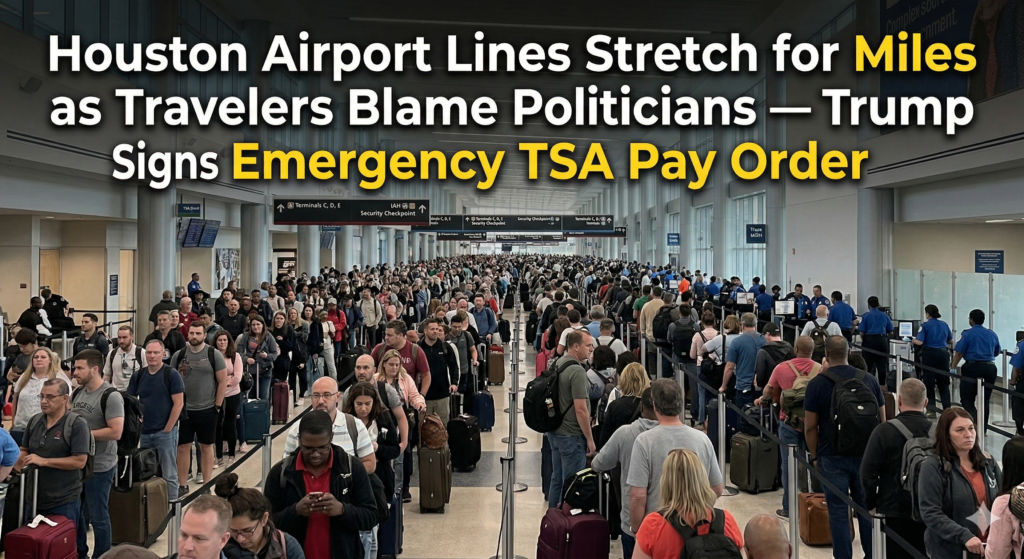
Everything traces back to one date: February 14, 2026, when federal funding for the Department of Homeland Security — the agency that runs TSA — officially expired.
The partial government shutdown that followed hit airports hard, but Houston’s Bush Intercontinental absorbed some of the worst of it. Security wait times climbed past four hours, and lines stretched well beyond the terminal walls. Meanwhile, TSA officers — federal employees — were still expected to show up for work every day, just without a paycheck arriving at the end of the week.
The financial toll was staggering. By late March, TSA had collectively missed out on roughly $1 billion in unpaid wages. Nearly 500 agents had already resigned. Thousands more simply stopped calling in. At Hobby Airport, the callout rate hovered around 32%. At Bush Intercontinental, it crept toward 40% — one of the highest figures recorded anywhere in the country.
Bush normally operates 37 active checkpoint lanes. During the peak of the crisis, fewer than half of those were running. Add a surge of spring break travelers, and you had a perfect recipe for gridlock.
What Houston Travelers Actually Said About Who’s to Blame
When journalists asked passengers standing in those lines who they held responsible, the answers came fast — and without much diplomatic softening.
A traveler named Tim put it plainly: “The politicians.” A woman nearby, who didn’t give her name, said: “All congressmen — all of them, no matter what party. They just need to do their jobs.”
Others had stronger takes. One traveler named Lancet pointed the finger specifically at Democrats: “The Democrats are not voting to reinstate DHS funding. And they’re the ones responsible for paying TSA from what I know. So if the people aren’t getting paid, of course they can’t work.”
From the other direction, some passengers laid blame at the White House and Republican leadership. U.S. Representative Al Green of Houston argued publicly that Trump’s real goal was pressuring Senate Republicans to drop the legislative filibuster — and that resolving the TSA crisis was never the priority.
Regardless of where passengers placed blame politically, the underlying frustration was universal. When Washington plays hardball, it’s everyday workers and everyday travelers who end up paying the bill.
How the Government Shutdown Turned Into a Full-Blown TSA Staffing Crisis
To understand how things got this bad, you have to go back to why the funding lapsed in the first place.
DHS funding ran out on February 14 after Senate Democrats blocked the spending bill in response to the killing of two U.S. citizens by ICE agents. Democrats demanded meaningful ICE reform before they would vote yes. Negotiations dragged on for weeks, coming close to a resolution multiple times — until Trump introduced a new condition, insisting that his election reform legislation be packaged into the same bill. That demand derailed the talks and extended the shutdown indefinitely.
The consequences inside TSA were severe. Assaults on TSA officers spiked by more than 500% during the shutdown, according to the acting TSA administrator, who also described officers donating plasma to cover bills and receiving eviction notices from landlords. On one particularly bad Wednesday, more than 3,120 TSA officers nationwide didn’t report for their shifts — a callout rate exceeding 11%.
The situation fed itself. Fewer staff meant longer lines. Longer lines meant angrier passengers. Angrier passengers made conditions even harder for the officers who were still showing up. Getting out of that spiral was never going to be quick.
What Trump’s Emergency Executive Order Actually Does for Airport Security
On March 27, 2026, President Trump signed an emergency executive order, calling the state of air travel “an emergency situation compromising the Nation’s security” and describing America’s air travel system as having “reached its breaking point.”
The order directed existing federal funds to be used to pay TSA workers immediately, bypassing the frozen appropriations process. Homeland Security Secretary Markwayne Mullin confirmed that officers could start seeing paychecks as early as the following Monday — the first real financial relief since February 14.
That said, experienced voices in the travel industry are advising travelers not to expect an overnight turnaround. One former TSA officer who writes a travel newsletter noted that many workers won’t return until they feel confident that the paychecks will keep coming reliably. His estimate: airport security lines may stay longer than normal for another one to two weeks, even with the order in effect.
The ICE-at-Airports Question
Before the executive order came through, the Trump administration deployed ICE agents to major airports, including Bush Intercontinental, to assist with the security backlog.
Their role was limited to checking IDs at entry points, managing crowd flow, monitoring exits, and distributing water to people waiting in line. They were not involved in the actual security screening process — which was the part that was critically understaffed.
Travelers weren’t impressed. One passenger said bluntly: “The fact that we don’t have anyone staffing TSA, but we have ICE officers standing around — that tells you a lot about who they actually care about.”
Security analysts made a similar point less personally. One expert compared deploying ICE agents to solve a TSA shortage to inserting a football player into a basketball game: they’re athletes, sure, but that doesn’t make them equipped for the job. Airport screening requires specific federal certification that ICE agents simply don’t have. Their presence helped manage chaos at the edges, but it didn’t move the security line one bit faster.
How Houston Airport Officials Are Managing the Ongoing Crisis
Jim Szczesniak, Director of Operations, publicly stated that the current level of TSA staffing is “not sustainable” and confirmed that the airport had pulled hundreds of its own employees — from departments like finance, administration, and facilities maintenance — to help with queue management and passenger flow.
Across the country, airport authorities and travel professionals have consistently urged the same thing: arrive much earlier than you normally would. During the worst days of the crisis, some airports recommended showing up four hours before domestic departure. That guidance still holds while staffing levels stabilize.
On the airline side, United and several other carriers quietly gave elite-status passengers access to expedited security pathways, helping them bypass the worst of the wait. It was a practical solution — but one that also underscored how differently the crisis affected travelers depending on their frequent flyer status.
Practical Advice for Travelers Flying Through Houston or Any Major US Airport
Give yourself far more time than feels necessary. Even with Trump’s executive order in place, getting staffing back to normal levels is a process, not a switch. For domestic flights, budget at least three hours. For international departures, build in four. It’s better to sit at your gate with time to spare than to watch your flight leave without you.
Use real-time wait time tools before you leave home. The TSA’s own MyTSA app has been inconsistently updated during the shutdown period. Third-party airport apps and official airport social media pages have generally been more current and reliable.
Look into TSA PreCheck or CLEAR if you haven’t already. Even during this disruption, expedited screening lanes have moved considerably faster than standard lines. If you travel more than two or three times a year, the enrollment cost pays for itself quickly.
Be open to alternative routing. On the worst days, some passengers found that smaller terminals or nearby regional airports had dramatically shorter waits. If your schedule allows for flexibility, it’s worth checking.
Track what Congress does next. The Senate deal still needs a House vote. If it passes, full DHS funding is restored and staffing should recover faster. If it stalls again, the executive order is only a temporary fix — and the uncertainty will keep officers cautious about fully returning.
Frequently Asked Questions
Why are TSA lines still so long in 2026?
The extended wait times are a direct result of the partial government shutdown that began February 14, 2026. TSA officers went without paychecks for over 40 days, causing thousands to stop reporting for duty. With up to 40% of staff absent at some checkpoints, airports like Bush Intercontinental in Houston were left operating with less than half their normal lane capacity — right during the busiest travel weeks of spring.
Did Trump’s executive order solve the airport security problem?
It helped, but it didn’t fix everything immediately. The order directed existing funds to compensate TSA officers right away, and workers were expected to start receiving payments within days of it being signed. Still, travel experts caution that restoring full staffing and normal wait times could take another one to two weeks, as returning officers need time to formally come back on schedule.
Who is genuinely responsible for the TSA staffing shortage?
Honestly, the blame is shared. The shutdown stems from a congressional dispute over DHS and ICE reform that both parties have been unable to resolve, further complicated when the White House tied unrelated election legislation to the spending bill. Democrats, Republicans, and the Trump administration each played a role in dragging the standoff past 40 days — while TSA officers and travelers absorbed the consequences.
How long will airport security delays continue?
Based on assessments from former TSA staff and travel industry professionals, delays may persist for one to two weeks beyond when officers begin receiving regular paychecks. Staffing levels don’t rebound overnight, especially after nearly 500 officers resigned and many others spent weeks unsure whether returning was worth the financial risk.
Which US airports were hit hardest by the TSA crisis?
Houston’s George Bush Intercontinental Airport was among the most severely affected, reporting callout rates near 40% at the peak of the crisis. Other major hubs that experienced significant disruption included JFK and LaGuardia in New York, Hartsfield-Jackson in Atlanta, and Baltimore-Washington International. Generally, larger airports with bigger TSA workforces saw the most extreme shortfalls.
A Preventable Crisis With a Political Price Tag
The marathon security lines that paralyzed Houston’s airports in March 2026 didn’t emerge from nowhere. They were the foreseeable outcome of a government funding fight that dragged on for more than six weeks — one that left nearly 50,000 TSA employees working without compensation during one of the heaviest travel periods of the year.
The passengers who lost hours of their lives in those queues — some missing flights, some spending hundreds of dollars rescheduling — weren’t collateral damage in some abstract policy debate. They were the real cost of a political stalemate that Washington’s leaders let go on far too long.
Trump’s executive order breaks the immediate deadlock and should bring meaningful relief. But unless Congress passes a full, clean DHS funding bill, the underlying fragility doesn’t go away. The next fight could produce the next crisis.
For More Information
Related Article
Iran War Hormuz Tensions Escalate: What It Means for Oil Prices and American Consumers
BREAKING: México – Portugal Ends 0-0 — Full Time Result & Highlights From Estadio Azteca
UFC Fight Night Results: Joe Pyfer Shocks the World with Stunning KO Win Over Adesanya
Spurs vs Bucks Last Game Recap: San Antonio Wins Again as Giannis Sits Out — March 28, 2026
3 thoughts on “Houston Airport Lines Stretch for Miles as Travelers Blame Politicians — Trump Signs Emergency TSA Pay Order”