


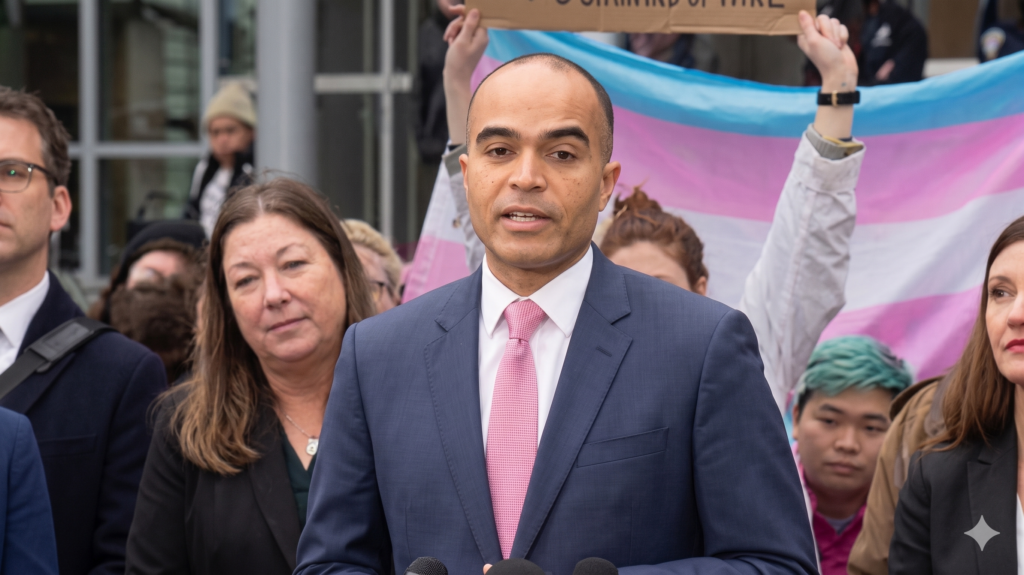
This case touches on healthcare policy, federal authority, states’ rights, and the role of the courts in checking executive power. Regardless of where you stand on the underlying issue, understanding what the court actually decided — and why — is essential. Here is a clear, factual breakdown of everything you need to know.
| 22 States + D.C. That Won the Lawsuit | 49 pp Pages in Judge Kasubhai’s Opinion | Dec 2025 Date of Kennedy Declaration | Apr 18 Date of Final Court Ruling, 2026 |
What Is the Trump Administration’s Gender-Affirming Care Ban for Minors?
To make sense of the court ruling, it helps to understand what the administration actually did. Shortly after taking office in January 2025, President Trump signed an executive order directing federal agencies to restrict gender-affirming medical care for anyone under the age of 19. The order specifically targeted puberty blockers, hormone therapy, and certain surgical procedures, and it directed agencies to withhold federal funding from any medical providers who continued offering such care.
The situation escalated further on December 18, 2025, when Health and Human Services Secretary Robert F. Kennedy Jr. issued a formal declaration — officially titled “Safety, Effectiveness, and Professional Standards of Care for Sex-Rejecting Procedures on Children and Adolescents.” The declaration made a sweeping claim: that gender-affirming care for minors was neither safe nor effective, and it threatened to strip hospitals and providers of their Medicare and Medicaid funding if they continued to provide it.
📋 What Is the ‘Kennedy Declaration’?
The Kennedy Declaration is a formal statement issued by HHS Secretary RFK Jr. on December 18, 2025. It asserted that treatments such as puberty blockers and hormone therapy for minors “fail to meet professionally recognized standards of health care.”
The declaration warned providers that continuing to offer gender-affirming care could result in their exclusion from Medicare and Medicaid — a threat that would be financially devastating to most hospitals. Critically, it bypassed the standard federal rulemaking process, which courts later identified as a central legal flaw.
How Did Hospitals Respond?
The impact was immediate and widespread. Within weeks of the declaration, hospitals across the country began halting or suspending their gender-affirming care programs — not because any court had ruled the care illegal, but out of financial fear. Facilities in Massachusetts, Maryland, Washington State, Colorado, and Virginia were among the earliest to pause appointments, leaving many patients who had been receiving ongoing care without access to providers.
In Minnesota, Children’s Minnesota suspended its gender-affirming care program for patients under 18 in February 2026. In Washington State, Mary Bridge Children’s Hospital in Tacoma closed its gender clinic around the same time. The HHS itself publicly claimed that “more than 30 hospitals and hospital systems” had stopped providing the care — a figure that Judge Kasubhai later cited critically in his written opinion.
The Federal Lawsuit: Twenty-Two States Challenge the Trump Administration in Court
The legal pushback came quickly. On December 23, 2025 — just five days after the Kennedy Declaration was issued — a coalition of 19 states and the District of Columbia filed suit in the U.S. District Court for the District of Oregon. The lawsuit was led by Oregon Attorney General Dan Rayfield, and the plaintiff coalition argued the declaration was unlawful on several distinct grounds.
States That Joined the Lawsuit (Oregon v. Kennedy)
| Oregon | California | Washington | New York |
| Illinois | Colorado | Connecticut | Delaware |
| Hawaii | Maine | Maryland | Massachusetts |
| Michigan | Minnesota | Nevada | New Jersey |
| New Mexico | Rhode Island | Vermont | Wisconsin |
| Pennsylvania | Washington D.C. |
The states’ legal arguments rested on three main pillars: first, that Kennedy had overstepped his statutory authority by issuing the declaration at all; second, that the declaration violated the Administrative Procedure Act (APA) because it effectively changed substantive law without going through the required public notice-and-comment rulemaking process; and third, that it unlawfully intruded on states’ own authority to set standards of medical care within their borders.
The Court Ruling: Judge Kasubhai’s April 18, 2026 Decision
U.S. District Judge Mustafa T. Kasubhai — who had heard nearly six hours of oral argument in Eugene, Oregon in March and signaled his direction at that hearing — issued his formal written opinion on April 18, 2026. The ruling is both sweeping and direct. He granted summary judgment in favor of all 22 plaintiff states and Washington, D.C., permanently voiding the Kennedy Declaration and blocking the administration from enforcing it.
“Unserious leaders are unsafe. There is nothing more serious than our leaders’ dedication to the rule of law so that we might maintain the integrity of our constitutional democracy.”
— U.S. District Judge Mustafa T. Kasubhai, April 18, 2026 Opinion
What the Judge Found — Explained in Plain Terms
Judge Kasubhai made several distinct legal findings that, taken together, stripped away every justification the administration had offered for the Kennedy Declaration. On the question of authority, the court held that federal officials simply do not have the power to unilaterally establish standards of care for gender-affirming treatment, and that HHS cannot exclude providers from Medicare or Medicaid for offering services that align with accepted medical guidelines. Kennedy, the court found, had never possessed the legal authority to take the action he did.
On procedural grounds, the ruling was equally firm. By issuing the declaration, Kennedy had effectively eliminated any federally recognized standard of care for gender-affirming treatment — a substantive regulatory change that, under the APA, requires formal public notice and an opportunity for comment before it can take effect. That process was never followed.
The judge’s language throughout the opinion was notably pointed. He wrote that Kennedy’s failure to observe the APA “harmed children” and created “chaos and terror” for patients, families, and healthcare providers across the country. He described the threat to revoke Medicare and Medicaid funding as amounting to a “financial death sentence” for medical institutions. He also characterized the administration’s broader pattern of conduct as reflecting a troubling willingness to disrupt established systems and wait to see what resistance emerges.
✅ What the Ruling Actually Does
Vacates the Kennedy Declaration entirely — it is now legally void and carries no force.
Permanently enjoins the federal government from enforcing the declaration, or any materially similar policy, against providers in the 22 plaintiff states and Washington, D.C.
Requires federal agencies to formally notify relevant officials within seven days that enforcement has ceased.
Reaffirms that states retain substantial discretion in how they direct Medicaid funding, including for gender-affirming care.
How the Legal Battle Unfolded: A Full Timeline
January 20, 2025
Trump signs executive order directing federal agencies to withhold funding from providers offering gender-affirming care to anyone under the age of 19.
February 2025
Hospitals in at least five states pause care. The ACLU and Lambda Legal file separate lawsuits. U.S. District Judge Brendan Hurson in Maryland issues a temporary restraining order blocking parts of the executive order.
December 18, 2025
RFK Jr. issues the Kennedy Declaration, claiming gender-affirming care for minors is “unsafe and ineffective” and threatening to revoke Medicare and Medicaid funding from providers who continue offering it.
December 23, 2025
A coalition of 19 states plus D.C., led by Oregon, files Oregon v. Kennedy in the U.S. District Court for the District of Oregon, challenging the declaration as unlawful.
March 19, 2026
After nearly six hours of oral argument, Judge Kasubhai signals he will rule in the states’ favor, stating that the declaration is “no mere opinion” and rejecting the administration’s core arguments.
April 18, 2026
Judge Kasubhai issues his 49-page formal opinion, permanently vacating the Kennedy Declaration and granting summary judgment to all 22 plaintiff states and D.C.
What This Means for Families and Healthcare Providers
For families of transgender youth living in the 22 states that participated in the lawsuit, this ruling offers meaningful legal relief. Providers in those states may now offer gender-affirming care to eligible minors without fear that the Kennedy Declaration will be used to revoke their Medicare or Medicaid status. Some institutions — including Children’s Minnesota — had already begun restoring suspended programs following the preliminary ruling issued in March.
The picture is more complicated for families in states that were not part of the lawsuit. The ruling applies specifically to the plaintiff states. It does not automatically restore access to care in states that have enacted their own legislative restrictions on gender-affirming treatment — and a significant number of states have done exactly that in recent years. Those laws face separate legal challenges in separate courts.
Is This the End of the Legal Fight?
Almost certainly not. The Trump administration has appealed numerous court rulings blocking its healthcare-related policies throughout 2025 and 2026, and this case is unlikely to be treated differently. The administration can appeal to the Ninth Circuit Court of Appeals, and the matter could ultimately reach the U.S. Supreme Court. The legal landscape around transgender healthcare remains deeply contested across all levels of government.
Additionally, the administration still has separate proposed rules — introduced in December 2025 — that would tie federal funding restrictions to gender-affirming care more broadly. If those rules are finalized, they will almost certainly face their own wave of legal challenges.
FAQ:
Q.1. What did the federal judge rule on gender-affirming care for minors?
Ans: On April 18, 2026, U.S. District Judge Mustafa T. Kasubhai issued a 49-page ruling permanently voiding the “Kennedy Declaration” that HHS Secretary RFK Jr. had issued in December 2025. The court found that Kennedy acted beyond his legal authority, violated the Administrative Procedure Act by bypassing required rulemaking procedures, and unlawfully overrode states’ authority over medical standards of care. The ruling permanently blocks the administration from enforcing the declaration or any substantially similar policy against providers in the 22 plaintiff states and Washington, D.C.
Q.2. What was the Kennedy Declaration, and why did the courts reject it?
Ans: The Kennedy Declaration was a formal statement issued by HHS Secretary Robert F. Kennedy Jr. on December 18, 2025. It claimed that gender-affirming care for minors — including puberty blockers and hormone therapy — was “unsafe and ineffective,” and it threatened to cut Medicare and Medicaid funding to providers who continued offering such services. Courts rejected it because Kennedy had no legal authority to unilaterally set medical standards of care and because the declaration bypassed the notice-and-comment process that federal law requires before substantive regulatory changes can take effect.
Q.3. Does this ruling apply to the entire country?
Ans: No. The April 18 ruling applies specifically to the 22 states and Washington, D.C. that were named plaintiffs in Oregon v. Kennedy. It does not automatically override state-level laws restricting gender-affirming care in other jurisdictions. Families living in states with their own legislative restrictions should review their state’s current laws and consult a healthcare provider about available options in their area.
Q.4. Can the Trump administration appeal this ruling?
Ans: Yes. The administration may appeal to the Ninth Circuit Court of Appeals and, if the case proceeds, potentially to the U.S. Supreme Court. Given the administration’s track record of challenging adverse rulings throughout 2025 and 2026, an appeal is widely anticipated. The broader legal battle over transgender healthcare policy is far from resolved.
Q.5. What is gender-affirming care, and which medical organizations support it?
Ans: Gender-affirming care refers to a range of medical and mental health services designed to support transgender and gender-diverse individuals in aligning their physical characteristics and social presentation with their gender identity. For minors, this typically includes mental health counseling, social transition support, puberty blockers, and in some cases hormone therapy. Major U.S. medical bodies — including the American Medical Association, the American Academy of Pediatrics, and the American Psychological Association — endorse access to gender-affirming care for minors when it is clinically indicated and pursued with appropriate parental involvement.
For More Information

Related Article
Trump Urges Iran to Halt Execution of 8 Women Protesters in Truth Social Post
Mets Losing Streak 2026 Reaches 12 Games — Full Breakdown, Stats, and What Happens Next
Mike Vrabel Dianna Russini Photo Scandal: NFL Rules No Discipline as Russini Resigns