


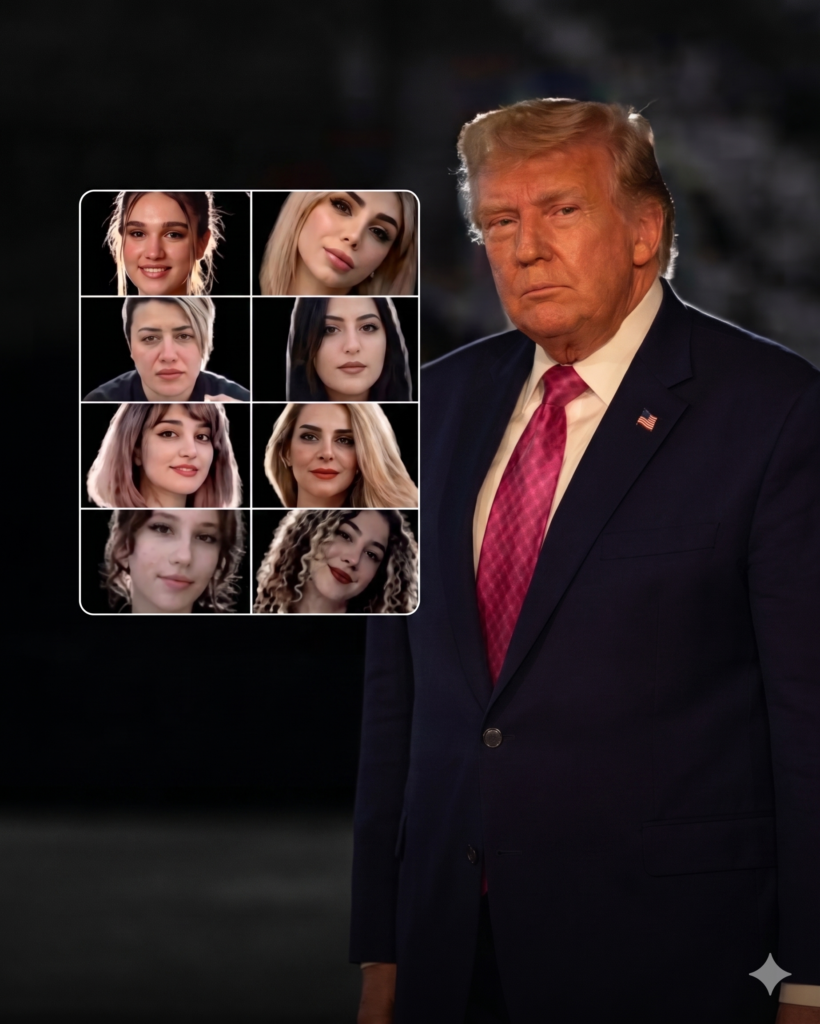
The Lawfare Project, a human rights nonprofit based in New York, identified all eight women by name: Bita Hemmati, Ghazal Ghalandari, Golnaz Naraghi, Venus Hossein Nejad, Panah Movahedi, Ensieh Nejati, Mahboubeh Shabani, and Diana Taher Abadi.
US-based Iranian dissident Masih Alinejad published their names on her X account, also claiming that at least one of the women was as young as 16 years old. All eight were reportedly arrested in connection with the massive wave of protests that shook Iran in January 2026 — demonstrations that erupted after the country’s currency went into freefall.
Bita Hemmati’s case stands out in particular. She was handed a collective death sentence alongside three other people, including her own husband. According to reports from the Tehran Revolutionary Court, the charges against them included disrupting national security and alleged connections to what the court called hostile foreign governments.
But these aren’t just legal cases. These are real people — some of them mothers, some of them young enough to still be called kids — who walked out onto the streets asking for something better. Now, they sit in cells waiting to find out if they will live.
What Exactly Did Trump Say — and Why Does It Matter?
Trump’s Truth Social message was direct. He addressed Iran’s leadership specifically, noting they would soon be entering negotiations with his representatives: “I would greatly appreciate the release of these women. I am sure that they will respect the fact that you did so. Please do them no harm! Would be a great start to our negotiations!”
The post included a screenshot originally shared by Eyal Yakoby, a 23-year-old commentator, who published photos of the eight women and warned the world that Iran was preparing to hang them.
Here’s why the timing matters so much. Trump’s appeal didn’t come out of nowhere — it landed right in the middle of active diplomatic back-and-forth between Washington and Tehran over nuclear agreements and a fragile ceasefire. That context gives his words far more weight than a random opinion piece or a protest sign ever could. He was, in effect, putting human lives on the diplomatic agenda.
This Wasn’t Trump’s First Time Pushing Back on Iran’s Executions
It’s worth looking at the track record here. Back in January 2026, Iran had reportedly lined up around 800 executions of protesters. The White House announced that all of them were halted after Trump made it clear to Iranian officials that continuing the killings would bring serious consequences, with all options remaining on the table.
Trump later acknowledged the cancellation publicly, saying he had tremendous respect for Iran’s decision to call off those executions. He had previously told reporters that he believed he had personally stopped 837 hangings in Iran by warning the regime of the fallout it would face.
Iran, for its part, denied that these executions were ever going to happen — but the timing of the halt was hard to ignore.
Iran’s Response: Denial, as Usual
Tehran’s official answer to Trump’s latest appeal was predictably dismissive. Iran’s judiciary flatly denied that any of the eight women were in danger of being executed. Officials claimed some of the women had already been released, while others faced charges that, even if upheld, would result in prison time rather than the death penalty.
State-affiliated media echoed this line, pushing back on Trump’s characterization and labeling outside concern as exaggeration or foreign meddling.
This response follows a pattern that’s become almost scripted at this point. Whenever international scrutiny falls on Iran’s treatment of protesters or political prisoners, the government either denies the severity of the situation outright or dismisses critics as part of an organized campaign to destabilize the country. Human rights organizations that operate independently, however, consistently report a reality that looks nothing like the government’s version.
The Bigger Picture: What’s Been Happening Inside Iran
To really understand why Trump’s intervention is drawing this much attention, you have to look at what Iran has been doing to its own people.
The current wave of unrest started on December 28, 2025, triggered by a dramatic economic collapse. The country’s currency lost enormous value almost overnight, sending ordinary Iranians into the streets in frustration and desperation. Security forces responded with overwhelming force, and the bloodiest single period came on January 8 and 9, 2026, when the death toll climbed into the thousands. Amnesty International has described this as the deadliest crackdown by Iranian security forces in the organization’s decades of research on the country.
Human rights groups have documented that dozens of people arrested during these protests were later sentenced to death through trials that moved at a shocking pace — trials where defendants reportedly lacked access to independent lawyers, faced confessions extracted through torture, and were denied basic due process.
The numbers behind all of this are almost hard to process. Iran executed at least 1,639 people in 2025 alone. Of those, 48 were women — the highest figure recorded in more than two decades, representing a 55% jump compared to the year before.
Behind every one of those numbers is a person. A family. A story that the Iranian government would prefer the world never heard.
Why Women Have Become a Symbol of This Fight
Women have been at the forefront of Iran’s protest movements for years. The 2022 “Woman Life Freedom” uprising, which began after Mahsa Amini died in morality police custody, brought Iranian women’s courage to global attention. That spirit didn’t disappear — it carried forward into the 2026 protests.
Authorities appear to have taken particular notice. Women and ethnic minorities have been increasingly targeted in Iran’s use of the death penalty. Meanwhile, hundreds of activists, lawyers, journalists, and ordinary citizens remain locked up without adequate legal representation.
Why Should Americans Care?
It’s a fair question. Iran is far away, and Americans have plenty of problems close to home. But the issues at the heart of this story aren’t foreign at all.
The right to speak freely. The right to take to the streets in protest. The idea that a government answers to its people rather than the other way around — these are values that Americans believe in deeply, even when they disagree about everything else.
Trump’s involvement also opens up a genuinely important conversation about what American power looks like in today’s world. A sitting president with one post on a social platform can potentially pull eight women back from the edge of execution. That’s not nothing. But it also raises harder questions: Is this influence being used every time it should be? Are these kinds of interventions consistent? And what happens to the cases that don’t make it into a viral post?
The broader U.S.-Iran relationship is also playing out on multiple fronts simultaneously — nuclear talks, ceasefire arrangements, and ongoing military tension in the region. The lives of these eight women have become tangled up in all of that, whether they asked to be or not.
What Comes Next?
The situation is still developing, and the outcome remains genuinely uncertain. Here’s where to focus your attention:
- Negotiation developments: If Iran agrees to release the women, it could be read as a meaningful gesture of goodwill in the wider nuclear talks — or simply as a calculated move to gain leverage. Either way, it would matter.
- International pressure: Organizations like Amnesty International and Human Rights Watch have been vocal on this issue. Sustained global attention tends to make governments more cautious, even authoritarian ones.
- Legal status of each woman: Some of the eight are still moving through Iran’s judicial system. Whether their cases reach full appeals — and whether those appeals are handled fairly — will shape their immediate futures.
- American public awareness: The more people in the U.S. know about this story, the harder it becomes for any administration to quietly let it drop from the agenda.
Frequently Asked Questions (FAQ)
Q.1. What did Trump say about the execution of Iranian women protesters?
Ans: Trump posted on Truth Social urging Iran’s leadership to release eight women who were reportedly facing the death penalty. He asked that they not be harmed and framed their release as a positive first step toward productive negotiations between the two countries.
Q.2. Who are the eight women Iran is accused of planning to execute?
Ans: The eight women are Bita Hemmati, Ghazal Ghalandari, Golnaz Naraghi, Venus Hossein Nejad, Panah Movahedi, Ensieh Nejati, Mahboubeh Shabani, and Diana Taher Abadi. All were reportedly arrested in connection with the anti-government protests that swept Iran in January 2026.
Q.3. Has Trump previously intervened to stop executions in Iran?
Ans: Yes. In January 2026, the White House reported that Iran halted approximately 800 planned executions after Trump made clear that continuing the killings would carry serious consequences. Trump later acknowledged Iran’s decision and expressed respect for it publicly.
Q.4. How did Iran respond to Trump’s appeal for the women’s release?
Ans: Iran’s judiciary denied that any of the eight women faced imminent execution. Officials stated that some had already been freed and that the others faced charges resulting in prison sentences, not death.
Q.5. How many people has Iran executed in recent years?
Ans: According to joint research by Norway-based Iran Human Rights and the Paris-based organization Together Against the Death Penalty, Iran executed at least 1,639 people in 2025. Among them were 48 women — the largest number recorded in over 20 years.
Staying Silent Is Also a Choice
The story of Trump, Iran, and these eight women isn’t finished. It may not be finished for a long time. But right now, while it’s still unfolding, each of us gets to decide how much attention we give it.
A president’s post on social media isn’t a substitute for policy. It’s not a guarantee that these women will be safe. But it opens a door — it forces Iran into a public position, keeps names in circulation, and signals to the international community that this matters to the most powerful country on earth.
The work that happens after that moment is what really counts. Supporting credible human rights organizations, sharing accurate information, and holding leaders accountable for following through — that’s where the real difference gets made.
For More Information

Related Article
Mets Losing Streak 2026 Reaches 12 Games — Full Breakdown, Stats, and What Happens Next
Mike Vrabel Dianna Russini Photo Scandal: NFL Rules No Discipline as Russini Resigns
Breaking: Nancy Mace Introduces Resolution to Expel Cory Mills Over Ethics Scandal
John Gotti’s Grandson Sentenced for $1.1 Million COVID Fraud Case