


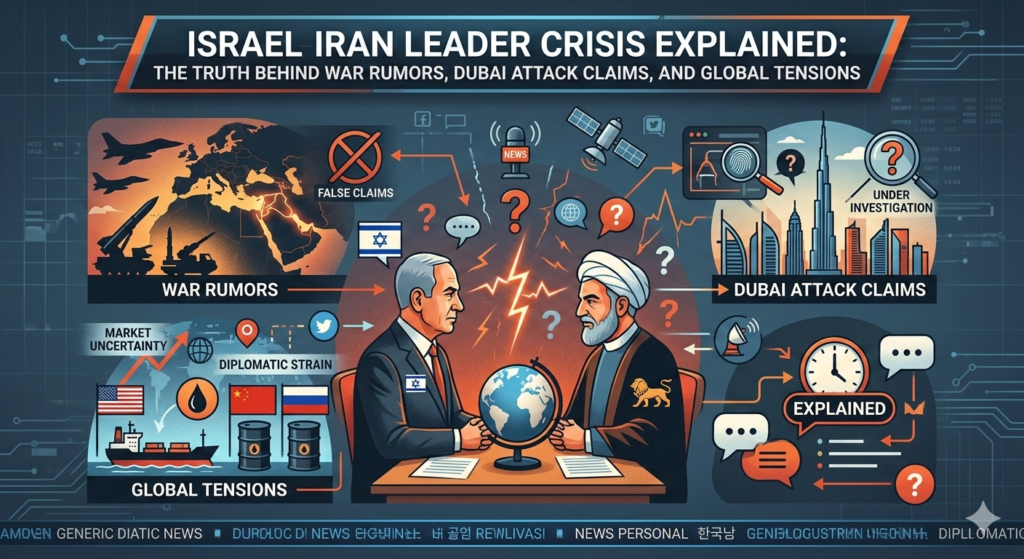
Why Everyone Is Suddenly Searching About the Israel Iran Leader
In recent weeks, global headlines have triggered a surge in online searches about the Israel Iran leader, with people asking urgent questions: Is Iran’s supreme leader alive? Why are attacks being reported across the Middle East? Did the U.S. declare war on Iran?
The rapid spread of breaking news — mixed with rumors and social media speculation — has left many readers confused about what is actually happening.
This guide breaks down the situation in clear, factual terms. You’ll learn who leads Iran, how leadership decisions influence regional conflicts, what recent military tensions mean, and which viral claims are accurate — and which are not.
Who Is the Iran Leader and Why the Role Matters Globally

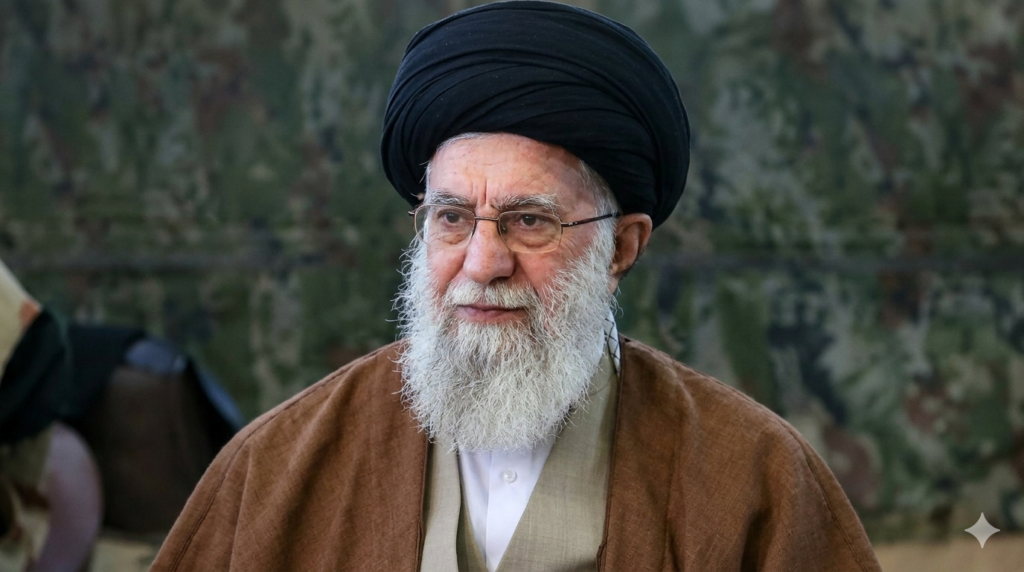
To understand Israel–Iran tensions, you first need to understand Iran’s political structure.
The Supreme Leader: Iran’s Most Powerful Position
Iran is not governed like most countries. While it has a president, the real authority belongs to the Supreme Leader, currently Ayatollah Ali Khamenei.
The Supreme Leader controls:
- Military strategy and national defense
- Foreign policy direction
- The Islamic Revolutionary Guard Corps (IRGC)
- Key judicial and media institutions
This means major decisions involving Israel, the United States, or regional military actions ultimately reflect the Supreme Leader’s strategic vision.
Why leadership decisions affect global stability
Unlike many political leaders who operate under parliamentary checks, Iran’s Supreme Leader holds long-term authority. Policies toward Israel and Western nations are shaped over decades rather than election cycles.
That continuity explains why tensions between Israel and Iran often appear persistent rather than temporary.
Is Iran’s Supreme Leader Alive? Understanding the Rumors
One of the most searched questions recently is: “Is Iran supreme leader alive?”
The reality behind viral speculation
Rumors about leadership health frequently appear during geopolitical crises. However, as of the latest confirmed reports, Iran’s Supreme Leader remains alive and continues to issue official statements through state media.
Why do these rumors spread?
- Limited transparency inside Iran
- Rapid circulation of unverified social media posts
- High global anxiety during military escalation
In conflict situations, misinformation spreads faster than verified updates. Reliable confirmation typically comes only from official announcements or multiple independent international news agencies.
News About Iran Leader: Why Israel and Iran Remain Strategic Rivals
Understanding the rivalry requires historical context.
Long-standing ideological conflict
Relations between Israel and Iran deteriorated after Iran’s 1979 Islamic Revolution. Since then:
- Iran has opposed Israel’s regional policies.
- Israel views Iran’s military and nuclear ambitions as a security threat.
This has led to decades of indirect confrontation rather than full-scale war.
Modern conflict happens indirectly
Instead of direct battles, tensions usually involve:
- Cyber operations
- Intelligence activities
- Proxy conflicts in neighboring regions
- Airstrikes targeting military infrastructure
These actions rarely escalate into declared war but create recurring crises that dominate global news cycles.
Why Did We Bomb Iran? Understanding U.S. Involvement
The United States has conducted limited military actions involving Iranian-linked targets in past confrontations, usually framed as defensive or retaliatory responses.
The broader explanation
Military strikes connected to Iran typically occur due to:
- Attacks on U.S. forces or allies
- Protection of international shipping routes
- Deterrence against escalation
Importantly, these actions do not automatically mean a full war between countries.
Did Congress declare war on Iran?
No — Congress has not declared war on Iran.
Under U.S. law, a formal declaration of war requires congressional approval. Most recent military operations have been authorized under existing defense powers rather than a new war declaration.
Why Is Iran Attacking Dubai? Separating Fact From Viral Claims
As of verified reporting, there is no confirmed large-scale direct Iranian attack on Dubai.
1. Regional fear during escalation
When tensions rise in the Gulf region, nearby cities like Dubai become part of online speculation due to their economic importance.
2. Confusion with broader Gulf incidents
Missile interceptions or regional security alerts are sometimes misinterpreted online as direct attacks.
3. Social media amplification
Unverified videos or old footage are frequently reshared during crises, creating false impressions.
Dubai remains one of the most heavily defended commercial hubs in the region, and confirmed incidents are quickly reported by international media when they occur.
How Leadership Decisions Influence Military Strategy
The Israel Iran leader dynamic plays a central role in how escalation unfolds.
Strategic deterrence instead of open war
Both sides generally avoid full-scale conflict because:
- Regional war would disrupt global oil markets.
- International alliances could rapidly expand the conflict.
- Economic consequences would be severe worldwide.
Instead, leaders rely on controlled signaling — actions strong enough to demonstrate power but limited enough to avoid uncontrollable escalation.
Real-world example
When strikes occur, responses are often carefully calibrated:
- Target selection is limited.
- Messaging emphasizes deterrence.
- Diplomatic channels remain open behind the scenes.
This pattern explains why tensions repeatedly rise and fall without turning into prolonged war.
How Media Coverage Shapes Public Perception
News alerts prioritize urgency. Words like attack, strike, or retaliation generate attention but may lack immediate explanation.
Practical tip for readers
When following fast-moving geopolitical stories:
- Check multiple reputable outlets.
- Wait for confirmation before sharing claims.
- Distinguish between verified events and expert speculation.
What Could Happen Next? Expert Perspectives
1. Controlled escalation
Limited responses continue without full war.
2. Diplomatic intervention
International mediators reduce tensions through negotiations.
3. Accidental escalation
Miscommunication or unexpected casualties could increase risks.
Historically, the first scenario has occurred most often.
FAQ:
Who is the leader of Iran right now?
Iran’s highest authority is the Supreme Leader, Ayatollah Ali Khamenei, who oversees military and foreign policy decisions.
Did Congress declare war on Iran?
No. The United States has not formally declared war on Iran.
Is Iran attacking Dubai?
There is no verified confirmation of a direct Iranian attack on Dubai. Many online claims stem from misinformation or unrelated regional events.
Why are Israel and Iran enemies?
Their rivalry stems from ideological differences, regional security concerns, and long-standing geopolitical disputes since 1979.
Could this conflict become a world war?
Experts consider a global war unlikely because major powers generally aim to contain escalation through diplomacy and deterrence.
Conclusion: Understanding the Israel Iran Leader Story Beyond Headlines
The surge in searches about the Israel Iran leader reflects a deeper global concern: people want clarity during uncertain moments.
While headlines can feel dramatic, the reality is more complex. Iran’s leadership structure, Israel’s security strategy, and international diplomacy all interact to create cycles of tension that rarely become full-scale war.
The key takeaway is simple: understanding leadership decisions helps make sense of global events that otherwise seem chaotic.
If you want to stay informed without feeling overwhelmed, consider following reliable daily geopolitical briefings or reading deeper explainers on Middle East politics. Building context — not just consuming headlines — is the smartest way to understand what happens next.
Related Article
Think You Know the News? The CNN News Quiz Is Challenging Millions — Can You Score High?
Jim Carrey’s César Awards Moment Leaves Audience Speechless — Here’s What Happened
United States Strikes on Iranian Nuclear Sites Spark Global Alarm — What Happens Next?
For More Information
