


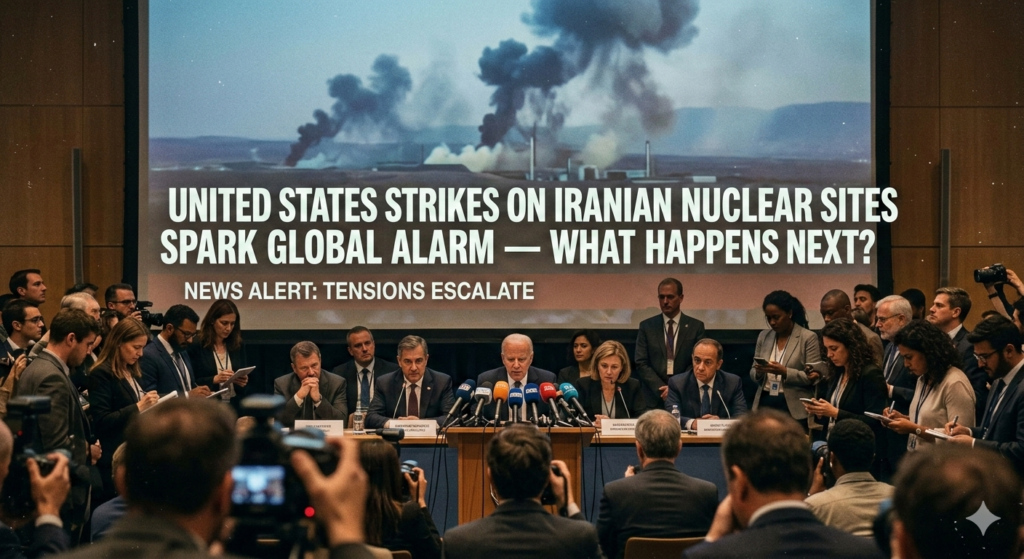
News about United States strikes on Iranian nuclear sites immediately triggered global concern — not just because of military action, but because of what it could mean for regional stability, oil prices, and the risk of a wider conflict.
Many readers searching right now are trying to separate facts from speculation. Are the strikes connected to ongoing tensions involving Israel? Did the attacks target active nuclear weapons programs? Could this escalate into a broader war?
This guide breaks down the situation in clear, neutral terms. You’ll learn what led to the strikes, how they relate to USA–Israel actions involving Iran, what experts say about the risks ahead, and why the developments matter far beyond the Middle East.
What Are the United States Strikes on Iranian Nuclear Sites?
The reported strikes refer to military actions attributed to the United States targeting facilities connected to Iran’s nuclear infrastructure inside Iran.
What was targeted?
While details vary depending on official confirmations and intelligence reports, nuclear-related targets typically include:
- Uranium enrichment facilities
- Research laboratories tied to nuclear development
- Missile or defense infrastructure supporting nuclear capability
- Storage or support installations linked to enrichment programs
These operations are generally described as precision strikes, designed to limit escalation while disrupting technological progress.
Why nuclear sites matter
Nuclear facilities are strategically sensitive because enriched uranium can potentially be used for civilian energy — or, at higher levels, weapons development. Western governments have long argued that limiting enrichment capacity reduces proliferation risks.
The Role of Israel: Are USA and Israel Acting Together?
One of the most searched questions linked to this topic is whether us and israel attack iran jointly.
The relationship between the Israel and the United States is central to understanding current tensions.
Why Israel is closely involved
Israel considers Iran’s nuclear progress an existential security threat. Over the years, reports have linked Israel to:
- Cyber operations targeting nuclear infrastructure
- Intelligence gathering inside Iran
- Airstrikes against Iranian-linked assets across the region
When headlines mention usa areisrael attacks iran or israel attacks iran today, they usually reflect coordinated strategic interests rather than identical military operations.
Cooperation doesn’t always mean joint strikes
Security analysts emphasize an important distinction:
- Countries may share intelligence and strategy.
- Actual military actions can still be conducted independently.
This nuance often gets lost in fast-moving news coverage.
Why Did the United States Target Iranian Nuclear Facilities?
Understanding the motivation requires looking at long-term geopolitical concerns rather than a single event.
1. Nuclear non-proliferation concerns
International monitoring bodies, including the International Atomic Energy Agency, have repeatedly assessed Iran’s uranium enrichment levels.
Higher enrichment percentages shorten the theoretical timeline needed to produce weapons-grade material — a key concern for Western governments.
2. Deterrence strategy
Military strikes sometimes aim to send a signal rather than start a war. The goal may include:
- Slowing technological progress
- Demonstrating military capability
- Preventing future escalation
This approach is often described as “deterrence through limited action.”
3. Regional security pressure
Conflicts involving proxy groups across the Middle East have increased tensions. When attacks occur against allies or shipping routes, retaliation risks rise.
In this context, strikes can be framed as part of a broader security response rather than an isolated decision.
How Iran Responds — Military, Political, and Economic Angles
Iran’s response typically operates on multiple levels simultaneously.
Military response
Iran may avoid immediate large-scale retaliation to prevent full war, instead choosing:
- indirect regional responses,
- cyber operations,
- strategic messaging.
Political messaging
Iran often frames strikes as violations of sovereignty, using them to strengthen domestic unity and international diplomatic support.
Economic impact
Global markets react quickly to Middle East tensions. Even limited strikes can affect:
- oil prices,
- shipping insurance costs,
- global energy supply expectations.
For everyday consumers worldwide, this can translate into higher fuel and transportation costs within weeks.
Why Global Audiences Are Following “Israel News” and Timing Updates
Search trends show spikes for terms like time in Iran and breaking israel news during escalating situations.
Why timing matters
Military operations often occur overnight local time for strategic reasons. Understanding the local time difference helps interpret breaking developments accurately.
For example:
- Night operations reduce civilian visibility.
- Market reactions occur hours later as global trading opens.
Media speed vs. verified information
One challenge readers face is misinformation during fast-moving crises. Early reports frequently change as governments confirm or deny details.
A practical tip: wait for multiple credible confirmations before treating initial reports as final.
Could This Escalate Into a Larger Conflict?
This is the biggest concern among analysts and policymakers.
Factors that reduce escalation risk
- Limited, targeted strikes rather than large invasions
- Diplomatic back-channel communication
- Economic incentives to avoid regional war
Factors that increase risk
- Miscalculation or accidental civilian casualties
- Retaliatory attacks involving allied groups
- Political pressure within countries to respond forcefully
Historically, both escalation and de-escalation cycles have followed similar incidents, making predictions difficult.
What It Means for the World: Beyond the Middle East
Even readers far from the region are affected by developments involving us attacks itan (a common misspelling seen in searches but reflecting the same topic).
Global economic effects
- Oil markets react instantly to supply risk.
- Inflation pressures can rise globally.
- Airline routes and shipping logistics may change.
Technology and cybersecurity risks
Geopolitical conflict increasingly extends into cyberspace, affecting:
- financial institutions,
- infrastructure networks,
- multinational corporations.
Diplomatic ripple effects
Allied nations must often choose diplomatic positions, reshaping international relations and trade agreements.
Internal linking opportunity: A related explainer on how geopolitical conflicts affect global fuel prices and inflation would naturally support readers here.
Key Takeaways: Understanding the Bigger Strategic Picture
Rather than viewing the strikes as a single military action, experts recommend seeing them as part of a longer geopolitical pattern involving deterrence, diplomacy, and regional security competition.
Key insights include:
- Nuclear capability remains the central issue driving tensions.
- U.S. and Israeli strategies often align but are not always operationally identical.
- Economic consequences can spread globally even without full-scale war.
- Information during crises evolves rapidly — patience and verified sources matter.
FAQ: United States Strikes on Iranian Nuclear Sites
Why did the United States strike Iranian nuclear sites?
The strikes were reportedly intended to slow nuclear development and deter further escalation linked to regional security threats.
Are the U.S. and Israel attacking Iran together?
They share strategic interests and intelligence cooperation, but actions may be conducted separately rather than as joint operations.
Could this lead to a war?
It’s possible but not inevitable. Limited strikes are often designed to avoid full-scale conflict while sending political or military signals.
Why is the world concerned about Iran’s nuclear program?
Higher uranium enrichment levels raise fears that nuclear material could eventually be used for weapons instead of civilian energy.
How does this affect ordinary people worldwide?
Energy prices, global markets, airline routes, and economic stability can all be influenced by Middle East tensions.
Conclusion: A Moment That Could Shape Global Stability
The United States strikes on Iranian nuclear sites highlight how fragile geopolitical balance can be in an interconnected world. While the actions may be limited militarily, their implications stretch across diplomacy, economics, and global security.
For readers trying to understand the situation, the most important takeaway is context: these events are part of a long-running strategic struggle rather than an isolated crisis.
To stay informed, consider reading a related guide explaining how Middle East conflicts influence global energy markets and international politics — a helpful next step for understanding what may happen next and why it matters far beyond the region.
Related Article
Jack Dorsey Just Hit Reset at Block — Here’s What the Layoffs Really Mean
Why Is Pokemon So Popular Again? The Real Reasons Behind the Revival
• Jack Dorsey’s Bold Move: Nearly Half of Block’s Workforce Gone Overnight
• Pokémon Just Brought Back Everyone’s Childhood — And Fans Are Losing It