
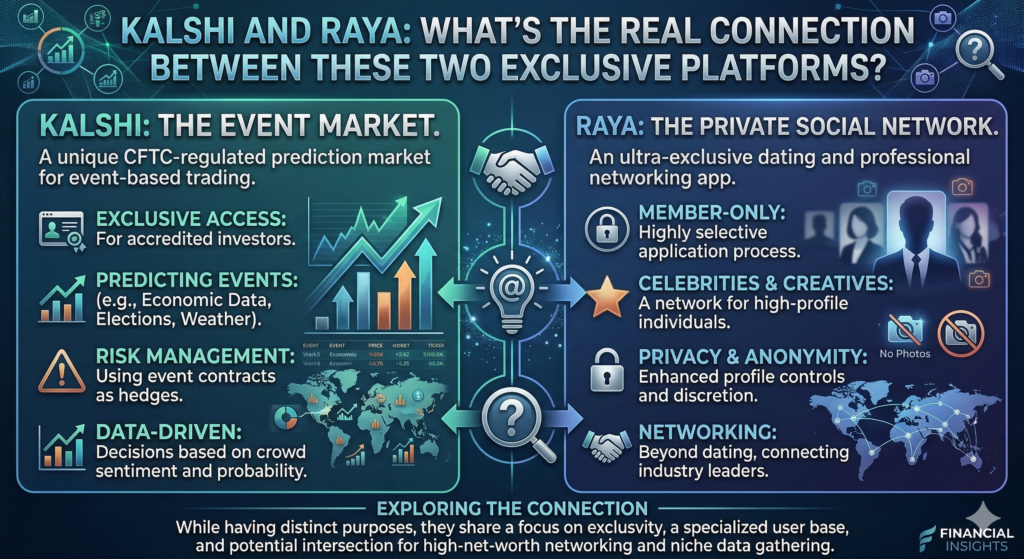
If you’ve been Googling “Kalshi and Raya” together, you’re probably wondering what a regulated prediction market has to do with a celebrity dating app. On the surface, they couldn’t seem more different. One is where you bet on NFL outcomes and interest rate decisions. The other is where Ben Affleck and Demi Lovato swipe right. And yet, these two platforms are connected — through one of the most compelling founder stories in tech right now.
In this article, we break down what Kalshi and Raya each are, why people are searching for them together, whether Kalshi is gambling or a legitimate financial platform, and what Kalshi sports markets actually look like. Whether you stumbled across this while researching Kalshi’s co-founder, or you’re genuinely curious about both apps, you’re in the right place.
What Is Kalshi? A Quick Primer on the $11 Billion Prediction Market
Kalshi is a federally regulated prediction market — the first of its kind in the United States. Founded in 2018 and approved by the Commodity Futures Trading Commission (CFTC) in 2020, it lets users trade event contracts: essentially yes-or-no bets on real-world outcomes like elections, economic indicators, and sports results.
Think of it less like a casino and more like a financial exchange — the kind of place where Wall Street traders, retail investors, and sports enthusiasts can all participate on equal footing. It’s regulated, it’s legal, and it’s growing at a staggering pace. In 2025 alone, Kalshi processed around $22.88 billion in trading volume, and the company is now valued at $11 billion following a $1 billion funding round in December of that year.
Is Kalshi legit? Absolutely. Being regulated by the CFTC — the same body that oversees the Chicago Mercantile Exchange — puts Kalshi in a very different category from offshore betting sites or crypto-based platforms. More on that below.
What Is Raya? The Celebrity Dating App Everyone Wants to Get Into
Raya is a private, membership-based social networking and dating app launched in 2015 by tech developer Daniel Gendelman. It’s iOS-only, invite-requiredinvite-only, and has earned the nickname “Illuminati Tinder” for its fierce exclusivity. Getting accepted to Raya has been compared to getting into an Ivy League school — the app reportedly has an acceptance rate of around 8%.
The Raya dating app has been linked to celebrities like Demi Lovato, Ben Affleck, John Mayer, Channing Tatum, and Lizzo, among many others. But it’s not purely for Hollywood stars. The app attracts creative professionals, entrepreneurs, influencers, and anyone in the upper tier of their industry — people who want to connect with equally accomplished individuals without the noise of mainstream dating apps.
Users create a photo slideshow set to music, link their Instagram, and are reviewed by an anonymous global committee before being accepted. Once in, you get a limited number of profiles per day to review — keeping things intentionally slow, curated, and exclusive.
So What’s the Connection Between Kalshi and Raya?
Here’s where it gets interesting. The link between Kalshi and Raya runs through Luana Lopes Lara — the 29-year-old Brazilian co-founder and COO of Kalshi who, in December 2025, was named by Forbes as the world’s youngest self-made female billionaire.
Luana is not a founder or investor in Raya. The connection is more social and cultural: as a young, high-profile female billionaire in the tech world with ties to elite circles in New York and beyond, she has sometimes been referenced in media profiles in connection with the kind of exclusive social world that Raya represents. She is, in many ways, exactly the profile of a person the Raya dating app was designed for — accomplished, creative-adjacent, financially successful, and operating in a rarefied social atmosphere.
Her story also resonates because it feels almost fictional: a Brazilian girl who endured brutal ballet training at the elite Bolshoi School in Brazil — where teachers reportedly held lit cigarettes under students’ thighs to test their form — before pivoting entirely, earning to earn degrees in computer science and mathematics at MIT, and then co-founding a billion-dollar financial exchange. It’s the kind of biography you’d expect from a Raya profile, not a CFTC filing.
Luana Lopes Lara: The Kalshi Co-Founder Who Bridges Two Worlds
From Ballet Floors to Wall Street
Luana grew up in Brazil, the daughter of a schoolteacher. She trained professionally as a ballerina at the Bolshoi Theater School affiliate in Brazil, later performing with the Salzburger Landestheater in Austria, before abandoning dance to pursue computer science at MIT. While there, she won a gold medal at the Brazilian Astronomy Olympiad and a bronze at the Santa Catarina Mathematics Olympiad — a combination of achievements that is, by any measure, extraordinary.
During her MIT summers, she interned at Ray Dalio’s Bridgewater Associates and Ken Griffin’s Citadel. It was during a shared internship at Five Rings Capital in New York in 2018 that she and Tarek Mansour — her eventual Kalshi co-founder — came up with the idea for a federally regulated prediction market on a walk home one evening. She now holds an estimated 12% stake in Kalshi, which at the company’s $11 billion valuation translates to a net worth of approximately $1.3 billion.
Why Her Story Keeps Coming Up Next to Raya
In a tech landscape dominated by older male founders, Luana’s profile is genuinely rare. She is young, female, an immigrant, a former professional athlete, and now a self-made billionaire. The social circles that come with that kind of success naturally overlap with the cultural world that Raya serves — creative industries, elite networking, and a premium on privacy and authenticity. So when people Google “Kalshi and Raya,” they’re often picking up on that cultural thread.
Is Kalshi Gambling? The Question Everyone Asks
This is one of the most searched questions about Kalshi — and the answer is nuanced.
Kalshi says no. Its contracts are classified as derivatives under the Commodity Exchange Act — the same legal framework that governs futures contracts at the Chicago Mercantile Exchange. Users are not wagering in the traditional gambling sense; they are trading event contracts, which can theoretically be used to hedge real-world financial risk.
State regulators disagree. In 2025, Massachusetts filed a lawsuit accusing Kalshi of operating unlicensed sports wagering, and a Superior Court judge issued a preliminary injunction in January 2026 barring Kalshi from offering sports markets to Massachusetts residents. Similar challenges have surfaced in Nevada and New Jersey, though Kalshi has prevailed in federal court in both states.
The bottom line: at the federal level, Kalshi is a licensed and regulated exchange. At the state level, the legal picture is still evolving. If you’re wondering “is Kalshi legit?” — yes, it is federally regulated. But depending on your state, access to certain markets (especially sports) may be restricted.
Kalshi Sports: The Engine Behind Kalshi’s Explosive Growth
Kalshi sports markets are, without question, the company’s biggest business driver right now. Sports contracts account for more than 90% of platform activity and approximately 89% of total fee revenue in 2025. The NFL season, in particular, drives enormous trading volume — with an estimated $3 to $5 billion bet ontraded on NFL games alone during the 2024-25 season.
What makes Kalshi sports different from a traditional sportsbook is how you participate. Instead of placing a standard money-line or point-spread bet, you buy a contract. For example: “Will the Kansas City Chiefs win the Super Bowl? Yes at 45 cents.” If they do, the contract pays out $1. If they don’t, you lose your 45-cent stake. The pricing reflects the market’s collective probability estimate, which shifts in real time as new information emerges.
Kalshi has also signed formal media partnerships with CNN and CNBC, with the goal of bringing real-time prediction market data into NFL broadcasts — similar to how traditional odds are already featured on sports networks. This mainstream push is a major part of Kalshi’s long-term strategy to become a household name in American sports media.
FAQ:
What is the connection between Kalshi and Raya?
Ans: Cultural, not corporate. Kalshi COO Luana Lopes Lara moves in elite social circles that Raya caters to. She has no role in Raya — the two platforms serve entirely different purposes.
Is Kalshi gambling?
Ans: Federally no — it’s CFTC-regulated as a designated contract market. Some states are challenging that classification in court, particularly around sports markets.
What is Raya and how is it different from regular dating apps?
Ans: Raya is an invite-only dating and networking app for celebrities and creative professionals. It requires referrals, has an ~8% acceptance rate, and is far more exclusive than mainstream apps like Tinder or Hinge.
Is Kalshi legit and safe to use?
Ans: Yes. It’s the first fully CFTC-regulated prediction market in the U.S. Funds are held in segregated accounts under the same legal framework as traditional futures markets.
Can anyone join Kalshi sports markets?
Ans: U.S. residents 18+ can use Kalshi, but sports market access varies by state. Massachusetts residents were blocked following a court injunction in January 2026.
Two Exclusive Worlds, One Fascinating Story
Kalshi and Raya exist in very different industries, but they share a common thread: they are both built on the idea that the best experiences come from being selective. Raya curates its community by reputation. Kalshi curates its credibility through regulation. And the person who connects them in the public imagination — Luana Lopes Lara — is a reminder that the most interesting people in tech don’t always come from where you’d expect.
Whether you’re here because you’re curious about Kalshi sports, wondering if Kalshi is gambling, or trying to figure out what Raya actually is — we hope this article gave you clear, honest answers. Both platforms are worth understanding as they grow in cultural and financial significance.
Want to stay updated on Kalshi, prediction markets, and the biggest names in fintech? Bookmark this page and subscribe to our newsletter for the latest insights delivered straight to your inbox.
Related Article
Kalshi IPO 2026: Valuation, Stock Price & Everything Investors Need to Know
Kalshi Lawsuit 2026: How One Startup Is Fighting 19 Legal Battles to Reshape American Betting
Kalshi Ayatollah Bet: What the Odds Are Really Telling You
3 thoughts on “Kalshi and Raya: What’s the Real Connection Between These Two Exclusive Platforms?”