
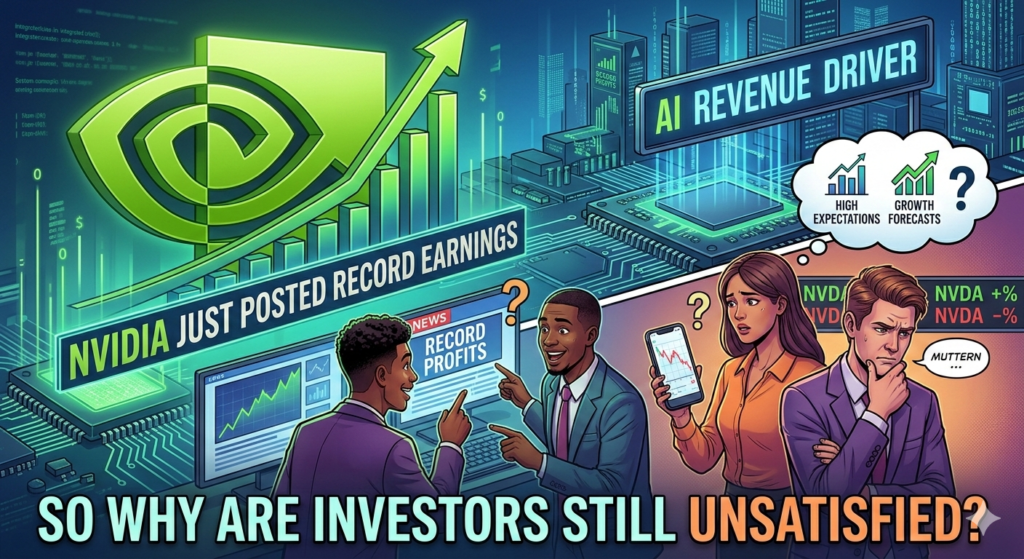
A Blockbuster Report — Followed by an Unexpected Market Reaction
For months, investors treated artificial intelligence as the unstoppable engine powering global markets. Then came Nvidia’s latest earnings report — and instead of celebration, Wall Street responded with hesitation.
The AI chip leader Nvidia delivered another powerful financial performance, reporting massive revenue growth fueled by demand for artificial intelligence infrastructure. Yet despite impressive numbers, markets reacted cautiously, revealing just how high expectations had climbed.
The result was a rare moment where strong success still felt like disappointment.
Why Nvidia’s Earnings Matter So Much
Nvidia has become one of the most closely watched companies in the world because its chips sit at the center of the AI revolution. From cloud computing giants to startups building generative AI tools, companies rely heavily on Nvidia’s graphics processing units (GPUs).
Over the past two years, the company’s explosive growth has helped drive gains across major stock indexes, turning AI into the dominant investment theme.
Because of this influence, Nvidia’s earnings are no longer just about one company — they often shape broader market sentiment.
Strong Revenue Growth Driven by AI Demand
In its latest quarterly results, Nvidia reported revenue that surged compared with the same period last year, continuing a streak of extraordinary growth powered by data center and AI-related sales.
Technology companies worldwide are racing to build AI systems, creating intense demand for high-performance chips. Nvidia’s hardware remains the industry standard for training large AI models, allowing the company to command premium pricing.
Data center revenue once again led the company’s performance, highlighting how enterprise and cloud customers are investing heavily in artificial intelligence infrastructure.
Executives emphasized that AI adoption is still in its early stages, suggesting long-term demand could remain strong.
The Problem: Expectations Were Even Bigger
Despite the impressive results, investors had already priced in near-perfect performance.
Over the past year, Nvidia’s stock surged dramatically as markets anticipated continued explosive growth. By the time earnings arrived, expectations had reached extraordinary levels.
Even though the company exceeded many forecasts, some investors hoped for stronger forward guidance — particularly regarding future revenue growth and supply expansion.
In modern markets, perception often matters as much as performance. When expectations rise too high, even excellent results can trigger cautious reactions.
Market Futures Slip After the Announcement
Following the earnings release, U.S. stock futures weakened, reflecting investor uncertainty.
Contracts tied to the Dow Jones Industrial Average, S&P 500, and Nasdaq Composite all showed softer momentum as traders reassessed the outlook for technology stocks.
Because Nvidia plays such a large role in tech-heavy indexes, its performance often influences broader market direction. A cautious reaction to its earnings therefore sent ripple effects across the entire market.
Investors appeared to shift from excitement toward evaluation — asking whether AI growth can continue at the same pace.
Guidance Becomes the Real Focus
While headline numbers grabbed attention, analysts focused closely on forward guidance — the company’s expectations for upcoming quarters.
Management projected continued growth but signaled a more measured pace compared with earlier explosive expansions. This shift did not indicate weakness but rather a potential normalization after an extraordinary surge.
For investors accustomed to rapid acceleration, even slight moderation raised questions about whether peak AI growth could eventually slow.
Market reactions often hinge less on what companies achieved and more on what they promise next.
CEO Jensen Huang’s Vision for the AI Future
During the earnings discussion, CEO Jensen Huang reinforced Nvidia’s long-term confidence in artificial intelligence.
He described AI as a foundational technological shift comparable to the internet or mobile computing revolutions. According to Huang, industries ranging from healthcare and finance to manufacturing are only beginning to integrate AI into daily operations.
The company continues investing heavily in new chip architectures and software platforms designed to expand AI capabilities beyond data centers into robotics, autonomous systems, and enterprise tools.
This broader vision remains a key reason many analysts remain optimistic despite short-term market reactions.
Why Investors Are Becoming More Careful
The cautious response to Nvidia’s earnings highlights a growing shift in investor psychology.
During early stages of technological booms, markets often reward growth at almost any cost. Over time, however, investors begin asking tougher questions:
- Can demand remain this strong?
- Are companies overspending on AI infrastructure?
- How sustainable are profit margins long term?
Some analysts believe markets are entering a phase where valuation matters more than hype.
Nvidia’s extraordinary success has set a very high benchmark — one that becomes increasingly difficult to exceed each quarter.
The Bigger AI Investment Debate
Nvidia’s results also sparked wider debate about the broader AI economy.
Technology giants have committed billions of dollars toward AI development, creating one of the largest investment cycles in modern tech history. While this spending drives demand for chips today, investors are watching closely to see when those investments translate into consistent profits for customers.
If companies slow spending, chip demand could eventually stabilize — a scenario markets are trying to anticipate early.
However, many experts argue AI adoption is still accelerating, meaning long-term growth opportunities remain significant.
Analysts Remain Divided
Market analysts offered mixed reactions following the earnings release.
Some described the results as another confirmation that AI demand remains incredibly strong. Others suggested that expectations had become unrealistic, making short-term volatility inevitable.
Several analysts emphasized that Nvidia’s growth rates, while still remarkable, may gradually normalize as the industry matures.
This divergence of opinion reflects a market transitioning from excitement to deeper analysis.
What This Means for Everyday Investors
For retail investors, the reaction to Nvidia’s earnings offers an important lesson about modern markets.
Stock prices often move based on expectations rather than raw performance. A company can deliver record-breaking results and still see cautious trading if investors were hoping for even more.
This dynamic is especially common in fast-growing sectors like artificial intelligence, where optimism can push valuations higher long before future earnings materialize.
Understanding this gap between expectations and reality helps explain why markets sometimes behave unpredictably after major announcements.
AI Momentum Remains Strong — But Not Unlimited
Despite the market’s muted reaction, few analysts believe the AI boom is ending.
Demand for computing power continues to expand as businesses integrate automation, machine learning, and generative AI into everyday workflows.
Nvidia remains uniquely positioned at the center of this transformation thanks to its technological leadership and strong ecosystem of developers and enterprise partners.
However, the latest earnings reaction suggests investors are shifting from blind enthusiasm toward long-term sustainability.
A Turning Point for the Tech Market?
Some market watchers view this moment as a potential turning point.
Rather than rewarding companies solely for growth narratives, investors may begin prioritizing profitability, scalability, and realistic forecasts.
If this trend continues, future earnings seasons could bring more volatility — especially for companies tied closely to emerging technologies.
Nvidia’s report may therefore mark not a slowdown in AI, but a maturation of how markets evaluate it.
Conclusion: Success Isn’t Always Enough for Wall Street
Nvidia delivered another extraordinary quarter, proving that artificial intelligence remains one of the most powerful forces reshaping the global economy. Revenue surged, demand stayed strong, and long-term prospects remain promising.
Yet the market’s cautious reaction reveals a deeper truth about investing: expectations can rise faster than reality.
As AI transitions from hype to long-term industry transformation, investors are becoming more selective, focusing on sustainability rather than momentum alone.
For Nvidia, the challenge ahead is no longer proving that AI demand exists — it is proving that historic growth can continue consistently in an increasingly demanding market.
One thing is certain: the AI revolution is far from over, but Wall Street is now watching more carefully than ever.
For More Read
Galaxy S26 Ultra Launch Shock: Samsung Introduces Features No One Expected
What Happened Inside Mary Cosby’s Home? Shocking Details Emerge After Son’s Death
2 thoughts on “Nvidia Just Posted Record Earnings — So Why Are Investors Still Unsatisfied?”