
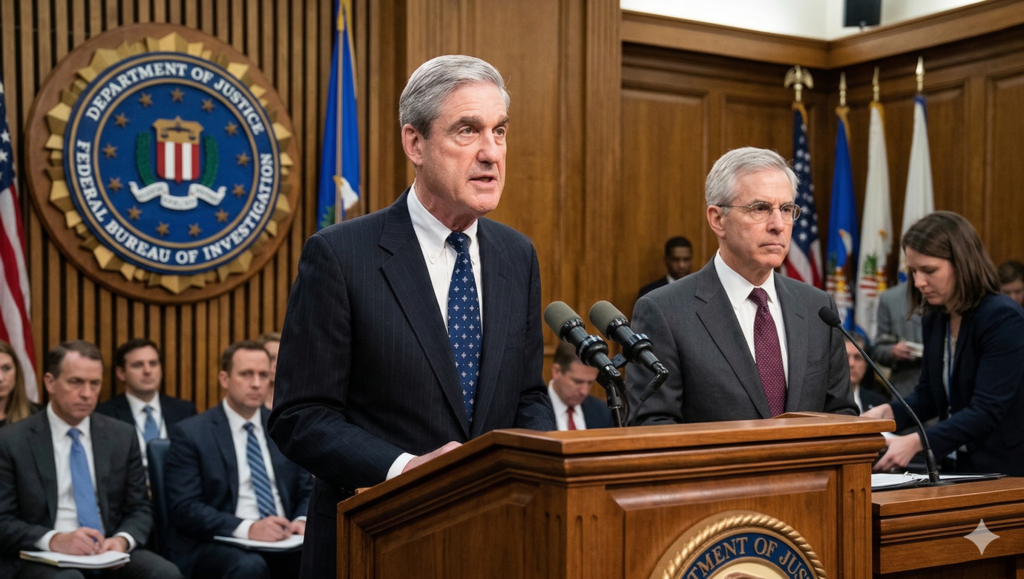
If you have been searching for answers about what happened to the former FBI director and special counsel Robert Mueller, you have come to the right place. This article provides everything you need to know — verified, clearly explained, and fully up to date.
Robert Mueller passed away on the evening of Friday, March 20, 2026, at the age of 81. His family released a statement confirming the news, expressing that they were sharing the loss of Bob with deep sadness and kindly requesting privacy during their time of grief. Within hours of the announcement, tributes began pouring in from former presidents, senior lawmakers, and law enforcement leaders alike — while a deeply controversial statement from President Donald Trump stirred fresh political debate.
This article covers Mueller’s final years, his health challenges, his remarkable legacy in public service, his family, and the wide range of reactions that followed his passing.
Is Robert Mueller Still Alive?
Robert Mueller is no longer alive. Robert Swan Mueller III died on March 20, 2026, at the age of 81. His family officially confirmed his passing through a public statement released on Saturday, March 21, 2026.
Mueller spent his final years in Charlottesville, Virginia, where he lived quietly with his family away from the public eye. His death brings to a close a life that was almost entirely dedicated to serving the United States — through military duty, federal law enforcement, and one of the most closely watched legal investigations in the nation’s history.
Robert Mueller’s Health: What Caused His Death?
For those asking how Robert Mueller died, no official cause of death was publicly disclosed. However, it is widely understood that his long struggle with Parkinson’s disease played a significant role in his declining health over several years.
According to reporting from major news outlets, Mueller had been diagnosed with Parkinson’s disease in 2021. The condition is a chronic and progressive neurological disorder that gradually impairs movement, balance, and coordination, and becomes increasingly debilitating over time.
By late 2025, his condition had worsened significantly. The House Oversight Committee withdrew a subpoena that had been issued for Mueller to testify before Congress after being informed that his deteriorating health made it impossible for him to appear.
Even as his body grew weaker, Mueller retained the quiet dignity that had defined his entire career. His final years were spent away from the media spotlight — a deliberate and purposeful choice that stood in stark contrast to the political storm that followed news of his death.
Where Was Robert Mueller Living in His Final Years?
After completing his work as special counsel and submitting the Mueller Report to Attorney General William Barr in March 2019, Mueller largely stepped back from public life.
He rejoined the Washington, D.C.-based law firm WilmerHale as a partner and took part in select academic engagements. In 2021, he taught a six-session course at the University of Virginia School of Law titled “The Mueller Report and the Role of the Special Counsel,” offering students a rare firsthand perspective on the investigation.
He also contributed the foreword to a book examining his investigation, titled Interference: The Inside Story of Trump, Russia, and the Mueller Investigation. Publisher Simon & Schuster announced the book in July 2024, with its official release following in September of that same year.
During these final years, Mueller resided in Charlottesville, Virginia, managing his Parkinson’s diagnosis as privately as possible while remaining close to his family.
Robert Mueller’s Legacy
Understanding the full significance of Robert Mueller’s death requires looking beyond the investigation that brought his name into every American household.
Mueller was born in New York City and raised in the suburbs of Philadelphia, Pennsylvania. He went on to graduate from Princeton University before enlisting as a U.S. Marine Corps officer. He served for three years during the Vietnam War, commanding a rifle platoon in active combat. For his service, he received the Bronze Star Medal, the Purple Heart, and two Navy Commendation Medals — a distinguished record that spoke to his courage and commitment long before he entered the legal profession.
After earning a law degree from the University of Virginia, he built a steady and respected career at the Department of Justice, working his way up through various senior roles before President George W. Bush nominated him as FBI Director in July 2001. Mueller was confirmed and sworn in just one week before the September 11 terrorist attacks transformed the United States overnight.
In the chaotic aftermath of those attacks, Mueller led the FBI through one of the most dramatic institutional overhauls in its history, reorienting the bureau from a crime-focused agency to a counterterrorism and national security organization. He served as director for a full 12 years — making him the longest-serving FBI director since J. Edgar Hoover — and worked under both a Republican and a Democratic president, which reflected the rare bipartisan trust he commanded throughout his career.
In May 2017, Deputy Attorney General Rod Rosenstein appointed Mueller as special counsel to investigate Russian interference in the 2016 presidential election, following President Trump’s dismissal of FBI Director James Comey. The investigation ran for approximately two years and resulted in 37 indictments and seven guilty pleas or convictions. The final report concluded that while Russian interference in the election was real and systematic, there was insufficient evidence to establish that the Trump campaign had coordinated directly with Russia. The report also declined to reach a definitive conclusion on whether Trump had obstructed justice, leaving that determination to the Attorney General.
Mueller is survived by his wife of nearly six decades, Ann Cabell Standish, their two daughters, and three grandchildren.
Trump’s Reaction to Robert Mueller’s Death
Of all the responses that followed the news of Mueller’s death, none generated more immediate controversy than that of President Donald Trump.
Shortly after the announcement became public, Trump posted a message on his Truth Social platform stating that Mueller had just died and expressing that he was glad, claiming that Mueller could no longer harm innocent people. The post was blunt, hostile, and unprecedented in its tone toward a recently deceased public figure.
The reaction was swift and severe. Senator Adam Schiff publicly condemned the statement, arguing that it demonstrated a fundamental lack of decency and fitness for the office of the presidency. Numerous Democratic lawmakers echoed similar sentiments across social media platforms throughout the day.
Trump’s animosity toward Mueller was well-documented and had persisted for years. Throughout the duration of the special counsel investigation, Trump had repeatedly and publicly labeled it a witch hunt, a scam, and a hoax. Even after the investigation concluded in 2019, the friction continued. In March 2025, Trump signed an executive order aimed at cutting all ties between federal agencies and WilmerHale, the law firm at which Mueller had served as a partner. A federal judge later struck down that order, ruling it unconstitutional.
By contrast, both former President Barack Obama and former President George W. Bush paid warm and respectful tribute to Mueller. Obama described Mueller as one of the finest directors the FBI had ever known and credited him with transforming the agency following the September 11 attacks. George W. Bush and former First Lady Laura Bush expressed deep sadness and honored Mueller’s decades of service to the American people.
How the Nation and Washington Responded to Mueller’s Passing
Across Washington and the broader legal and law enforcement communities, the response to Mueller’s death was one of genuine mourning and deep respect.
Former FBI Director Christopher Wray offered a heartfelt tribute, describing Mueller as someone who embodied the principle of placing the nation’s interests above his own and who always prioritized the mission over personal recognition.
WilmerHale, the law firm where Mueller had worked before and after the special counsel investigation, issued a statement honoring him as an extraordinary leader, a person of exceptional integrity, and a public servant of the highest caliber. The firm expressed pride in having counted him as a partner.
Senator Mark Warner expressed that he joined many Americans in mourning the loss of a man who had spent his life in service to the country, always guided by a commitment to the rule of law.
Even political figures who had disagreed with the conclusions or conduct of Mueller’s investigation largely chose to acknowledge the breadth and sincerity of his dedication to public service. The bipartisan outpouring of respect reflected the rare kind of credibility Mueller had built over the course of an entire career.
FAQ:
Did Robert Mueller die?
Yes, Robert Mueller passed away on March 20, 2026, at the age of 81. His family publicly confirmed his death the following morning.
How did Robert Mueller die?
An official cause of death was not publicly released. However, Mueller had been living with Parkinson’s disease since his diagnosis in 2021, and the progressive condition is believed to have significantly affected his health in his final years.
What did Trump say when Robert Mueller died?
President Trump posted on Truth Social expressing that he was glad Mueller had died and claiming that Mueller could no longer harm innocent people. The statement drew widespread condemnation from Democratic lawmakers and broad criticism across the political spectrum.
Where did Robert Mueller die?
Robert Mueller died in Charlottesville, Virginia, where he had been living in his later years.
Who are Robert Mueller’s surviving family members?
Mueller is survived by his wife, Ann Cabell Standish, to whom he was married for nearly 60 years, as well as their two daughters and three grandchildren.
Remembering a Public Servant of Rare Distinction
By virtually any standard of measurement, Robert Mueller stands as one of the most consequential public servants the United States has produced in the past century. From a young Marine officer leading men into combat in Vietnam to the director who rebuilt the FBI in the wreckage of September 11, and ultimately to the special counsel who steered one of the most politically charged investigations in American history — Mueller met each role with the same unwavering sense of duty.
His death on March 20, 2026, marks the end of a singular chapter in American public life. Yet the questions his work raised, the institutions he helped shape, and the standard of integrity he modeled will continue to resonate for generations.
If this article has answered your questions about Robert Mueller’s passing, consider sharing it with others who may be looking for accurate and clearly written information. For continued coverage of major political developments and profiles of public figures, browse our related articles below.
For More Information
Related Article
Buffy the Vampire Slayer’s Nicholas Brendon Dead at 54 — Remembering Xander Harris
Why Did Chuck Norris Die in 2026? Cause of Death, Age & Legacy Explained
Taylor Frankie Paul Video TMZ: What the Footage Shows and Why ABC Cancelled The Bachelorette
NCAA Women’s Basketball Tournament 2026 — Everything You Need to Know
4 thoughts on “Did Robert Mueller Die? The Full Story Behind His Death at 81”