


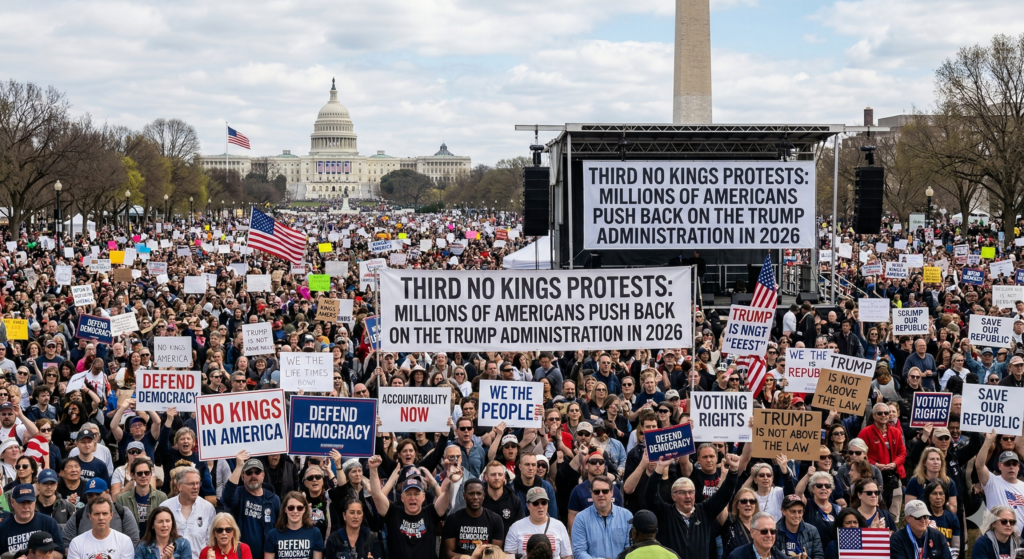
The “No Kings” movement was founded by Indivisible, a progressive grassroots organization that came together during the early months of President Donald Trump’s second term. The name is a direct nod to one of America’s oldest and most defining values: the idea that this nation was deliberately built to reject monarchy, tyranny, and the concentration of power in a single individual.
The slogan is short and to the point: “In America, we have no kings.”
What began as a single organized day of civic protest has since blossomed into one of the most sustained, broad-based demonstrations of public dissent in recent memory. Crucially, it does not have a single political figure at its helm. No one party, senator, or celebrity is steering this movement. It is driven instead by local organizers, neighborhood coalitions, and citizens who feel something has gone seriously wrong — and who believe silence is no longer an option.
A Quick Look at the No Kings Timeline
First No Kings Day — June 14, 2025: Timed deliberately to fall on Trump’s 79th birthday and overlap with a military parade he had requested in Washington, D.C., the debut protest drew somewhere between four and six million participants at roughly 2,100 locations across the country.
Second No Kings Day — October 18, 2025: This round was ignited by a combination of factors — a federal government shutdown, increasingly aggressive immigration enforcement, and the controversial deployment of National Guard troops to major American cities. Turnout swelled to an estimated seven million people across more than 2,700 events, with independent crowd analysts placing the figure between five and six and a half million.
Third No Kings Day — March 28, 2026: With over 3,200 events registered nationwide, organizers are billing this as the movement’s most powerful day yet — and potentially the most significant single-day nonviolent protest in U.S. history.
Why Are So Many Americans Protesting the Trump Administration?
The short answer is that there is no single reason — and that is actually part of what makes this movement so significant. People are showing up for different reasons, from different backgrounds, and from different parts of the country. Here are the main issues driving the public reaction to Trump policies in 2026.
The War in Iran
On February 28, 2026, the Trump administration launched a military offensive against Iran in coordination with Israel. Critics — including legal scholars, former military officials, and members of both parties — have questioned whether the action had a proper legal foundation or a coherent long-term strategy.
The ripple effects have been immediate and felt at the pump. Gas prices have climbed sharply, adding pressure to an economy that many middle-class families were already finding difficult to navigate. For those who supported Trump partly because of his “no more forever wars” rhetoric, the Iran conflict has landed as a painful contradiction.
Naveed Shah, a spokesperson for Common Defense — a veterans’ advocacy group aligned with the No Kings coalition — put it plainly: the administration has pulled the country deeper into armed conflict even as communities at home are dealing with their own crisis of safety and government force.
Immigration Crackdowns and the Toll on Communities
The administration’s immigration enforcement push, most visibly through an operation known as “Operation Metro Surge” in Minnesota, triggered some of the most disturbing scenes of the year. Federal agents deployed pepper balls and tear gas in confrontations with residents in the Twin Cities area. Two civilians — Renee Good and Alex Pretti — lost their lives during federal law enforcement actions in January 2026.
That grief has not gone away. Minnesota has become one of the emotional centers of Saturday’s protests, and the St. Paul rally is drawing heavy hitters: Senator Bernie Sanders, Jane Fonda, Joan Baez, and a live performance from Bruce Springsteen.
The Pinch of Everyday Costs
Beyond the headline policy debates, there is something far more immediate driving people out of their homes and into the streets: the cost of living. Grocery bills have not come down. Gas prices are rising again. Wages are not keeping pace. For many working families, the frustration is less ideological and more visceral — they are simply running out of room in their budgets.
Randi Weingarten, president of the American Federation of Teachers, captured this feeling well, noting that families are genuinely afraid and struggling to cover even the most basic household expenses.
Concerns About Democratic Institutions
Beyond specific policies, a broader and perhaps deeper worry is motivating a significant portion of protesters: the belief that American democracy itself is under stress. Critics of the Trump administration point to an unusually heavy use of executive authority to bypass congressional debate, the targeting of political opponents through legal mechanisms, and what they describe as a systematic effort to narrow the space for free expression and free voting.
The Real Story: Protests Are No Longer Just a Big-City Phenomenon
Two-thirds of the people registered for Saturday’s No Kings events do not live in major metropolitan areas. That share has grown by nearly 40 percent since the first protest back in June 2025. Events are taking place not just in predictable urban strongholds like New York and San Francisco, but in small towns, farming communities, and traditionally Republican-leaning suburbs from coast to coast.
Leah Greenberg, co-executive director and co-founder of Indivisible, has been clear that this geographic expansion is the defining story of the third mobilization. The pushback against the current administration, she argues, is no longer limited to liberal cities — it is moving into corners of the country where dissent has historically been rare and politically costly.
This matters enormously when viewed through the lens of the upcoming November 2026 midterms. With Trump’s approval rating sitting around 40 percent, and control of both the House and Senate potentially in play, the energy in rural and suburban communities could translate directly into ballot-box consequences.
Key Cities and Locations to Follow on Protest Day
Thousands of events are scattered across the country, but a handful of locations are expected to attract especially large and high-profile gatherings:
Washington, D.C. — Protests near the nation’s symbolic landmarks carry particular weight, and the capital is expected to draw a substantial and spirited crowd.
New York City — Multiple boroughs are hosting events, with the largest rally anchored in Manhattan, where turnout in the tens of thousands is anticipated.
Los Angeles — The city has remained a consistent focal point for political protests since the National Guard was deployed to California in 2025.
Minneapolis-St. Paul, Minnesota — Given the events of earlier this year, the Twin Cities rally carries a charge unlike anywhere else. Celebrity speakers and live music are expected to draw one of the day’s most memorable gatherings.
Columbus, Ohio — Columbus is emblematic of the movement’s push into Midwestern, purple-state territory — a sign that this is no longer a coastal story.
Are These Protests Actually Changing Anything?
On a concrete level, protest pressure and public scrutiny following the Minnesota confrontations contributed to a pullback in some federal enforcement operations in the state. Deirdre Schifeling, the ACLU’s chief political and advocacy officer, has pointed to this as evidence that sustained, visible civic action produces real results — even when change comes slowly.
On the other side, critics argue that street demonstrations rarely produce direct policy shifts in the short term. Some Republican leaders have characterized the No Kings gatherings as anti-American spectacles, and conservative commentators have highlighted isolated moments of inflammatory rhetoric — though independent reporting consistently describes the events as overwhelmingly peaceful.
What history does tell us is that large-scale protest movements shape elections, especially midterm ones. When voter anger is this visible and this widespread, parties and candidates take notice. With November approaching, the political establishment on both sides is paying close attention.
FAQ:
Q: What does the phrase “No Kings” actually mean? It is a reference to one of America’s founding convictions — that the country broke from Britain specifically to escape the rule of a monarch, and that no single individual should ever hold unchecked authority over its people. Protesters apply this principle to what they see as the current administration’s overreach.
Q: Is this movement connected to the Democratic Party? Not officially. The No Kings movement describes itself as nonpartisan and grassroots in nature. Notably, organizers have pointed out that a growing share of participants includes former Trump supporters and residents of Republican-leaning areas who believe the administration has not delivered on its promises.
Q: Have the protests been peaceful? By and large, yes. The vast majority of events at both prior No Kings days took place without incident. There were some tense confrontations with law enforcement during the October 2025 protests in Los Angeles, but these were not representative of the broader movement.
Q: What specific changes are protesters demanding? Protesters are raising a range of concerns: ending the military campaign in Iran, halting what they consider abusive immigration enforcement practices, protecting civil liberties and voting rights, and holding the administration accountable for its conduct. There is no single legislative demand — the coalition is bound together more by what it opposes than by a shared policy platform.
Q: How do I find a protest event in my area? The official No Kings website at nokings.org lists all registered events by location, including options that are ADA-accessible and family-friendly, across all 50 states.
A Movement With Momentum — and a Message
The third No Kings day of action is not a repeat performance. It is something larger — a movement that has grown with each gathering, reached deeper into the country’s geography, and drawn in people who never imagined they would be standing on a street corner with a handmade sign.
What is clear is that a substantial and growing portion of the American public feels strongly that the country has drifted off course, and that waiting silently for elections to fix things no longer feels like enough.
The midterms are now just months away. The country is watching — and, in thousands of towns and cities today, the country is also marching.
For More Information

Related Article
CDC Tracks COVID-19 Cicada Variant BA.3.2 in 25 States — What U.S. Health Officials Are Saying
Iowa State Basketball 2026: Sweet 16 Loss to Tennessee Ends a Season Worth Celebrating
Tiger Woods Accident 2026: Everything You Need to Know About the Florida DUI Arrest