


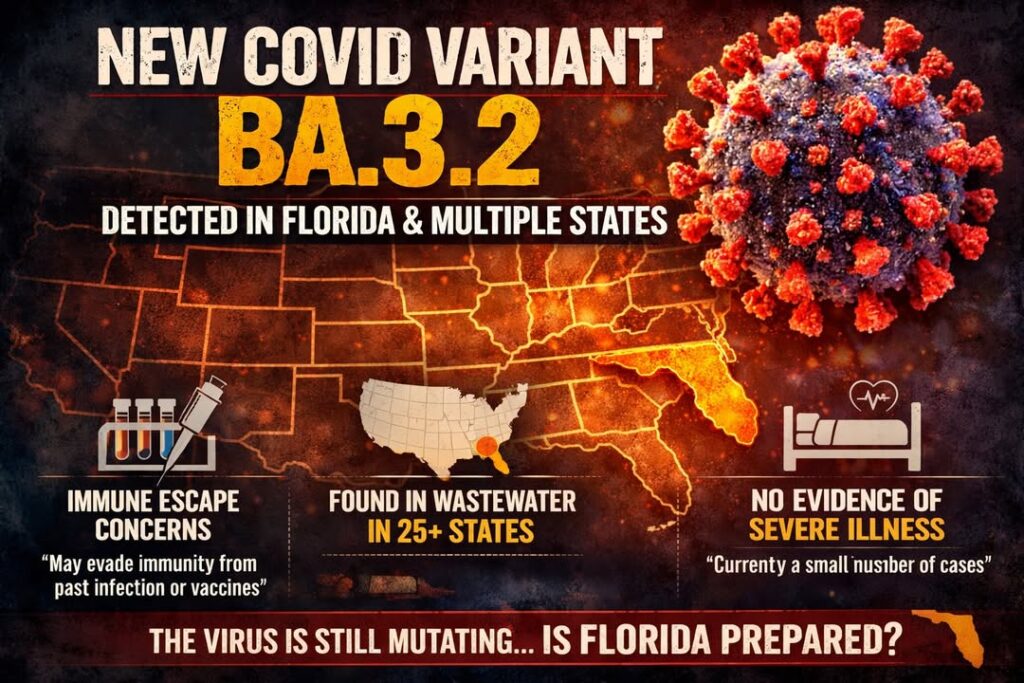
A strain called BA.3.2, widely nicknamed the COVID-19 Cicada variant, has been drawing serious attention from health officials in the United States and around the world. Like its namesake insect — the periodical cicada that disappears underground for years before erupting back to the surface in huge numbers — this highly mutated strain went largely unnoticed for a long time before suddenly appearing on surveillance radars in early 2026.
By March 2026, the Cicada variant had been detected in wastewater samples from at least 25 states and confirmed in more than 20 countries. That’s a lot of ground to cover quickly.
So what does this actually mean for you, your family, and your day-to-day life? Should you change anything about how you’re living right now? In this article, we’ll walk you through what we know, what experts are saying, and what practical steps you can take — without the fear-mongering that often comes with these kinds of news cycles.
What Exactly Is the COVID-19 Cicada Variant (BA.3.2)?

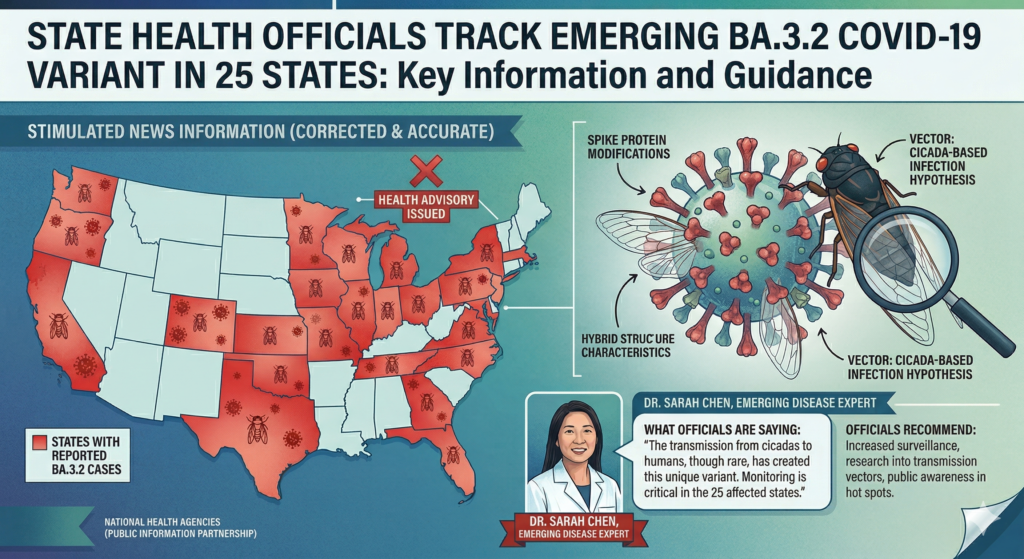
The Cicada variant is a strain of SARS-CoV-2, which is the virus responsible for COVID-19. Its official scientific designation is BA.3.2, and it belongs to the Omicron lineage — specifically descending from BA.3, a subvariant that briefly appeared in early 2022 alongside the better-known BA.1 and BA.2 strains before quietly fading away.
Fast-forward two years and dozens of additional mutations, and BA.3.2 has made its return. It was first identified by researchers in South Africa in November 2024, then began a slow and steady march across continents throughout 2025, eventually gaining enough traction to catch the attention of major health agencies worldwide.
The “Cicada” nickname was coined by T. Ryan Gregory, a professor of evolutionary biology at the University of Guelph in Canada. The comparison is fitting: just as a periodical cicada spends years underground before an unexpected mass emergence, BA.3.2 spent a long time below the radar before health officials started seeing meaningful upticks in case data.
Why Is BA.3.2 Drawing So Much Attention?
The short answer is: the number of mutations it carries.
The Cicada variant contains roughly 70 to 75 changes in its spike protein — the part of the virus that attaches to human cells during infection. That level of genetic divergence makes it notably different from the strains that our current vaccines were built to fight.
Dr. Andrew Pekosz, a virologist at the Johns Hopkins Bloomberg School of Public Health, has pointed out that these mutations may allow the variant to sidestep a significant portion of the immune protection built up by vaccination or prior infection. That’s an important point — but it’s not the whole story, as we’ll explain shortly.
How Widespread Is the Cicada COVID Variant Across the USA?
What the Data Is Showing Right Now
In mid-March 2026, the CDC confirmed that the Cicada outbreak in the USA was being tracked at 132 wastewater surveillance sites spread across at least 25 states. The variant has also appeared in voluntary nasal swab samples collected from international travelers passing through U.S. airports — a sign that it’s traveling across borders with relative ease.
Here’s some perspective, though: BA.3.2 has not overtaken the strains currently driving most U.S. COVID cases. As of mid-March 2026, variant XFG — nicknamed “Stratus” — still led the pack at 53% of all samples. The LF.7 subvariant, called “Nimbus,” came in second at 10.3%. The Cicada variant accounted for just 3.7% of wastewater samples analyzed nationally.That number is worth watching, but it does not indicate a crisis — at least not yet.
Which Regions Are Being Most Closely Watched?
The CDC has not yet published a state-by-state breakdown of confirmed Cicada detections. However, Michigan has publicly acknowledged that its health officials are actively tracking the variant. Wastewater signals have also been picked up across states along the East Coast and throughout the Midwest — regions that public health teams are monitoring with particular care.
Local health departments in these areas are taking the east coast and midwest Cicada emergence health warning signals seriously, even as federal authorities continue to urge measured calm rather than widespread concern.
How Does the U.S. Fit Into the Global Picture?
Globally, BA.3.2 has been confirmed in at least 23 countries. In parts of Europe — including Germany, Denmark, and the Netherlands — the variant already makes up roughly 30% of all COVID-19 genetic sequences submitted for analysis. The World Health Organization formally designated it as a “variant under monitoring” in February 2026, meaning it has cleared the bar for international scientific attention, even if it hasn’t been classified as a “variant of concern” just yet.
Cicada Variant Symptoms
Common Symptoms Associated with BA.3.2
Here’s something genuinely reassuring: the symptoms of the Cicada COVID variant closely mirror those of other strains currently in circulation. According to CDC guidance, COVID-19 symptoms in 2026 typically include:
- Fever or chills
- Persistent cough
- Fatigue or unusual tiredness
- Sore throat — notably, a severe sore throat is being flagged as a particularly common complaint with BA.3.2
- Runny or congested nose
- Headache
- Muscle or body aches
- Shortness of breath, in more serious cases
For most healthy adults, these symptoms resolve on their own within a week or so with rest and basic supportive care. There is currently no solid evidence indicating that the Cicada variant produces more serious illness than other circulating strains.
Who Faces the Greatest Risk?
As with all COVID-19 variants, certain groups deserve extra caution. Neil Maniar, who directs the master of public health program at Northeastern University, has noted that even if BA.3.2 doesn’t appear more severe on average, it could still create added pressure on vulnerable populations if it spreads broadly. Older adults, people who are immunocompromised, and those managing chronic health conditions remain the groups most deserving of focused protection.
Are Current COVID Vaccines Still Effective Against the Cicada Variant?
This is probably the question on most people’s minds — and the honest answer is that it depends on what kind of “effective” you mean.
The 2025–2026 COVID-19 vaccines were formulated around the JN.1 lineage of Omicron. BA.3.2 has diverged so significantly from JN.1 — through those 70-plus spike protein mutations — that the current shots were not specifically designed with this strain in mind.
Laboratory studies have found that existing vaccines are less effective at blocking infection from BA.3.2 compared to strains they were tailored for. However, and this point is critical: vaccines are still expected to provide meaningful protection against severe disease, hospitalization, and death. That protective effect against the worst outcomes remains largely intact, even when a variant can partially bypass the antibodies targeting infection in the first place.
Dr. Robert H. Hopkins Jr., medical director at the National Foundation for Infectious Diseases, acknowledged that the sheer number of mutations makes it “less likely” that current vaccines will perform at their best against the Cicada variant — while also emphasizing that more real-world data is still needed before drawing firm conclusions.
What Are U.S. Health Officials Actually Doing About This?
How the CDC and WHO Are Responding
The US health officials’ response to the Cicada virus has been best described as alert but measured. The CDC’s March 19, 2026 report officially formalized its tracking of BA.3.2, framing surveillance as a way to assess how capable the variant is of getting around existing immune defenses — whether from vaccination or a prior infection.
The WHO classified BA.3.2 as a “variant under monitoring” in December 2025 and reinforced that designation in February 2026. As of now, neither the CDC nor the WHO has raised it to the status of a “variant of concern” — the highest tier of alert — which is a meaningful distinction worth understanding.
Could There Be a Summer Surge?
Several experts have raised this as a real possibility, particularly given the variant’s immune-evasion potential and the gradual decline in population-level vaccine uptake compared to earlier pandemic years.
Dr. Hopkins has stated it’s plausible that the Cicada variant could fuel a summer wave in the U.S. On the other hand, Dr. Pekosz offered a more tempered view, noting that if BA.3.2 had a truly dominant competitive advantage, it likely would have surged globally much faster than it has. “We didn’t see that,” he said, “but it’s not going away, so it’s something to keep an eye on.”
That tension between possibility and probability is where most experts currently sit: cautious, watchful, but not sounding alarms just yet.
Practical Steps to Help Keep Yourself and Your Family Safe
No matter which variant is trending at any given moment, the fundamentals of protection don’t change much. Here’s what public health experts recommend right now:
If you’re generally healthy and vaccinated:
- Stay current with your COVID-19 vaccines and any recommended booster doses
- Practice good hand hygiene and respiratory etiquette consistently
- Stay home and rest if you’re feeling unwell — pushing through symptoms helps no one
- Improve indoor ventilation where you can, especially in shared spaces
If you’re in a higher-risk category:
- Have a direct conversation with your healthcare provider about your personal risk profile
- Consider wearing a well-fitted N95 or KN95 mask in crowded or poorly ventilated indoor settings
- Test early if you develop symptoms — prompt action matters most for high-risk individuals
- If you test positive, ask your doctor about antiviral treatments right away — experts have confirmed that existing COVID antivirals, such as Paxlovid, remain effective against BA.3.2
Steps that apply to everyone:
- Check the CDC’s variant tracker regularly so you’re working from current information
- Avoid spending time around others when you have active respiratory symptoms
- Keep at-home COVID tests stocked so you’re not scrambling if symptoms appear
Dr. Maniar put it well when he said, “At this point, COVID is something that’s part of our day-to-day lives, similar to the flu and other respiratory illnesses.” The key, he added, is continuing to focus protection efforts on those who need it most.
FAQ:
Q: Is the Cicada COVID variant more dangerous than earlier strains?
A: Based on available evidence, no. BA.3.2 does not appear to cause more severe illness than the variants currently circulating in the U.S. Countries where it has already spread more widely have not reported a significant spike in hospitalizations linked to it. It may be more adept at evading immune responses, but its clinical profile looks similar to what we’ve seen from recent Omicron-descended strains.
Q: Where in the U.S. has the Cicada variant been detected?
A: Wastewater surveillance has picked up signs of BA.3.2 at 132 monitoring sites across at least 25 states. Michigan is one of the states that has officially confirmed active monitoring. The East Coast and Midwest have received particular attention from public health teams, though the CDC has not yet released a detailed state-level breakdown.
Q: Do I need a new COVID vaccine specifically for the Cicada variant?
A: Not at this time. Current vaccines offer reduced protection against infection from BA.3.2, but they continue to provide important protection against serious illness and hospitalization. Health officials are watching closely and may recommend a reformulated booster if the variant becomes the dominant strain in the U.S. For now, keeping up with your existing vaccination schedule is the right move.
Q: How is the Cicada COVID variant different from seasonal flu?
A: They are caused by entirely different viruses. The Cicada variant is a form of COVID-19 caused by SARS-CoV-2, while seasonal influenza is caused by the influenza virus. What makes BA.3.2 specifically notable among COVID strains is its unusually high number of spike protein mutations, which give it a stronger ability to dodge antibodies compared to earlier Omicron subvariants. The flu and COVID are tracked through separate surveillance systems with different tools and strategies.
Q: Should I be concerned about a Cicada variant surge this spring or summer?
A: Being informed is wise; being alarmed is premature. A seasonal surge driven by BA.3.2 is possible, but experts say it is far from certain. The variant has not shown the rapid, decisive growth pattern that would suggest an imminent explosive wave. Following the core protective measures — updated vaccines, early testing, smart precautions in high-risk settings — puts you in the best position regardless of how the situation unfolds.
Stay Informed, Stay Level-Headed, and Stay Protected
The COVID-19 Cicada variant (BA.3.2) deserves attention — but it does not deserve panic. U.S. and global health authorities are watching it closely, tracking its movement through wastewater data and genetic sequencing, and sharing updates as they come in. So far, there is no evidence that it produces more dangerous illness than the strains Americans have been navigating for the past year.
What it does remind us — again — is that this virus keeps changing. Being informed is not a burden; it’s a genuine advantage. Knowing the facts means you can make smart, calm decisions about your own health and the health of the people around you.
Your action plan for today:
- Visit vaccines.gov to confirm you’re current on COVID-19 vaccinations and boosters
- Bookmark the CDC’s COVID variant tracker and check it periodically for updates
- Make sure you have at-home COVID tests available so you’re prepared if symptoms appear
- If you’re in a high-risk group, schedule a conversation with your doctor about a personalized protection strategy
The story around the Cicada variant is still developing. Check back for updates as new findings from the CDC, WHO, and independent researchers continue to emerge.
For More Information

Related Article
Iowa State Basketball 2026: Sweet 16 Loss to Tennessee Ends a Season Worth Celebrating
Tiger Woods Accident 2026: Everything You Need to Know About the Florida DUI Arrest
Arizona Diamondbacks vs Dodgers Match Player Stats: LAD 8, AZ 2 — March 27, 2026
Andrew McCarthy Drove 10000 Miles to Reconnect With Old Friends — Here’s What He Found