


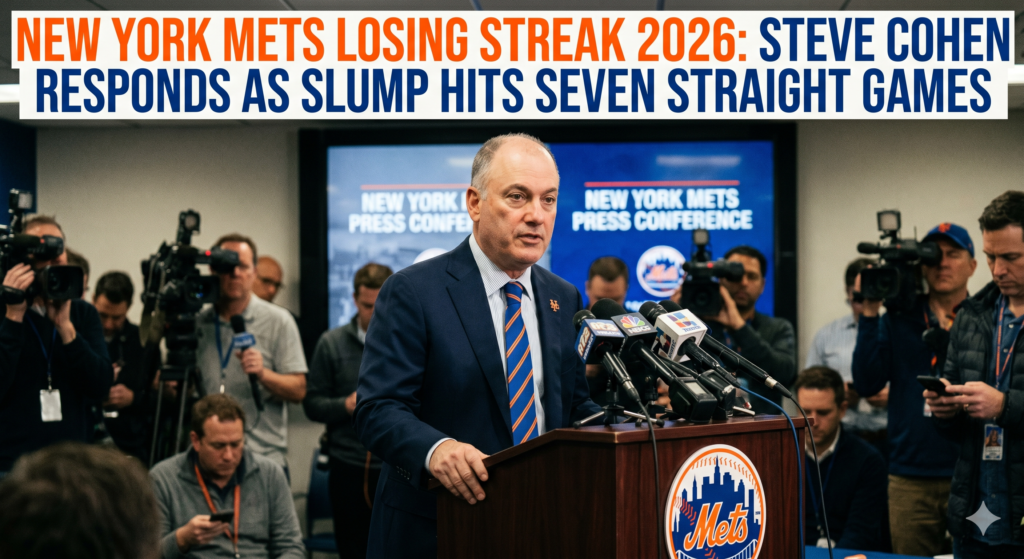
The 2026 New York Mets were built to be different. A reshaped roster, exciting new additions, and yet another massive payroll — this was supposed to be the year the Amazins finally put everything together. Three weeks into the season, however, that optimism has curdled into something far more familiar: frustration, finger-pointing, and a losing streak that refuses to end.
As of April 15, 2026, the Mets have dropped seven consecutive games. They sit at 7–11 — dead last in the National League East — with an offense that has gone completely cold at the worst imaginable time. If you are a Mets fan asking yourself what went wrong, you are in very good company. Even owner Steve Cohen has stepped away from the owner’s box long enough to address the situation directly on social media.
How Did the Losing Streak Begin?
Ironically, the Mets actually looked like genuine contenders in the early going. Through their first several series, they climbed to a 7–4 record and briefly held a half-game lead atop the NL East. Then everything unraveled.
After a win over the Arizona Diamondbacks on April 7, New York lost the remainder of that series before getting swept at home by the Oakland Athletics. That five-game skid stretched to six when the Mets were shut out 4–0 by the Los Angeles Dodgers on April 13 — their second straight scoreless game and third shutout in four contests. A 2–1 defeat the following evening pushed the streak to seven.
What makes the slide particularly painful is just how thoroughly the offense has collapsed. Over a recent six-game window, the Mets scored a combined nine runs. During that same stretch, the Minnesota Twins put up 43, including 13 in a single game. That kind of gap is hard to fathom for a club carrying one of the two largest payrolls in baseball.
Cohen’s Message to Fans: Patience and “Green Shoots”
Following the April 14 loss, Cohen took to X (formerly Twitter) to speak candidly with Mets supporters. Rather than going quiet, he chose to acknowledge the pain while searching for reasons for optimism.
He pointed to what he called “green shoots” in the lineup — specifically citing Francisco Lindor’s two-hit night that included a home run, and noting that new acquisition Bo Bichette showed signs of adjusting his approach by hitting to the opposite field. His underlying appeal to fans was simple: hang tight, the turnaround is coming.
Not everyone found that reassuring. Several fans pushed back online, noting that the Mets have ranked among baseball’s most frequent losers since the midpoint of last season. One widely circulated post on X captured the mood bluntly — it is hard not to feel deflated by a team that keeps underperforming despite the financial commitment behind it.
This is not the first time Cohen has felt compelled to address a rough patch publicly. During a similar stretch in 2025, he urged fans to “keep the faith” while admitting he was every bit as frustrated as they were. His willingness to engage directly remains rare among major sports owners — but words only carry so much weight when the losses keep mounting.
Breaking Down the Offensive Collapse
To understand why this losing streak has been so jarring, you have to look at who is struggling. The short answer: almost everyone.
Francisco Lindor’s Troubling Start
The face of the franchise has been among the biggest disappointments. Through his first 17 games of 2026, Lindor posted just a .541 OPS without a home run or RBI — the longest such drought to open a season in his entire career. Advanced data points to a specific vulnerability against breaking balls. After hitting .250 against curves and sliders last year, his average against those pitches has fallen to just .095 this season. Opposing pitchers have clearly found a weakness, and Lindor is still working on his counter.
New Additions Yet to Deliver
The offseason brought several high-profile names to Flushing. Bo Bichette, Marcus Semien, and Jorge Polanco were all acquired to stabilize a lineup that had been inconsistent for too long. None of them have found their footing yet. Bichette is batting .225 with an on-base percentage below .275. Semien’s slash line sits at a difficult .176/.254/.279. Polanco, managing an Achilles issue, has barely appeared and is posting negative WAR. Meanwhile, Mark Vientos — who began the year scorching hot — endured an 0-for-20 stretch over six games that dragged the lineup down considerably.
A Ground Ball Tendency Working Against Them
One under-discussed problem is the team’s ground ball rate, currently the sixth-highest in baseball at 45.4%. Pounding the ball into the dirt limits extra-base opportunities and kills offensive momentum — precisely what a lineup of this caliber cannot afford. Manager Carlos Mendoza acknowledged the issue, describing the team’s at-bats as too often “chasing, passive, in between,” with far too many non-competitive plate appearances.
Is Carlos Mendoza’s Job at Risk?
The losing streak has put the spotlight squarely on Mendoza, who is navigating his second full season as manager. With such a talented and expensive roster producing so little, questions about his job security have begun circulating through the New York media.
The pressure in this city is unrelenting, and Cohen has never hidden his desire for a championship. He has committed hundreds of millions of dollars to building this club — the Mets have paid the Competitive Balance Tax for several consecutive years — and the results still have not matched the investment. That pressure inevitably filters from the owner down to the front office and eventually lands on the manager’s desk.
Mendoza was involved in hiring Jeff Albert as the new director of hitting and Troy Snitker as the hitting coach this past offseason. If the offensive woes persist, those decisions will attract increasing scrutiny. For now, his position is secure — but sustained losing will eventually force difficult organizational choices.
Where Is Juan Soto?
One element that deserves more attention in any conversation about the Mets’ early struggles is the absence of Juan Soto, who is currently on the injured list with a calf issue. Soto is one of the handful of players in baseball capable of changing the complexion of a game by himself. Without him in the lineup, the Mets look thinner and easier to pitch around than they should be. His return timeline remains unclear, but getting him back healthy would immediately alter the offensive equation for New York.
Putting the Mets’ Start in Perspective
It is worth stepping back for a moment. April is a long way from October. At 7–11, the Mets are in an early hole — but baseball seasons have a well-documented way of sorting themselves out over 162 games. Cohen himself said before the season that reaching the playoffs was the minimum standard for success in 2026.
There is genuine talent on this roster. The pitching staff, in particular, has been more encouraging than the record suggests. Young starter Nolan McLean carries a 2.28 ERA with 28 strikeouts across fewer than 24 innings. Clay Holmes, back from a hamstring issue, has been reliable when available. There is real upside in the rotation.
The honest assessment is that the Mets’ problems right now are almost entirely offensive — and offenses can heat up quickly. But with the NL East competitive from top to bottom, there is very little margin for continued error.
FAQ
Q.1. How many games have the Mets lost in a row?
As of April 15, 2026, the Mets have lost seven straight, dropping to 7–11 and last place in the NL East.
Q.2. What did Steve Cohen say about the losing streak?
After the April 14 defeat, Cohen posted on X pointing to encouraging signs from Lindor and Bichette while urging fans to remain patient.
Q.3. Why is the offense struggling?
A combination of factors: Lindor’s slow start, inconsistent production from new additions Bichette and Semien, Polanco’s injury, and a team-wide tendency to produce weak ground-ball contact. Soto’s absence has also significantly thinned the lineup.
Q.4. Is Mendoza’s job in danger?
No official decision has been made, but media reports have raised the question if losses continue. Ownership has high expectations for a roster built to win now.
Q.5. What’s next on the schedule?
Following the Dodgers series, the Mets travel to Wrigley Field to face the Chicago Cubs.
Can the Mets Recover?
The 2026 losing streak stings, but it does not have to define the season. Teams bounce back from early April slumps regularly, and the Mets still have enough talent to compete if the bats come alive and Soto returns to full health.
That said, the window is not wide open. Every game lost now is ground that must be recovered later. Cohen’s confidence that things will improve is genuine — no one questions how much he wants to win or how much he has spent in pursuit of it. The question is whether the players can back him up.
For More Information

Related Article
Florida Doctor Arrested After Removing Wrong Organ During Surgery, Patient Dies
NYC Mayor Mamdani Faces Sharp Criticism Over First 100 Days in Office
DC Appeals Court Blocks Trump Contempt Probe — Here’s What the 2026 Ruling Really Means
It’s Official: HBO Max and Paramount+ Will Combine Into a Single Streaming Service