
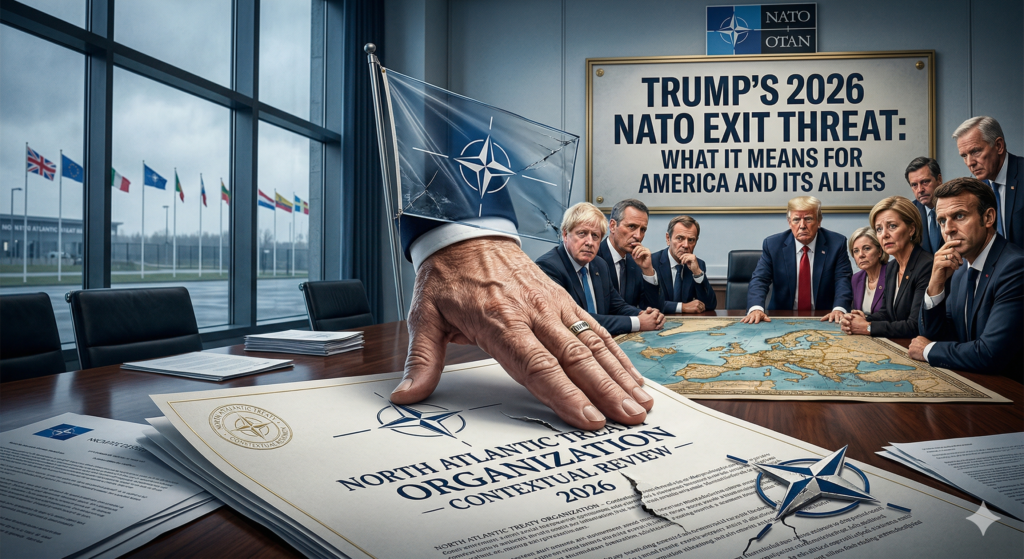
The comments came from an interview with the British newspaper The Telegraph published on April 1. When asked whether he’d reconsider NATO membership after the U.S.‑Israeli campaign wrapped up, Trump was blunt.
“Oh yes, I would say [it] is beyond reconsideration. I was never swayed by NATO. I always knew they were a paper tiger, and Putin knows that too, by the way.”
He followed up with a Reuters interview saying he was “absolutely” thinking about withdrawing the U.S. from the alliance. That’s more than a snide comment; it’s a policy hint.
This isn’t the first time Trump has complained about NATO, but this is the first time he’s openly floated actually leaving the alliance.
HOW WE GOT HERE
Trump’s frustration dates back to at least 2018, when he threatened to pull out if allies didn’t boost their defense spend to 2 % of GDP. Back then, most thought it was pure bluster.
Now, earlier in 2026, the U.S. and Israel launched military operations against Iran. Trump expected NATO allies to automatically back the effort: open bases for U.S. combat aircraft, ship–to–ship cooperation, and a clear show of force in the Middle East.
The allies disagreed. Spain closed its airspace to U.S. combat missions. Italy denied a landing right for a combat‑related mission. France and the U.K. both declined to participate, saying they weren’t consulted.
Trump saw this as a betrayal. His words: “We’ve been there automatically, including Ukraine. Ukraine was not our problem; it was a test and we were there for them… They weren’t there for us.”
WHAT TRUMP IS SAYING, QUICK FACTS
- Trump called NATO a “paper tiger” in the Telegraph interview.
- He says he’s “absolutely” considering leaving the alliance.
- Secretary of State Marco Rubio said the U.S. must “reexamine” our NATO commitment.
- Defense Secretary Pete Hegseth noted allies “put up questions, roadblocks, and hesitations.”
- The U.S. Ambassador to NATO confirmed Trump is “reevaluating everything.”
CAN TRUMP LEAVE NATO?
Legal experts say the president can’t unilaterally pull the U.S. out. In 2023 Congress passed a law that any president requesting withdrawal must get a two‑thirds Senate vote or an act of Congress. (The same law was co‑sponsored by Marco Rubio—now Trump’s Secretary of State.)
Senator Thom Tillis made it clear: “The president of the United States cannot withdraw from NATO. Instead, he can undermine it from within, performing a functional deletion if he wants to.”
Legal Breakdown (Heading 3)
Under the 2023 law, Trump needs a Senate vote or congressional action. A 2020 DOJ opinion argues the president has treaty‑authority; if a court gets involved, the final answer could take years. Meanwhile, Trump can weaken NATO by cutting cooperation and putting political pressure on allies.
ALLIED REACTIONS
The response from European leaders has been swift and unequivocal.
| Country | Reaction |
|---|---|
| United Kingdom | PM Keir Starmer says NATO is “the single most effective military alliance the world has ever seen” and the UK remains “fully committed.” |
| Poland | Defense Minister Dariusz Kosiniak‑Kamysz calls Trump’s threat “reckless, dangerous…and plays directly into the hands of adversaries.” |
| Estonia | Foreign Minister Signe Tsahkna says the threat to remove the U.S. is “harmful” to collective Western security. |
| Finland | President Sauli Runne says he had a “constructive discussion” with Trump; “problems are there to be solved, pragmatically.” |
Allied leaders took the threat seriously. In previous Trump‑era NATO complaints many states dismissed as noise, but with the U.S. now in an active conflict and being sidelined, the stakes are higher.
WHY YOU CARES
- Gas Prices – The Iran conflict has shut down the Strait of Hormuz, which is vital for global oil transport. U.S. gas prices have already risen. Any further NATO collapse could push them higher.
- U.S. Troops in Europe – About 100 000 U.S. soldiers are based across Europe under NATO agreements. If the alliance crumbles, those deployments could be reduced, affecting readiness and fiscal planning.
- Russia Gains – Vladimir Putin has, over the years, tried to wedge Western allies. A weakened NATO is a major strategic win for him. Trump himself remarked that Putin “knows” NATO is a paper tiger.
WHAT HAPPENS NEXT?
Most analysts see the immediate outcome as pressure, not exit. Trump can’t leave without Congress. What we’ll likely see is a slow erosion: less joint training, fewer shared resources, and more political pressure on allies. Rubio’s comments about “reexamining” the alliance point to that path.
The takeaway for allies: automatic U.S. military support for European‑led priorities may disappear—even if a formal withdrawal never becomes reality.
FAQ:
Q1: Why is Trump talking about leaving NATO now?
A: He’s angry that NATO allies refused U.S.‑Israeli aerial and naval support during the Iran campaign. Spain blocked U.S. combat flights; Italy denied landing; France and the U.K. declined. Trump sees this as a betrayal after U.S. backed NATO during Ukraine.
Q2: What is NATO, and how long has the U.S. been in it?
A: The North Atlantic Treaty Organization was founded in 1949, containing 32 members today. The U.S. has been a founding member and the alliance’s biggest contributor.
Q3: Has Trump threatened to leave NATO before?
A: Yes. In his first term, he threatened to leave unless allies spent 2 % of GDP on defense. All 32 members meet that target now; the 2025 requirement climbs to 5 %. This is the first time he’s floated actually leaving, not just a bargaining chip.
Q4: What happens if the U.S. actually leaves?
A: It would be the biggest U.S. foreign‑policy shift in decades—Russia would win, U.S. troops in Europe could be recalled, and the principle that an attack on one is an attack on all would vanish. Global security would face significant destabilization.
Q5: What do Republicans in Congress think?
A: They’re split. Many oppose a full exit; Sen. Thom Tillis has been clear that Trump can’t leave without Senate approval. Trump’s base loves the pressure on allies, and few Republicans are willing to publicly challenge him on it.
CALL‑TO‑ACTION
The Trump‑NATO situation is moving fast. It’s one of the most significant foreign‑policy debates of a generation—and it reaches beyond European politics to the prices we pay at the pump and the safety net you have around the corner. Bookmark this page and stay tuned for the next development.
For More Information
Related Article
Daniel Caesar Tour 2026 USA: Full Schedule, Ticket Presales & Venue
How to Find Dodger’s Stash Inside the Traffic Tunnel – ARC Raiders Guide 2026
YTB Fatt Dead or Alive? Here’s What We Actually Know in 2026
Kristi Noem Husband Daily Mail: The Bryon Noem Scandal Fully Explained
2 thoughts on “Trump’s 2026 NATO Exit Threat: What It Means for America and Its Allies”