
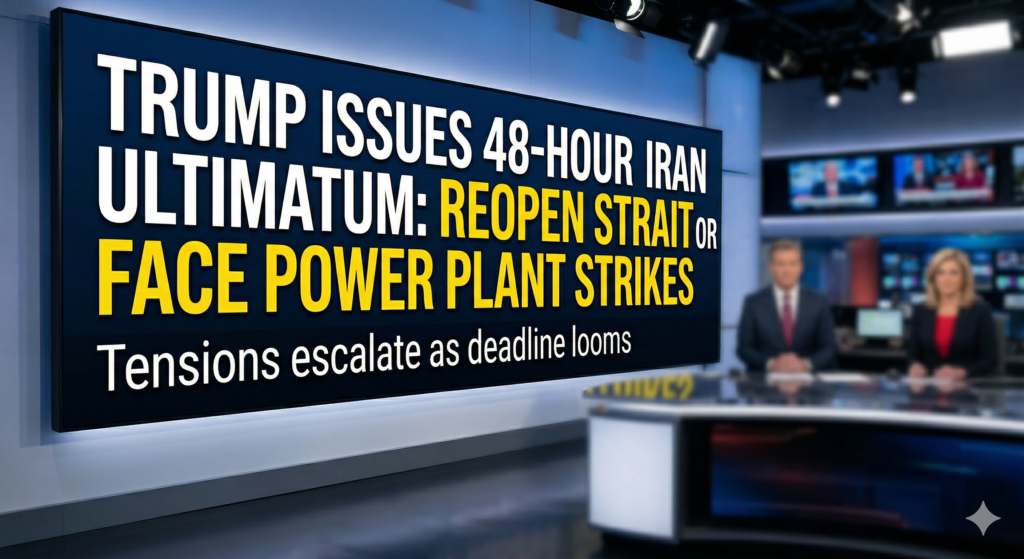
Tensions in the Middle East have reached a dangerous new peak. Late on Saturday, March 22, 2026, President Donald Trump delivered one of the most forceful warnings of his presidency — a 48-hour ultimatum directed at Iran, demanding the full reopening of the Strait of Hormuz or the destruction of the country’s power plants.
This sharp escalation arrives nearly four weeks into an active US-Iran conflict that has already shaken global energy markets, choked critical shipping routes, and pushed the region closer to an all-out war than it has been in decades. In this article, we examine exactly what Trump said, how Iranian leadership responded, why the Strait of Hormuz holds such enormous strategic value, and what independent analysts believe could happen next.
What Did Trump Say?
In a late-night post on Truth Social, President Trump issued a blunt and unambiguous warning to the Iranian government.
He declared that if Iran failed to fully open the Strait of Hormuz without conditions or threats within 48 hours, the United States would strike and destroy Iran’s power plants — beginning with the largest facility first.
This Trump ultimatum to Iran is a dramatic shift from the tone he struck just one day before, when he publicly suggested that American forces were close to achieving their military goals in the region and implied that operations might soon be scaled back. That more measured message came as a surprise to many observers — and so did the reversal that followed. Within hours of his conciliatory remarks, the Pentagon confirmed the deployment of three additional warships along with roughly 2,500 Marines to the surrounding area.
The Trump Iran power plant threat zeroes in on civilian and industrial energy infrastructure — a type of target that experts say would have sweeping consequences for the Iranian population. It also signals that the White House has grown deeply frustrated with the strait’s continued closure, which has been in effect since fighting broke out on February 28.
Why Is the Strait of Hormuz So Important?
To fully grasp the weight of the Trump 48-hour Iran ultimatum, it is essential to understand the global significance of the Strait of Hormuz and why its blockade is causing such widespread alarm.
The World’s Most Critical Energy Corridor
The Strait of Hormuz is a slender but strategically vital waterway separating Iran to the north from Oman to the south. Under normal conditions, approximately one-fifth of the entire world’s oil and liquefied natural gas supply moves through this narrow passage daily. Any disruption to traffic here does not stay confined to regional politics — it sends immediate ripple effects to fuel stations, airline operations, manufacturing plants, and household energy bills across every major economy on earth.
Since the US-Israel military campaign against Iran began in late February 2026, vessel traffic through the strait has nearly stopped altogether. Tehran officially declared the waterway off-limits to ships belonging to its adversaries, and private shipping firms along with marine insurers have largely withdrawn from the route, citing skyrocketing risk premiums and safety concerns. The practical outcome has been a steep rise in crude oil prices globally, feeding into broader inflationary pressure across multiple industries.
As of this past Saturday, the average price of gasoline across the United States climbed to $3.93 per gallon — an increase of almost one full dollar compared to $2.94 recorded just a month ago, prior to the outbreak of hostilities.
How Has Iran Responded to Trump’s Threat?
Iran’s response to Trump’s 48-hour warning was both immediate and combative, making clear that Tehran has no intention of yielding to outside pressure.
Iran’s Counter-Threat Targeting Energy Infrastructure
Colonel Ebrahim Zolfaqari, serving as the official spokesperson for Iran’s Khatam al-Anbiya military headquarters, issued a direct counter-warning: should Iran’s energy and fuel infrastructure come under attack, Iranian forces would retaliate by striking fuel supplies, power systems, information technology networks, and desalination facilities operated by the United States and its allies throughout the region.
Iran’s parliament speaker, Mohammad-Bagher Ghalibaf, reinforced this position through his own public statement, cautioning that vital energy and oil infrastructure across the wider region would face permanent damage and that petroleum prices would remain elevated for an extended period if military action against Iran were carried out.
Iran’s newly installed Supreme Leader, Mojtaba Khamenei, has publicly reaffirmed that the strait will stay blocked until the broader conflict reaches a resolution — a stance that appears unlikely to shift simply because a 48-hour deadline has been set.
Adding another layer of complexity, Iran’s representative to the International Maritime Organisation argued that the waterway technically remains open to neutral commercial vessels — only those belonging to countries Iran considers hostile are restricted. In practice, however, commercial maritime activity through the strait has all but ceased.
A Conflict Spreading Across the Region
Iran war news today continues to point toward a widening battlefield. During the same Saturday on which Trump issued his ultimatum, Iranian forces launched an attack on a joint US-UK military installation located in the Indian Ocean. A ballistic missile was also fired toward Dimona in southern Israel — an area associated with Israeli nuclear infrastructure — resulting in a number of casualties. Since the war began, Israel’s defense forces have reported intercepting more than 400 Iranian ballistic missiles, achieving an interception rate of approximately 92 percent.
Iran War News Update Today
The overall situation remains highly volatile and continues to shift by the hour as Trump’s deadline draws nearer.
US Military Operations This Week
Earlier during the week, American forces operating under US Central Command carried out strikes using heavy bunker-buster munitions against a fortified Iranian coastal installation near the Strait of Hormuz. The facility was being used to store anti-ship cruise missiles along with the mobile launch systems needed to deploy them. CENTCOM commander Admiral Brad Cooper stated that Iran’s capacity to threaten maritime vessels in the strait had been meaningfully reduced — though he stopped short of claiming it had been eliminated entirely, and outside analysts have echoed that caution.
The Nuclear Risk Factor
The presence of nuclear sites in the conflict zone has added a particularly alarming dimension to the crisis. Iran’s Natanz nuclear enrichment facility sustained damage during the fighting, though the International Atomic Energy Agency subsequently confirmed that no unusual radiation levels had been recorded in the area. The IAEA has formally appealed to all parties to exercise restraint and avoid any action that could trigger a radiological emergency. On the other side of the conflict, Iran’s missile strike near Israel’s Dimona site has raised parallel concerns about the vulnerability of Israeli nuclear infrastructure.
Economic Measures Taken by Washington
Seeking to cushion the domestic impact of soaring fuel costs, the Trump administration announced a temporary suspension of sanctions on Iranian crude oil that is currently loaded on vessels at sea — an estimated 140 million barrels. Treasury Secretary Scott Bessent defended the decision while simultaneously labeling Iran a state sponsor of global terrorism. The move drew sharp criticism from lawmakers and analysts who viewed it as contradictory; economists cautioned that the volume involved would offset only a brief portion of the supply shortfall created by the strait’s closure.
What Experts Are Saying About Trump’s Iran War Strategy
The Trump 48-hour Iran ultimatum has prompted pointed commentary from a wide range of regional specialists and former defense officials.
Ross Harrison, a senior research fellow at the Middle East Institute, argued that the ultimatum may reflect a lack of effective leverage rather than strength, noting that even a full-scale strike on Iranian power generation facilities would not automatically reopen the waterway. He pointed out that as long as Iran retains any meaningful capacity to respond militarily, purely kinetic measures are unlikely to produce the desired strategic result.
Veterans of US naval operations have similarly cautioned that commercial shipping will remain at substantial risk within the strait even if individual missile batteries and launch sites are destroyed — because the conflict itself has not been resolved.
Trump’s criticism of NATO also became a notable subplot this week. He publicly accused the alliance of lacking the resolve to contribute to reopening the passage. A coalition of NATO member nations did subsequently release a joint statement condemning Iran’s blockade and calling on Tehran to comply with UN Security Council Resolution 2817, though this fell short of the direct military support Trump appeared to be seeking.
What Happens If Iran Refuses?
With the clock running down, observers across the diplomatic and defense communities are weighing several plausible outcomes.
Scenario 1 — Iran offers partial compliance: Tehran could allow a limited resumption of neutral commercial shipping as a goodwill gesture, providing Trump with a political opening while avoiding the optics of full capitulation. Iran has shown little public willingness to pursue this path, but quiet diplomatic channels could still make it possible.
Scenario 2 — The United States strikes Iranian power facilities: Should Trump carry out his threat, military and energy analysts warn that the retaliation from Iran could be severe — potentially targeting American military installations across the Persian Gulf, fuel storage terminals, and desalination infrastructure that millions of people in the region depend on for drinking water.
Scenario 3 — A back-channel diplomatic agreement is reached: Multiple governments are reportedly acting as informal intermediaries between Washington and Tehran. A face-saving compromise negotiated away from public view remains conceivable, even if there is currently no visible indication that one is imminent.
Scenario 4 — The deadline is extended or reframed: International ultimatums are frequently adjusted in practice when circumstances shift. Given Trump’s own contradictory messaging over the 24 hours preceding his post, some room for recalibration may still exist without either side losing face entirely.
FAQ:
Q: What exactly has Trump threatened to do to Iran? President Trump warned that the United States would strike and destroy Iran’s power plants — prioritizing the largest one first — if Tehran does not unconditionally reopen the Strait of Hormuz within a 48-hour window. The warning was posted on Truth Social on the night of March 22, 2026.
Q: Why did Iran close the Strait of Hormuz in the first place? Iran shut the strait to vessels affiliated with the United States, Israel, and their partner nations following a coordinated US-Israeli military campaign against Iran that launched on February 28, 2026. Tehran has employed the closure as both a military pressure tactic and a tool for disrupting the global energy market.
Q: Has Iran signaled any willingness to comply with Trump’s ultimatum? No. Iranian military commanders, political officials, and the Supreme Leader have all publicly rejected the demand and threatened large-scale retaliation against US and allied energy infrastructure if Iran’s own power grid is attacked.
Q: What would the civilian impact of attacking Iran’s power plants be? A sustained assault on Iran’s electricity generation capacity would deprive millions of civilians of access to power for hospitals, homes, water treatment systems, and food supply chains. Human rights organizations and international legal scholars have raised serious questions about whether such an attack would meet the standards required under the laws of armed conflict.
Q: How has the ongoing conflict affected fuel prices for American consumers? Before the outbreak of the US-Iran conflict, the national average for gasoline in the United States stood at approximately $2.94 per gallon. By March 22, 2026, that figure had climbed to $3.93 — a jump of nearly one full dollar in less than thirty days — reflecting the market’s anxiety over the prolonged closure of the world’s most important oil shipping route.
A Crisis That Could Define 2026
Trump’s 48-hour Iran ultimatum has moved the ongoing US-Iran conflict into its most precarious chapter to date. Iran remains openly defiant, energy prices are climbing steadily, nuclear facilities on both sides have already been placed in the crossfire, and American military forces continue their operational tempo near the world’s most consequential maritime chokepoint. The window for a peaceful resolution is narrowing with each passing hour.
Whatever unfolds over the next two days carries the potential to redraw the strategic map of the Middle East and send lasting shockwaves through the global economy.
For More Information
Related Article
How Did Arsenal Go From Losing 8-2 to Manchester City to Becoming Their Biggest Threat?
Where to Watch Phoenix Suns vs Milwaukee Bucks: Channel, Stream & Tip-Off Time
Did Robert Mueller Die? The Full Story Behind His Death at 81
Buffy the Vampire Slayer’s Nicholas Brendon Dead at 54 — Remembering Xander Harris
2 thoughts on “Trump Issues 48-Hour Iran Ultimatum: Reopen Strait or Face Power Plant Strikes”