


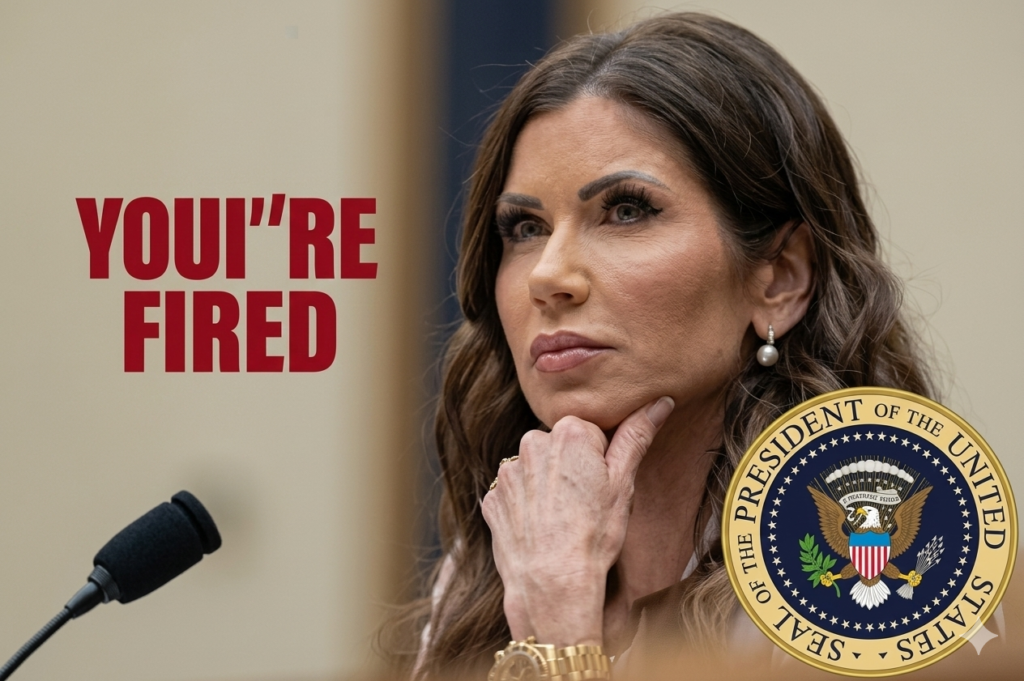
What You Need to Know at a Glance:
| Firing date: March 5, 2026 — Trump broke the news via a post on Truth Social |
| Noem had led the Department of Homeland Security for roughly 13 months |
| She becomes the first Cabinet-level official dismissed during Trump’s second administration |
| Named successor: Sen. Markwayne Mullin (R-OK), with a handover date of March 31, 2026 |
| Noem transitions to a newly created post: Special Envoy for The Shield of the Americas |
| Senior DHS advisor Corey Lewandowski is also stepping down from the department |
Few Washington announcements in recent memory landed with quite as little warning as the one President Donald Trump posted to Truth Social on the afternoon of March 5, 2026. In the space of a short statement, he confirmed what only a small circle inside the White House had known was coming: Homeland Security Secretary Kristi Noem was being removed from her post, and Oklahoma Senator Markwayne Mullin was set to take her place. When the message went live, Noem was at a lectern in Nashville delivering a speech to law enforcement officials, with no outward sign that her tenure at DHS had just come to an end.
Trump firing Noem represents the most significant Cabinet-level shake-up of his second term, arriving at a moment when the administration is already navigating overlapping pressures. DHS has been caught between a prolonged congressional funding standoff, a partial government shutdown leaving tens of thousands of federal employees in limbo, and an intensifying national debate over the methods used to carry out the administration’s immigration enforcement agenda. This article examines the full picture: what drove the decision, who steps into the role, and what the transition at the top of Homeland Security is likely to mean going forward.
Who Is Kristi Noem and What Did She Do at DHS?
To fully understand the significance of Trump’s decision, it helps to start with who Noem is and why she was chosen for the job in the first place. A former two-term governor of South Dakota and a consistent national profile within the Republican Party, Noem was nominated by Trump at the outset of his second term and confirmed by the Senate in early 2025 to lead the Department of Homeland Security.
The DHS portfolio is one of the broadest in the federal government. Noem was responsible for a workforce of approximately 250,000 people and a mandate that stretched from border security and immigration enforcement to FEMA disaster response, Coast Guard operations, cybersecurity infrastructure, and counterterrorism strategy. The administration’s central assignment for her was unambiguous: build and execute the largest mass deportation operation in the country’s history, with an annual target of removing one million people without legal status.
Noem threw herself into the public face of that mission. She traveled widely, maintained a heavy media schedule, and oversaw a large-budget advertising campaign in which she appeared alongside Border Patrol and ICE personnel. For much of her tenure, she ranked as one of the administration’s most recognizable surrogates — a distinction that, as events unfolded, would prove to be part of her undoing.
Why Did Trump Fire Kristi Noem? A Breakdown of the Key Reasons
The episode that did the most lasting damage to Noem’s standing within her own party unfolded in Minneapolis in January 2026. During a large-scale federal immigration enforcement operation, two American citizens — Renee Good and Alex Pretti — were shot and killed by federal officers. The incident drew immediate condemnation from Democrats, civil rights advocates, and, critically, from Republican members of Congress who had previously backed her.
What compounded the damage was Noem’s public response. She characterized both victims as domestic terrorists who had posed an active lethal threat to federal officers — a description that conflicted sharply with video footage widely circulated in the aftermath. Republican senators who had voted for her confirmation began publicly calling on her to step down, and the reputational damage proved impossible to fully repair in the weeks that followed.
A $220 Million Advertising Campaign Under Scrutiny
The congressional hearings this week surfaced another serious problem: a DHS public affairs campaign that had consumed approximately $220 million in taxpayer funds. The campaign placed Noem front and center in a series of professionally produced promotional videos. Under questioning from Senator John Kennedy, significant doubts emerged about whether standard procurement procedures had been observed and whether the White House had formally authorized the expenditure.
Noem told the committee under oath that Trump had personally approved the campaign. Within hours, Trump told Reuters that he had no recollection of doing so. The White House then issued a statement confirming that the $220 million contract had never received presidential sign-off — a direct contradiction of Noem’s sworn testimony. Multiple sources described that moment as the point at which her removal became inevitable.
Management Failures, Agency Feuding, and the FEMA Bottleneck
Behind the high-profile controversies, a quieter pattern of institutional dysfunction had been taking shape inside the department. An administration official described the decision to remove Noem as reflecting accumulated leadership shortcomings — including persistent internal disputes with the heads of CBP and ICE, a management style that Republican lawmakers characterized as dismissive of congressional priorities, and a reluctance to respond to urgent oversight requests.
Noem’s stewardship of FEMA drew particular criticism. Reports indicated that she had insisted on personally approving any agency expenditure exceeding $100,000 — a requirement that introduced significant delays in delivering disaster relief to communities still recovering from Hurricane Helene. Over the course of her tenure, FEMA cycled through three different acting administrators, and the agency absorbed substantial staffing reductions.
Two Days of Senate Testimony That Decided Her Fate
Noem’s appearance before Senate committees over two consecutive days this week drew criticism from across the political spectrum. Republican Senator Thom Tillis issued a public floor statement labeling her time at DHS a failure and declared he would block future administration nominations until she provided satisfactory answers to his outstanding questions. Other GOP senators who had supported her original confirmation declined to offer continued endorsements of her leadership. One lawmaker, speaking to NBC News, compared the mood in the hearing room to a pot of water finally boiling over.
Trump had reportedly been taking informal soundings from Republican senators about confidence in Noem’s leadership for several weeks. He watched her congressional testimony and, according to multiple reports, concluded that the situation had become untenable. White House staff had already begun conversations with potential replacements — including Mullin — before the formal announcement was made.
Who Is Markwayne Mullin?
To lead DHS through its current turbulence, Trump has turned to one of his most reliable congressional allies. Senator Markwayne Mullin of Oklahoma will formally assume the role of Homeland Security Secretary on March 31, 2026, subject to Senate confirmation.
Background: From the Octagon to Capitol Hill
Mullin’s path to the Senate is not a conventional one. Now 46, he competed as an amateur mixed martial arts fighter before building a multi-location plumbing company in Oklahoma. He entered Congress through a House seat, which he held for a decade, and transitioned to the Senate following a 2022 special election to fill a vacancy left by the retirement of Jim Inhofe. He is an enrolled citizen of the Cherokee Nation — a biographical detail that carries particular weight given that the DHS role encompasses federal policy toward tribal communities alongside its immigration and border functions.
Within the Senate, Mullin has carved out a profile as one of Trump’s most vocal and high-energy defenders. Trump is said to closely follow his cable news appearances, occasionally calling Mullin after strong performances to express approval. White House communications staff have leaned on him repeatedly for media engagements, a responsibility he has taken on with evident enthusiasm.
Why Mullin Was Trump’s Choice
Mullin’s appeal to the White House goes beyond personal chemistry. During negotiations over the 2025 budget reconciliation package, he functioned as an informal go-between bridging the House and Senate Republican caucuses — experience that could prove valuable for a DHS Secretary who will need to work closely with both chambers on funding and oversight. He also has a track record of working across the aisle; Democratic Senator John Fetterman of Pennsylvania publicly advocated for Noem’s removal and indicated early approval of Mullin as a successor.
Mullin told Capitol reporters that the appointment came as a surprise and that his personal relationship with Trump was a primary factor in his decision to accept. Confirmation is expected to proceed without major delays given his familiarity with Senate colleagues, though the ongoing DHS funding impasse may complicate the timeline.
The Oklahoma Senate Vacancy
Mullin’s move to the executive branch leaves an open Senate seat that Oklahoma Governor Kevin Stitt must fill by appointment. State law gives the governor a 30-day window to designate a replacement from the same party, and Stitt — a Republican — has signaled his intention to appoint a committed conservative aligned with Trump’s agenda. Because Mullin’s term runs only through January, there will be no special election to fill the seat; whoever Stitt appoints will serve through the November 2026 election cycle.
What Is Noem’s New Role?
Rather than a clean severance from government, Noem’s exit from DHS comes with an immediate onward appointment. Trump’s announcement included confirmation that she would be taking up a newly established diplomatic position: Special Envoy for The Shield of the Americas, a Western Hemisphere security framework that the president planned to introduce publicly at a Mar-a-Lago adjacent event in Doral, Florida on March 7, 2026.
Noem welcomed the transition publicly, posting on social media to thank the president and framing the envoy role as a natural next step built on the national security foundation she had developed at DHS. Her statement outlined what she described as landmark achievements during her time running the department and expressed genuine interest in the international dimension of the new assignment.
Observers have noted, however, that the Special Envoy title — however strategically named — does not come with the operational footprint of a Cabinet department: no 250,000-person workforce, no independent budget authority at that scale, and no confirmation hearing. Whether the appointment reflects a genuine expansion of Noem’s policy role or serves primarily as a dignified transition arrangement is an open question that time will likely answer.
What Noem’s Firing Means for DHS, Immigration Enforcement, and What Comes Next
The question occupying most policy watchers right now is whether swapping out the secretary changes anything of substance at DHS — or whether the immigration enforcement machinery rolls on unchanged under new management.
On that point, the White House has left little room for ambiguity. An administration official confirmed that the enforcement agenda remains intact and framed Noem’s removal strictly as a response to internal management deficiencies rather than any rethinking of policy direction. Trump himself paired the firing announcement with praise for what he called significant progress at the southern border, drawing a clear line between his satisfaction with the agenda and his dissatisfaction with its executor.
The operational reality Mullin inherits is considerably more complicated, however. Public approval of the administration’s immigration approach has softened in recent months, based on polling referenced across multiple major outlets. DHS has been running under a partial funding shutdown for approximately three weeks at the time of writing, with large numbers of employees working without compensation. Federal courts have issued injunctions against several of the department’s signature enforcement methods, and the Supreme Court is actively engaged on related constitutional questions.
Mullin takes charge of a department under simultaneous institutional, legal, and financial pressure. Managing those competing stresses while keeping the administration’s enforcement priorities operational will define his tenure — assuming the Senate confirms him on schedule.
Frequently Asked Questions: Trump Firing Noem and the DHS Leadership Change
| 1: Why did Trump fire Kristi Noem? A: Trump fired Noem on March 5, 2026, over a $220 million ad scandal, two citizen deaths during a DHS operation, and damaging Senate testimony. |
| 2: Who is taking over from Kristi Noem at DHS? A: Senator Markwayne Mullin (R-OK) takes over as DHS Secretary on March 31, 2026. The Oklahoma senator is a former MMA fighter and longtime Trump ally. |
| 3: Is Kristi Noem out of government altogether? A: No. Trump appointed Noem as Special Envoy for The Shield of the Americas, a Western Hemisphere security initiative — a diplomatic role with less authority than running DHS. |
| 4: Is Noem the first person Trump has fired from his Cabinet in his second term? A: Yes. Noem is the first Cabinet secretary fired in Trump’s second term — a stark contrast to his first term, when he cycled through five DHS secretaries. |
| Q: What happens at DHS between now and Mullin taking over? A: Acting officials will run DHS until Mullin starts March 31. The department faces a funding shutdown, active litigation, and institutional strain — but the administration says immigration policy will not change. |
What Trump Firing Noem Really Means
Kristi Noem’s removal from the Department of Homeland Security did not happen in a day. The conditions for it were laid over months — through a string of management failures, a Minneapolis tragedy that generated lasting political damage within her own party, and a public funding controversy that placed her in direct conflict with the president’s own account of events. The congressional hearings this week were the final catalyst, not the cause.
By selecting Markwayne Mullin as her successor, Trump has opted for a figure who brings personal loyalty, practiced media instincts, and working relationships on both sides of Capitol Hill. Whether those qualities are sufficient to stabilize a department simultaneously managing a funding shutdown, active litigation, and the relentless operational demands of the administration’s immigration program is the central question of the coming months.
Homeland Security touches more aspects of American life than almost any other federal department — from what happens at the southern border to how quickly disaster relief reaches storm-affected communities to the security of the country’s digital infrastructure. A change of leadership at the top of DHS is not just a Washington personnel story. Its effects will reach far beyond the Beltway, and the full scope of those effects is only beginning to come into focus.
For More Information

Related Article
Kalshi Verification Code: What It Means and What to Do Next
Winter Paralympics 2026 Tickets: Prices, Events & How to Book
Britney Spears Arrested for DUI in California — What Really Happened
DJ Moore Bills Trade Official: Why the Bears Dealt Their WR1 to Buffalo