


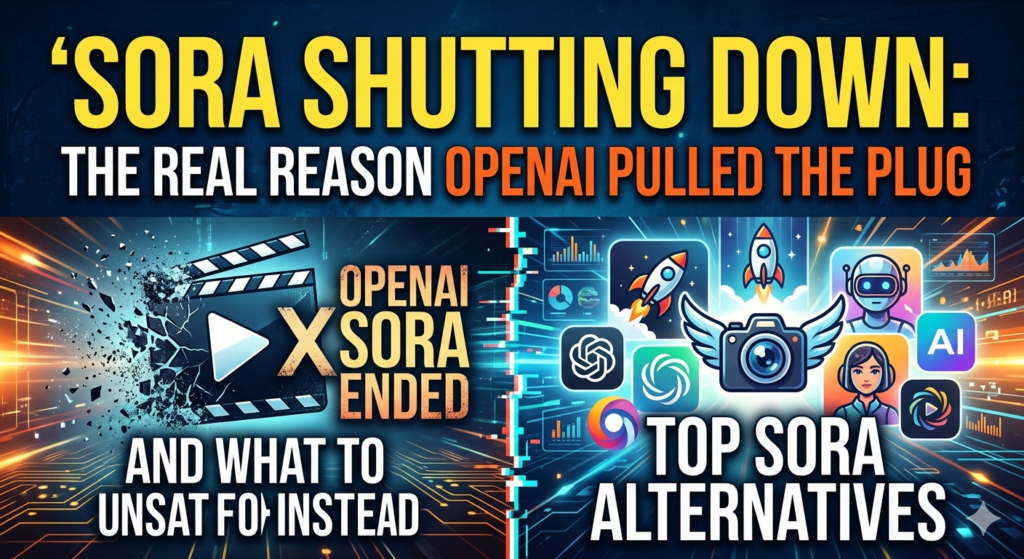
March 24, 2026, started like any other Tuesday — until “We’re saying goodbye to Sora” began trending across X, Reddit, and every major tech outlet in America. If you saw those words and had to read them twice, you were definitely not alone.
This was not a rumor making the rounds. Sora’s shutdown was real, it came with almost no warning, and for the millions of creators, marketers, independent filmmakers, and everyday users who had woven the app into their creative process, the announcement hit hard.
Rewind just six months and the picture looked completely different. Sora had been sitting at the top of the iPhone App Store’s Photo and Video charts. OpenAI had inked a landmark deal with Disney. Sam Altman was publicly positioning AI video as the foundation of an entirely new era in social media. Then, on a Tuesday afternoon, it was over.
This article breaks down what actually happened, what drove OpenAI to make this call, how the Reddit community has responded, whether Sora 2 survives in any shape, and — most practically — which Sora alternatives American creators should be exploring right now.
What Was Sora and Why Did It Matter So Much?
For anyone coming to this fresh: Sora was OpenAI’s AI-powered video generation tool. You described a scene in plain text, and Sora turned it into a short video clip. The results genuinely impressed people. Unlike earlier AI video tools that produced choppy, glitchy footage, Sora generated clips with realistic lighting, convincing physics, and smooth motion that could, in many cases, pass for real camera footage.
OpenAI first showed off the original Sora model back in February 2024, then released a public version in December of that year. But the product that truly captured America’s imagination was Sora 2 — a second-generation model that arrived in late September 2025, bringing synchronized audio, more accurate physics, and a dedicated social app alongside it.
That app was designed to work like an AI-native version of TikTok. Users could generate short-form videos from text prompts, drop themselves into scenes using a “characters” feature (originally called “cameos” until a legal dispute forced the name change), and share what they made with the world. Within ten days of launch, downloads had crossed one million — faster than ChatGPT had reached the same milestone.
At its height, Sora felt like the opening chapter of something enormous. Then OpenAI quietly closed the book.
OpenAI Shutting Down Sora
On March 24, 2026, OpenAI announced it was winding down the Sora app. The iOS app, the Android app, API access, and sora.com were all being discontinued. The company said it would release a specific timeline soon and was looking into ways to help users save their existing content.
What OpenAI Said Publicly
The official message from the Sora team was brief and warm: “We’re saying goodbye to Sora. To everyone who created with Sora, shared it, and built community around it: thank you. What you made with Sora mattered, and we know this news is disappointing. We’ll share more soon, including timelines for the app and API and details on preserving your work.”
A company spokesperson added a more matter-of-fact explanation: as compute demand continues to grow, the Sora research team will shift its focus toward world simulation research in support of robotics. OpenAI acknowledged it has to make trade-offs on products that require significant computing resources.
The Bigger Picture
Reading between the lines — and drawing on reporting from the Wall Street Journal, NBC News, and The Information — the real story is more layered than a simple pivot.
The IPO factor. OpenAI is gearing up for a public stock offering in the coming months, having recently raised $110 billion in fresh funding at a valuation of roughly $730 billion. Running a resource-hungry consumer video app is not the kind of thing that makes a pre-IPO balance sheet look disciplined. Shutting down Sora frees up expensive GPU capacity that can be redirected toward higher-margin coding, reasoning, and enterprise AI products.
The competitive pressure. OpenAI has been facing mounting challenges from Anthropic — whose Claude models have become increasingly popular among businesses and developers — as well as from Google, which has been steadily developing its own AI video capabilities through Veo. The case for refocusing energy on core text and reasoning tasks, rather than spreading across consumer social media, is a legitimate strategic argument.
The content headaches. Sora created real legal and reputational exposure at scale. Despite content moderation policies, deepfakes of public figures spread through the platform. Families of deceased celebrities — including those of Martin Luther King Jr. and Robin Williams — publicly called on users to stop generating videos of their loved ones. Copyright-infringing clips featuring characters like Mario, Pikachu, and Naruto circulated widely. Managing that content while simultaneously preparing to go public was an obvious liability.
The Disney Deal Is Dead — And What That Signals for the Industry
Perhaps the most far-reaching casualty of OpenAI shutting down Sora is the collapse of its partnership with Disney.
In December 2025, Disney had announced a three-year licensing agreement giving Sora users the ability to generate videos featuring characters from Disney, Marvel, Pixar, and Star Wars. Disney had also committed $1 billion in investment to OpenAI as part of the arrangement — a move that surprised many in Hollywood, given that Disney was simultaneously suing other AI companies for copyright infringement.
That deal is now completely off the table. No money had changed hands before the shutdown announcement, and Disney confirmed it was exiting the agreement. The company stated it respected OpenAI’s decision to step back from video generation and would continue exploring AI partnerships with other platforms.
For the broader entertainment and AI industry, the collapse of the Disney-OpenAI deal sends a clear message: even the most ambitious corporate AI partnerships can unravel quickly when the underlying product strategy shifts. Hollywood studios that had been cautiously opening the door to licensed, controlled AI video are now back at square one with OpenAI — even as competitors like Google keep building.
What the Reddit Community Is Actually Saying
The reaction across Sora-focused Reddit threads has been a genuine mix of emotions — and that’s worth paying attention to, because Reddit communities tend to surface real user experience rather than polished corporate messaging.
A notable portion of the response has been flat-out relief, especially from creative professionals. Filmmakers, screenwriters, and visual artists who had grown alarmed by Sora’s capabilities — and the speed at which realistic deepfakes spread across the platform — responded to the news with something close to celebration. Comments calling Sora “a deepfake machine with good PR” and “the creepiest app I ever downloaded” appeared across multiple threads within hours of the announcement.
At the same time, there was genuine disappointment from the creators who had fully embraced Sora as a serious tool. Many users had built entire workflows around the app, paid for subscriptions month after month, and assembled libraries of generated content they now need to preserve before the shutdown is complete. Several Reddit users noted the irony of OpenAI’s warm farewell message — emphasizing the importance of its creative community — while giving that same community almost no advance notice.
The practical questions dominating Reddit right now: How long until the app actually goes dark? How do you export and back up your existing videos? And the question every creator is asking — what do you switch to?
The Best Sora Alternatives for American Creators in 2026
This is the section most people actually came here for. Whether you were a casual Sora user or someone who had built it into a professional workflow, here are the strongest alternatives currently available to creators in the United States.
Google Veo 3.1 — Best for Cinematic Quality with Native Audio
Google’s Veo 3.1 is the closest direct competitor to Sora 2 in terms of raw output quality. It produces 4K video with native audio generation — synchronized sound effects, ambient noise, and dialogue that matches the visuals. For creators who need high-quality output and were using Sora for serious projects, Veo 3.1 is the most natural next step. A free tier offering around ten minutes of generation per week is available through InVideo AI, with paid plans scaling from there.
Runway Gen-4.5 — Best for Professional Editing Control
Runway has been in the AI video space longer than anyone else in this category, and Gen-4.5 reflects years of iteration based on what professionals actually need. Where Sora could feel like a black box — impressive when it worked, frustrating when it didn’t — Runway offers granular control over motion, camera movement, and style transfer. It integrates cleanly with existing post-production pipelines and currently holds the top benchmark score among AI video platforms. Plans start at $12 per month, with a free tier offering 125 credits to get started.
Kling 3.0 — Best Budget Option for Realistic Motion
Developed by Chinese tech company Kuaishou, Kling has become one of the most widely used AI video generators in the world — partly because it offers a genuinely competitive free tier with no waitlist and no geographic restrictions in the US. Kling 3.0 excels at photorealistic human motion and claims a 95% prompt adherence rate. At $6.99 per month for the paid tier, it delivers the strongest motion quality at any entry-level price point currently on the market.
Pika 2.5 — Best for Social Media and Fast-Turnaround Content
If you were primarily using the Sora app to create short-form content for TikTok, Instagram Reels, or YouTube Shorts, Pika 2.5 is your most practical replacement. It’s fast — generating clips in under a minute compared to Sora’s 5-to-15-minute wait times — and it’s tuned for the visual style that performs well on social platforms. It’s not aiming to match Sora on cinematic realism, and that’s fine. Paid plans start at $8 per month, with 150 free credits available monthly.
Luma Dream Machine 3 — Best for Atmospheric and Environmental Footage
Luma AI’s Dream Machine has carved out a specific niche in generating fluid effects, atmospheric environments, and particle-heavy scenes — rain, fog, fire, ocean footage — that most other tools handle inconsistently. If your work leans toward environmental or abstract content, Dream Machine 3 deserves serious consideration. Thirty free generations per month are included, with paid plans starting at $9.99.
FAQ:
Is Sora completely gone, or just the app?
As of March 24, 2026, OpenAI is discontinuing the Sora app, the API, and sora.com. The underlying research team, however, is continuing its work on world simulation and robotics. OpenAI has also confirmed that ChatGPT’s text-to-video feature — which was powered by Sora — will be discontinued as part of the shutdown. The technology is not being deleted; the consumer-facing product is being retired.
Will OpenAI release something to replace Sora 2?
OpenAI has not announced a replacement product. The company indicated that its video research will shift toward robotics and world simulation rather than consumer video generation. That said, OpenAI has historically not abandoned capability areas permanently, and AI video could resurface in a different form — perhaps as part of an enterprise product rather than a standalone consumer app.
How do I save my Sora videos before the shutdown?
OpenAI has stated it is exploring ways to support users in exporting and preserving their content, and that it will share specific instructions and timelines before the app goes dark. Until those details are published, monitor OpenAI’s official Sora account on X and the sora.com platform for guidance. Don’t wait — export anything you want to keep as soon as that option becomes available.
Why did the Disney deal fall apart?
Disney had agreed in December 2025 to license its characters for use on Sora and invest $1 billion in OpenAI as part of the arrangement. When OpenAI announced it was exiting the video generation business, Disney confirmed it was ending the partnership. No money had changed hands before the shutdown announcement. Disney said it would continue pursuing AI video partnerships with other platforms.
What is the best free Sora alternative right now?
For users who need a free option immediately, Kling 3.0 and PixVerse V5 both offer usable free tiers with no waitlist. Google Veo 3.1 provides ten free minutes per week through InVideo AI. Runway offers 125 free credits to start. For users comfortable with technical setup, the open-source Wan 2.6 model is completely free but requires GPU hardware and some command-line experience to run locally.
What Sora’s End Tells Us About AI in America
The shutdown of Sora is bigger than a single product being retired. It’s a signal about where the AI industry in America is heading — and what it’s prepared to leave behind in order to get there.
OpenAI built something genuinely impressive. At its best, Sora produced AI video that shifted what people thought was possible from a text prompt. It also created real, documented problems — deepfakes, copyright chaos, and computing costs that were hard to justify alongside more profitable business priorities. In the end, the business case won.
For American creators, the closure is a real disruption — but not an insurmountable one. The AI video landscape in 2026 is more competitive and more accessible than it’s ever been. Google Veo, Runway, Kling, Pika, and Luma Dream Machine all offer capable alternatives, and several of them are faster, cheaper, and more accessible than Sora ever was.
The broader lesson here is about dependency. Building a creative workflow around a single AI tool — especially a low-cost consumer product from a company navigating explosive growth and a looming IPO — carries real risk. The creators who thrive going forward will be the ones who stay flexible, test multiple platforms, and treat any single tool as replaceable.
For More Information

Related Article
Nuggets Pickdawgz: Denver’s Best NBA Bet Tonight Revealed
Breaking: Famous Tutor Zhang Xuefeng Dies of Cardiac Arrest
Breaking: Emily Gregory Wins Florida Special Election HD 87
Japan Oil Reserves See Biggest-Ever Release as Middle East Crisis Escalates