


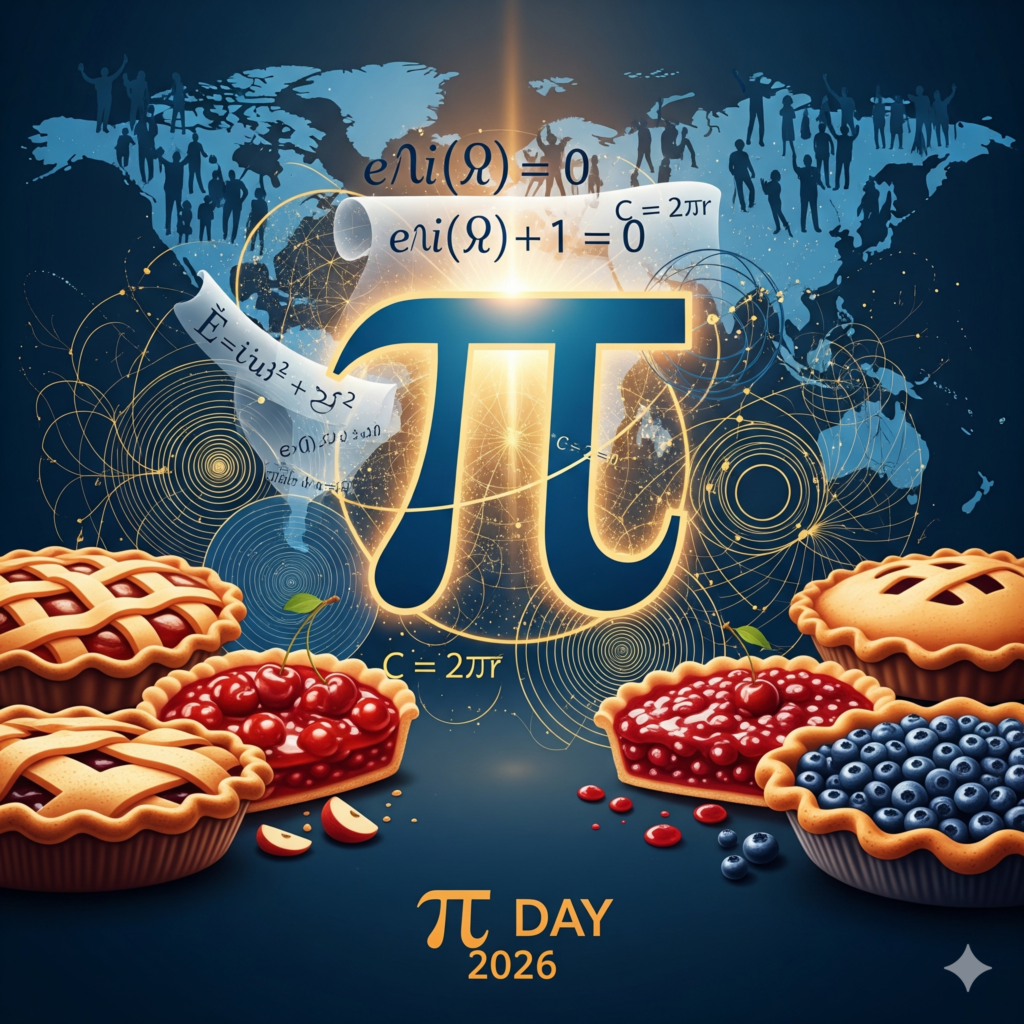
Each year, March 14 brings together students, educators, scientists, and dessert lovers for one of the most unusual holidays on the calendar: Pi Day. It is a day built around a number — an infinite, non-repeating decimal that mathematicians have been fascinated by for thousands of years. But when exactly did Pi Day begin, and how did it turn into a global celebration?
This guide covers everything worth knowing — the precise origin of Pi Day, the meaning behind pi itself, key moments such as Pi Day 2015, what is coming up for Pi Day 2026, and the essential math concepts that make pi so useful in everyday life.
What Is Pi? Understanding the World’s Most Famous Number
Pi (symbolised by the Greek letter π) is a mathematical constant. It expresses the relationship between a circle’s circumference — the distance around it — and its diameter, the straight-line width through its centre. No matter how large or small a circle is, dividing its circumference by its diameter always produces the same value: pi.
Pi begins as 3.14159 and continues indefinitely without forming a repeating sequence. Mathematicians classify it as an irrational number for precisely this reason — it cannot be captured as a clean fraction. Computers have now computed pi to trillions of decimal places, yet the sequence never settles into a pattern.
The Diameter and Radius of a Circle: Two Terms You Need to Know
Two measurements sit at the core of circle geometry, and both connect directly to pi:
- Diameter of a circle: This is the full width of a circle measured through its centre point, from one side to the other. It represents the longest possible chord within that circle.
- Radius of a circle: This is the distance from the centre of a circle to any point along its edge — exactly half the diameter. The radius appears in nearly every formula involving circles, including the area calculation.
Grasping these two concepts makes it far easier to understand why pi matters beyond the classroom. Both measurements appear constantly in architecture, engineering, physics, and design.
When Was Pi Day First Celebrated? The Origin Story
Pi Day was first celebrated on March 14, 1988. The event took place at the Exploratorium, a science and technology museum located in San Francisco, California. Larry Shaw, a physicist on the museum’s staff, conceived the idea and organised the first observance.
Shaw’s reasoning was straightforward: in the month/day date format used in the United States, March 14 is written as 3/14, which mirrors the opening digits of pi — 3.14. The connection was too good to ignore. That inaugural celebration was modest but memorable. Shaw led his colleagues on a circular march through the museum’s halls, after which the group shared fruit pies. The tradition stuck.
To answer the question directly: Pi Day was first celebrated in 1988, and the Exploratorium remains its spiritual home to this day.
From Local Tradition to National Recognition
For roughly two decades after its founding, Pi Day grew quietly through word of mouth. Teachers adopted it as a creative way to introduce mathematical concepts, and science centres around the country began hosting their own events. However, it remained largely informal until 2009.
That year, the United States House of Representatives passed an official resolution recognising March 14 as National Pi Day. The measure called on schools and educational institutions to incorporate pi-themed activities into their programmes and to use the occasion as a springboard for broader engagement with mathematics.
Since then, Pi Day has expanded well beyond American borders. Today it is observed in schools, universities, and public spaces worldwide. Bakeries run pi-themed promotions, mathematicians attempt to recite pi from memory, and social media fills with circular graphics and clever number puns every March 14.
Pi Day 2015: A Once-in-a-Century Mathematical Alignment
Not all Pi Days are created equal. Pi Day 2015 stands apart as perhaps the most remarkable occurrence in the holiday’s history. On March 14, 2015, writing the date in American format produced 3/14/15 — the first five digits of pi in sequence: 3.1415.
The alignment went even further. At precisely 9:26:53 AM on that morning, the date and time together spelled out 3.141592653 — ten consecutive digits of pi. Enthusiasts dubbed the moment “Pi Second.” Because the calendar cycles every hundred years in this context, this particular combination will not occur again until 2115.
Celebrations on Pi Day 2015 were accordingly large. Universities held special lectures, communities organised events, and countless people gathered at 9:26 AM to mark the precise moment. It served as a vivid reminder that mathematics can create moments of genuine collective wonder.
How Do You Find the Area of a Circle?
Pi plays a central role in one of the most commonly used formulas in geometry: the area of a circle. Whether you are designing a circular patio, planning a garden bed, or solving a textbook problem, this formula is indispensable.
Area = π × r²
Here, r represents the radius. To use the formula, square the radius and then multiply by pi. For example, a circle with a radius of 5 centimetres has an area of π × 25, which equals approximately 78.54 square centimetres.
This calculation appears across a broad range of real-world situations — from working out how much paint covers a circular surface to determining the cross-sectional area of a pipe. Pi transforms a simple radius measurement into genuinely useful information.
When Is Pi Approximation Day Celebrated?
For countries that write dates in the day/month format, March 14 does not read as 3/14 — it reads as 14/3. This means the numerical connection to pi is lost. Pi Approximation Day offers an alternative: July 22, or 22/7 in the day/month format.
The fraction 22 divided by 7 yields approximately 3.14286, which is close enough to pi for many practical applications. Ancient mathematicians, including Archimedes, used this fraction centuries before modern decimal notation existed. Today, 22/7 is still taught in schools as a reliable approximation.
If you happen to miss the March festivities, Pi Approximation Day on July 22 gives you a second opportunity each year to raise a slice of pie in honour of mathematics.
Pi Day 2026: Ideas for Celebrating This Year
Pi Day 2026 falls on Saturday, March 14 — a weekend date that gives individuals, families, and schools plenty of room to plan something special. Here are several practical ways to mark the occasion:
- Bake a circular pie and invite friends or family to recite pi digits before each serving.
- Attend a pi-themed event at a local science museum, university, or community centre.
- Demonstrate the area-of-a-circle formula to younger learners using everyday household objects.
- Read about the history of pi across different cultures, from ancient Babylon to modern computing.
- Challenge yourself to memorise pi beyond the standard 3.14 — even reaching 20 digits is a meaningful personal milestone.
Pi Day 2026 is an ideal occasion to bring a bit of mathematical curiosity into your weekend, regardless of your background or skill level.
FAQ:
When is Pi Day celebrated each year?
Pi Day is observed annually on March 14. The date corresponds to 3/14 in the American month/day format, reflecting the first three digits of pi. In regions that use the day/month format, Pi Approximation Day on July 22 (representing the fraction 22/7) serves as a parallel celebration.
What is the diameter of a circle?
The diameter is the measurement of a circle taken as a straight line through its centre from one edge to the opposite edge. It equals twice the radius. Pi is defined as the ratio of circumference to diameter, which is why the diameter is so fundamental to understanding this constant.
What is the radius of a circle?
The radius is the distance between the centre of a circle and any point on its boundary. It is equal to half the diameter. The radius is the key variable in the area formula A = πr² and in many other geometric and scientific calculations.
How do you find the area of a circle?
Multiply pi by the square of the radius: A = π × r². Start by squaring the radius (multiplying it by itself), then multiply that result by pi (3.14159). As an example, a circle with a 6 cm radius has an area of approximately 113.10 square centimetres.
Why is pi considered an irrational number?
Pi cannot be written as a ratio of two whole numbers, which is the defining characteristic of an irrational number. Its decimal form extends without end and without repetition. Swiss mathematician Johann Heinrich Lambert confirmed this property in 1768. In practice, values such as 3.14 or 22/7 provide workable approximations for most calculations.
A Holiday Worth Celebrating Every March 14
Pi Day has come a long way since Larry Shaw organised that first circular walk at the San Francisco Exploratorium in 1988. What started as a playful nod to a mathematical coincidence has grown into a genuinely global event that brings schools, museums, and communities together every year on March 14.
Understanding pi — its definition, its connection to the diameter and radius of a circle, and its role in calculating the area of a circle — gives the holiday a meaning that goes beyond the puns and pastries. It is a reminder that a single number, first noticed in ancient times, still shapes how we understand and measure the world around us.
With Pi Day 2026 landing on a Saturday, there has never been a more convenient time to take part. Mark your calendar, refresh your knowledge of the formula A = πr², and find a way to celebrate — with or without an actual pie.
📢 Found this article useful? Share it with a student, a teacher, or anyone who appreciates a good number — and make sure Pi Day 2026 is on your calendar!
For More Information

Related Article
Illinois Basketball Today: Live Updates, Scores, and Highlights
Chipotle Buy One Get One Tattoo Deal Is Back — Here’s How to Score a Free Burrito on March 13
St Louis Basketball Tickets in High Demand as Billikens Eye 2026 A-10 Tournament Glory
Breaking: KC-135 Crash Claims Four Lives in Western Iraq — What We Know So Far