


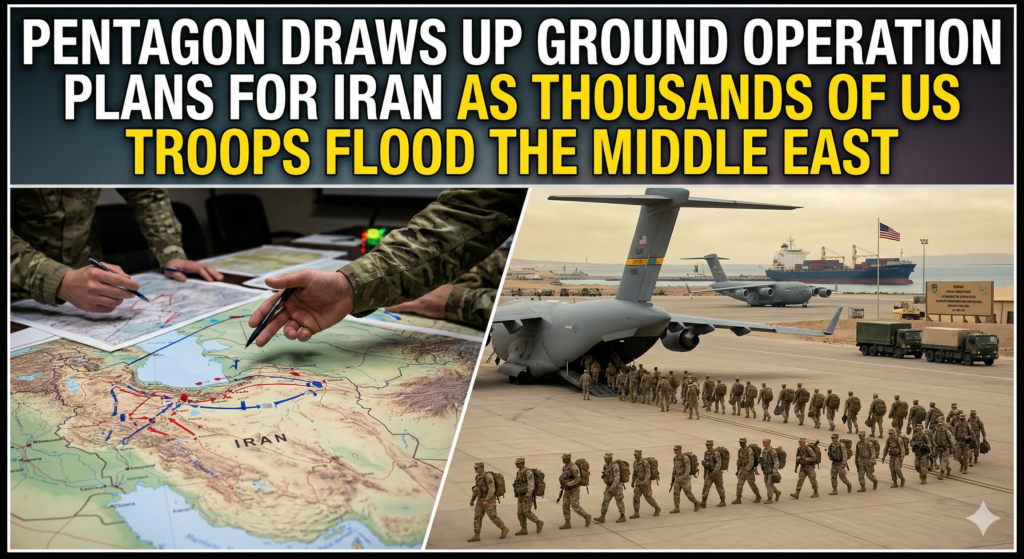
On February 28, 2026, the United States and Israel launched coordinated military strikes against Iran under an operation designated Epic Fury. Those strikes killed Supreme Leader Ayatollah Ali Khamenei along with several senior commanders in Iran’s military structure. Iran’s government responded by firing missiles at US installations in Bahrain and Saudi Arabia and issued sweeping pledges of wider retaliation.
The conflict is now deep into its fifth week. Thirteen American service members have died — six in a plane crash in Iraq, six killed in a drone strike in Kuwait, and one lost at Prince Sultan Air Base in Saudi Arabia. More than 300 additional troops have sustained injuries from Iranian drone and missile attacks on American facilities spread across at least seven countries throughout the Middle East.
That is the situation from which the Pentagon’s current ground operation planning has emerged.
What the Pentagon Is Planning — and What It Is Not
The scenarios under development do not constitute a full-scale ground invasion of Iran. Officials who briefed the Washington Post were explicit on that. What is being considered involves targeted raids conducted by Special Operations forces alongside conventional infantry units — operations built around defined objectives and followed by withdrawal, not extended occupation.
Two sets of targets stand out in the reporting. The first is Kharg Island, located in the Persian Gulf and serving as Iran’s primary oil export terminal. Approximately 90% of Iran’s oil exports move through that island. A military strike on its defense infrastructure — while leaving oil facilities intact, consistent with signals Trump sent in March — would significantly weaken Iran’s economic and military footing.
The second category involves weapons positions Iran has established along the coastlines near the Strait of Hormuz. Those installations pose a direct threat to commercial and military vessels navigating one of the most strategically critical waterways on the planet. Neutralizing them would reduce the danger to global energy shipping and shield US naval assets working in the area.
Michael Eisenstadt, a military analyst at the Washington Institute for Near East Policy, told the Washington Post that mobility would be central to any effective operation. Keeping forces moving rather than occupying fixed positions, he explained, is a core element of force protection against sustained Iranian countermeasures.
Axios separately reported that the Pentagon has drafted contingency plans for operations reaching deeper into Iran — specifically aimed at securing highly enriched uranium stored at nuclear facilities. Officials, however, have described large-scale air strikes against those sites as considerably less operationally risky than a ground insertion.
The Scale of the US Military Buildup in the Region
US Central Command confirmed as of March 28 that the USS Tripoli strike group — carrying around 3,500 sailors and Marines, supported by transport aircraft, strike fighters, and amphibious assault equipment — has completed its transit to the region.
The 31st Marine Expeditionary Unit, numbering approximately 2,200 personnel, was ordered to the area in recent weeks. It carries strong capability for rapid-strike operations, though a retired senior military officer has noted that sustaining extended operations without resupply would test its logistical limits.
On top of those units, reporting indicates the Pentagon is readying thousands of soldiers from the 82nd Airborne Division for potential deployment. The 82nd is widely regarded as the US military’s most rapid-response conventional force for major contingencies. This would supplement the roughly 5,000 Marines already being repositioned to the region — themselves layered on top of the approximately 50,000 American troops that were already stationed across the Middle East before the current buildup began.
Secretary of State Marco Rubio offered diplomatic context on Friday, noting that the United States could still achieve its strategic aims without committing ground forces — but that the deployments were intended to ensure the president retained full flexibility to adapt the approach if circumstances required it.
What the Four “Final Blow” Scenarios Actually Involve
Axios reported that Pentagon planners have developed four distinct courses of action around what they’ve internally framed as a “final blow” — a decisive operation intended either to resolve the conflict on favorable terms or to create the leverage needed to bring Iran to serious negotiations.
The first option centers on a precise, contained strike by elite Special Operations units against specific high-value military targets such as ballistic missile storage and launch facilities, followed by rapid extraction. The objective would be to degrade Iran’s strike capability without setting the stage for a prolonged ground commitment.
The second option would involve seizing strategic coastal territory or key islands — Kharg Island among them — to cut off Iran’s maritime military reach and protect the energy shipping lanes that the global economy depends on. This scenario would likely require a longer on-the-ground presence than the first.
A third option is substantially broader in scope: a wide-ranging military campaign designed to dismantle the Revolutionary Guard’s command structure and degrade its military infrastructure across multiple domains. This is the most resource-intensive of the four and carries the highest political and human cost.
The fourth option shifts to economic warfare — blocking or intercepting vessels carrying Iranian oil through the eastern approaches to the Hormuz Strait. This would apply severe financial pressure on Tehran while avoiding direct combat with Iranian ground forces.
None of these options has been formally approved. Iran’s parliament speaker issued a pointed warning this week: any effort to seize Iranian islands would invite retaliatory strikes against the critical infrastructure of any regional nation that aids the operation.
What All of This Means for Americans at Home
On the security front, the concern is direct. US intelligence has separately intercepted communications raising the possibility that Iranian-linked operatives inside the United States may have received activation signals following the death of Iran’s Supreme Leader. The FBI has shifted counterterrorism resources onto high alert. A sustained military operation overseas, paired with an elevated threat environment at home, creates a security posture that federal agencies are approaching with the seriousness it warrants.
Economically, the stakes are equally significant. The Strait of Hormuz carries more than 20% of the world’s daily oil supply. If Iran responds to any ground operation by mining or blockading the strait — a threat its officials have made repeatedly — the downstream effects on American consumers could be severe. Higher gas prices, disrupted supply chains, and renewed inflationary pressure would all follow.
Diplomatic channels have not closed entirely. Pakistan is currently facilitating meetings among the foreign ministers of Saudi Arabia, Turkey, and Egypt in an effort to find a mediated path forward. Iran has not categorically ruled out talks. But US officials are candid about the difficulty: senior commanders within Iran’s Revolutionary Guard remain deeply distrustful of any negotiated settlement, and that hostility is shaping Tehran’s posture at every level.
Whether Trump ultimately approves any of the ground operation plans will hinge in large part on what the next few days of diplomacy produce — or fail to produce.
What Defense Experts Are Saying About the Risks
Even carefully planned, limited raids carry genuine danger. American forces operating in Iranian coastal environments would face drones, missiles, coastal defense artillery, and improvised explosive threats. The toll already sustained in the broader conflict — 13 deaths and more than 300 wounded — is a stark reminder that military operations do not unfold without human cost, regardless of how well they are planned.
Some analysts hold that limited, targeted raids can achieve discrete tactical goals — eliminating weapons stockpiles, degrading coastal military infrastructure — without pulling the United States into a sustained engagement it cannot cleanly exit. Others point to intelligence assessments indicating that roughly two-thirds of Iran’s military arsenal remains functional despite weeks of US and Israeli strikes. Iran retains real capacity to respond.
The regional picture adds another layer of complexity. An escalation by the United States risks activating proxy forces that Iran has cultivated for precisely this kind of moment — Hezbollah in Lebanon, Houthi factions in Yemen — and could create friction with Russia and China, both of which maintain significant strategic and economic ties to Tehran. The Iranian parliament chair made the stakes plain in a public statement this week: any attempt to seize Iranian territory would result in strikes on the vital infrastructure of any regional government that lends assistance to the effort.
That warning was broadly interpreted as a direct signal aimed at the UAE, which has an active territorial claim over Abu Musa island, currently under Iranian control.
FAQ:
Have US ground operations in Iran already begun?
No. As of March 29, 2026, no ground operations have been authorized or executed. The Pentagon is actively developing plans and moving forces into position, but President Trump has not approved any ground action. White House press secretary Karoline Leavitt confirmed that the preparations are intended to preserve presidential options — not to announce a decision that has already been taken.
Why does Kharg Island matter so much strategically?
Kharg Island functions as Iran’s central oil export hub in the Persian Gulf. Around 90% of Iran’s oil shipments originate there. Damaging or seizing its military facilities — while leaving oil infrastructure intact, as Trump’s March signals suggested — would significantly undermine both Iran’s revenues and its capacity to sustain military operations. Defense planners regard it as one of the highest-value targets in any escalation scenario.
How large is the US military presence in the Middle East right now?
Before the current buildup, roughly 50,000 American troops were already stationed throughout the region. Since then, the Pentagon has deployed approximately 5,000 additional Marines, moved the USS Tripoli task force of 3,500 sailors and Marines into position, and is readying further forces from the 82nd Airborne Division. The total increase could reach 10,000 or more beyond the pre-conflict baseline.
How would US ground operations in Iran affect oil prices and the US economy?
The economic impact would depend on the scope of any operation and how Iran chooses to respond. If Iran were to blockade or mine the Strait of Hormuz in retaliation, global oil prices would spike sharply, with direct consequences for American consumers through higher fuel costs, supply chain disruptions, and renewed inflation. Energy markets are already factoring in the current level of uncertainty.
Is a diplomatic resolution still possible?
Yes, but the window is narrowing. Pakistan is facilitating talks that involve Saudi Arabia, Turkey, and Egypt as regional mediators. Iran has not walked away from the table entirely, but US officials are frank about the obstacles: Iran’s Revolutionary Guard leadership remains deeply suspicious of any settlement that leaves its military structure intact. Trump has publicly indicated that he is prepared to escalate further if diplomacy fails to yield concrete movement within a short timeframe.
The Decisions Ahead Carry Lasting Consequences
The Pentagon’s ground operation planning for Iran is not background noise — it is one of the most significant military planning processes the United States has undertaken in over a decade. The forces are real. The options on the table are real. The risks they carry — to American service members in the field, to regional stability, to global energy markets, and to homeland security — are equally real.
What remains absent is a presidential decision. Trump stated in March that he had no intention of putting troops on the ground in Iran. The White House continues to characterize everything as contingency preparation. But moving thousands of Marines, positioning a rapid-deployment airborne division, and sailing a full amphibious assault group into a theater of active conflict is not simply an exercise in keeping doors open. It is a signal of intent that the region — and the world — is reading carefully.
For Americans following this from home, the essential facts are these: the conflict has been active for five weeks with no clear diplomatic resolution in sight; American troops are already dying and being wounded in the region; and the window for a negotiated outcome, while not yet closed, grows narrower with each passing day.
For More Information

Related Article
Iran Sleeper Cell Warning: What the 1500 Border Stops Really Mean
Iran War Hormuz Tensions Escalate: What It Means for Oil Prices and American Consumers
BREAKING: México – Portugal Ends 0-0 — Full Time Result & Highlights From Estadio Azteca