


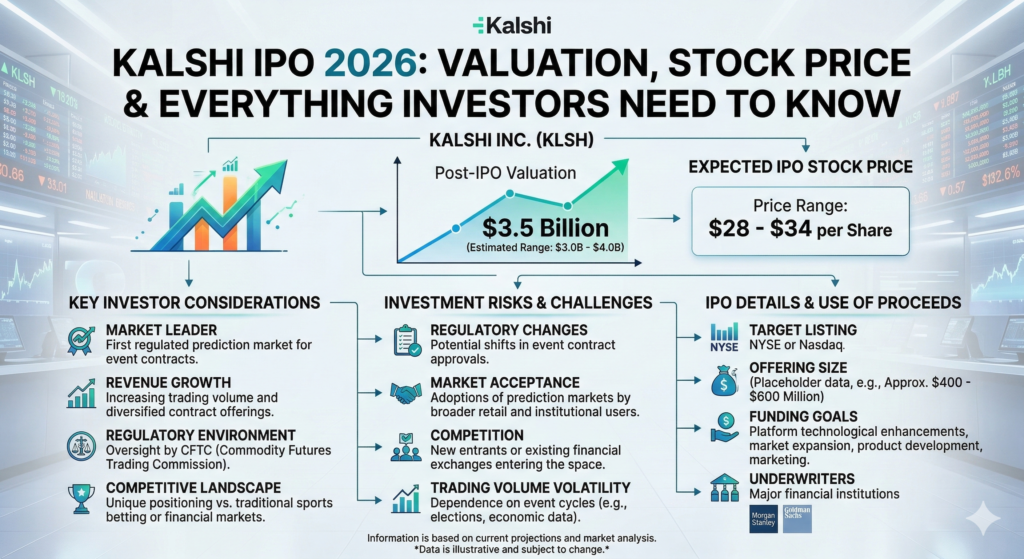
If you’ve been hearing the name Kalshi everywhere lately — from financial Twitter to ESPN broadcasts — you’re not alone. In just a few short years, this New York startup has grown from a scrappy fintech experiment into an $11 billion giant that’s reshaping how Americans engage with everything from elections to the NFL playoffs. And investors are asking one burning question: when is the Kalshi IPO?
In this article, we break down exactly what Kalshi is, who founded it, what the Kalshi valuation looks like today, whether a Kalshi stock is in your near future, and how it stacks up against rival Polymarket. Whether you’re a curious investor or someone who’s been trading on the platform, here’s everything you need to know.
What Is Kalshi?
Kalshi is a federally regulated prediction market — an exchange where users can buy and sell event contracts based on real-world outcomes. Think of it like a stock market, except instead of trading shares in Apple, you’re trading yes-or-no contracts on questions like “Will the Fed raise interest rates this month?” or “Who will win the Super Bowl?”
The platform launched publicly in July 2021 and became the first exchange in U.S. history to receive approval from the Commodity Futures Trading Commission (CFTC) to operate a prediction market. That regulatory stamp of approval is what separates Kalshi from offshore competitors — and it’s a big reason why investors are paying attention.
Today, sports markets account for more than 90% of activity on the platform, with the NFL season driving enormous trading volumes. But Kalshi also offers markets on economic indicators, political outcomes, cryptocurrency prices, and cultural events. The company describes its long-term vision as “financializing everything” — turning any difference of opinion about the future into a tradeable asset.
The Kalshi Founders: Two MIT Grads Who Bet Big on Uncertainty
The story of Kalshi begins at MIT, where Tarek Mansour and Luana Lopes Lara crossed paths in a computer science class. Their backgrounds couldn’t have been more different — and that contrast turned out to be one of their greatest strengths.
Tarek Mansour: Kalshi CEO
Tarek Mansour, the Kalshi CEO, was born in Algeria and raised in Lebanon before moving to the United States. He studied computer science and quantitative finance at MIT before cutting his teeth as a quantitative trader at Goldman Sachs and Citadel. During those years on Wall Street, he noticed that enormous amounts of trading activity were essentially bets on future events — from Brexit outcomes to interest rate decisions — but there was no clean, direct way to trade on the event itself. That gap became the foundation of Kalshi.
Luana Lopes Lara: From Ballet to Billionaire
If Tarek’s story is impressive, Luana’s is nothing short of extraordinary. The Kalshi and Raya co-founder (she has sometimes been referenced in context alongsidementioned in connection with Raya, the exclusive dating app, given her elite social circles) is a Brazilian entrepreneur who trained professionally as a ballerina at the prestigious Bolshoi Theater School in Brazil — enduring grueling 13-hour training days — before pivoting entirely to study computer science at MIT.
After MIT, she worked as a quantitative researcher and trader at Bridgewater Associates, Citadel Securities, and Five Rings Capital. It was during a shared internship at Five Rings that she and Mansour had their eureka moment on a walk home one evening — and the concept of Kalshi was born.
In December 2025, Forbes named Luana Lopes Lara the world’s youngest self-made female billionaire, thanks to her estimated 12% ownership stake in Kalshi following the company’s $11 billion valuation. She serves as Kalshi’s COO, overseeing product development, operations, and strategic partnerships.
Kalshi Valuation: From $0 to $11 Billion in Seven Years
Few startups in financial services have scaled as fast as Kalshi. Here’s a quick look at the funding trajectory that has investors so excited:
2021: Kalshi raises its seed round backed by Charles Schwab, Sequoia Capital, and Y Combinator, publicly launching its exchange.
October 2025: Kalshi closes a $300 million Series D at a $5 billion valuation.
December 2025: Just weeks later, Kalshi raises $1 billion in a Series E round led by Paradigm, with participation from Sequoia, Andreessen Horowitz, ARK Invest, CapitalG, and others — pushing its Kalshi valuation to $11 billion.
March 2026: Reports indicate Kalshi is seeking a $20 billion valuation in its latest fundraising round.
What’s fueling this meteoric rise? Revenue tells the story. In 2025, Kalshi reportedly generated around $260 million in revenue — an increase of roughly 994% compared to 2024. The company processed approximately $22.88 billion in trading volume over the year, with sports markets accounting for 89% of total fee revenue. Annualized trading volume hit $70 billion by December 2025, reflecting an eightfold increase in just six months.
The Kalshi IPO Question: Will Kalshi Go Public?
This is the question on every investor’s mind. The short answer: as of March 2026, Kalshi has not announced any formal IPO plans.
Kalshi CFO Saurabh Tejwani has said only that going public is “something we will consider” — vague language that neither confirms nor rules it out. The company has so far been able to raise all the capital it needs from private investors, which reduces the urgency to go public in the near term.
Why a 2026 Kalshi IPO Seems Unlikely
Several factors suggest investors shouldn’t hold their breath for a Kalshi stock listing this year. First, at an $11 billion valuation (potentially climbing to $20 billion), Kalshi would already debut as a large-cap company — reducing the early-stage upside that typically makes IPOs attractive to growth investors. Second, its regulatory environment is still evolving, with active lawsuits in multiple states over its sports betting markets. Companies under significant legal scrutiny typically prefer to resolve those issues before facing the heightened disclosure requirements of public markets.
Third, there’s a broader trend: fast-growing companies simply stay private longer today. Kalshi was founded in 2018 and has raised over $1.7 billion in total equity and debt financing without once needing public markets. Comparisons to companies like Google (which went public six years after founding) suggest Kalshi might still be a few years away from an IPO.
How to Access Kalshi Stock Today (Pre-IPO Options)
Currently, there is no Kalshi stock price available on public exchanges — no ticker symbol, no Nasdaq or NYSE listing. However, accredited investors do have some options to gain indirect exposure:
Pre-IPO secondary markets: Platforms like Hiive and Nasdaq Private Market allow accredited investors to purchase Kalshi shares from existing holders. Hiive estimated the Kalshi share price at around $353.88 per share as of early 2026.
ARK Venture Fund: ARK Invest participated in Kalshi’s December 2025 round, and Kalshi makes up approximately 2.13% of the ARK Venture Fund as of January 2026 — offering retail investors a more accessible, if diluted, route to exposure.
Robinhood (HOOD) stock: Robinhood currently contributes more than half of Kalshi’s trading volume through its brokerage partnership. Investing in Robinhood is one way to gain indirect exposure to the prediction market boom.
Kalshi vs. Polymarket:
The most common comparison investors make is between Kalshi and Polymarket — and for good reason. Both are prediction market giants, but they’ve taken very different strategic paths.
Kalshi operates as a fully CFTC-regulated exchange in the United States, meaning it can legally serve American users without geofencing them. Polymarket, on the other hand, is a crypto-based platform that remains blocked from U.S. users following a 2022 CFTC settlement. Polymarket has been valued between $8 billion and $15 billion in recent funding discussions and is also privately held.Polymarket is also privately held, with a valuation estimated between $8 billion and $15 billion in recent funding discussions. A Polymarket IPO is equally speculative at this stage.
The key advantage Kalshi holds is regulatory legitimacy on U.S. soil. While Polymarket captures more global market share through crypto rails, Kalshi has exclusive access to the American consumer market. With Robinhood, Coinbase, and CNBC all partnered with Kalshi, its distribution network is rapidly approaching mainstream finance territory.
Is Kalshi Gambling? The Regulatory and Ethical Debate
“Is Kalshi gambling?” is one of the most searched questions about the platform — and it’s a genuinely complex one.
Kalshi argues emphatically that it is not. The company is regulated as a designated contract market by the CFTC, the same regulatory framework that governs futures exchanges like the Chicago Mercantile Exchange. From a legal standpoint, its contracts are derivatives — financial instruments used for price discovery and risk hedging — not wagers in the traditional gambling sense.
Critics — including several state regulators and the Massachusetts Attorney General — see it differently. In September 2025, Massachusetts filed a lawsuit accusing Kalshi of operating unlicensed sports wagering in the state. A Superior Court judge issued a preliminary injunction in January 2026, effectively barring Kalshi from offering sports markets to Massachusetts residents. Similar legal challenges have emerged in Nevada and New Jersey, though Kalshi has prevailed in federal court in both those cases.
The debate has significant implications for the potential Kalshi IPO. Public investors and institutional underwriters will want to see legal clarity before a listing. Until the regulatory picture settles — especially around sports markets, which now drive the overwhelming majority of Kalshi’s revenue — the path to a public offering carries meaningful risk.
What’s Next for Kalshi in 2026 and Beyond?
Even without an IPO on the immediate horizon, Kalshi is moving fastquickly on multiple fronts:
Media partnerships: Kalshi has signed formal partnerships with CNN and CNBC, with the potential for prediction market odds to appear alongside NFL broadcast coverage — similar to how traditional betting lines are now integrated into sports media.
Brokerage expansion: Kalshi has announced a partnership with Coinbase for a revenue-sharing integration, joining its existing relationship with Robinhood and Webull.
New fundraising round: As of March 2026, Kalshi is reportedly seeking a new round at a $20 billion valuation, which would nearly double its December 2025 valuation in under four months.
International expansion: Kalshi has stated its goal of reaching the next 100 million users, suggesting aggressive international growth plans are in the works.
FAQ:
Q:1. What is the Kalshi stock price?
Ans. Kalshi is privately held — no official stock price exists. Secondary markets like Hiive estimate shares around $353.88 (early 2026), but these are unofficial.
Q:2.When will Kalshi IPO?
Ans. No date announced. Regulatory battles and private funding make a 2026 IPO unlikely.
Q:3.Who founded Kalshi?
Ans. Tarek Mansour (CEO) and Luana Lopes Lara (COO), MIT grads, founded it in 2018. Forbes named Luana the world’s youngest self-made female billionaire in December 2025.
Q:4. Kalshi vs. Polymarket?
Ans. Kalshi is CFTC-regulated and legal for U.S. users. Polymarket uses crypto and blocks Americans. Both are valued at $8B+, neither has IPO plans.
Q:5.Is Kalshi legal?
Ans. Federally yes — it’s a CFTC-regulated exchange. But state-level challenges persist; Massachusetts issued an injunction in January 2026.
The Kalshi IPO Is Worth Watching — Just Not Waiting On
Kalshi is one of the most interesting companies in American finance right now. Its founders built something genuinely new — a federally regulated marketplace where anyone can trade on the future — and the market has responded with billions in capital, explosive revenue growth, and mainstream distribution deals that would have seemed impossible just two years ago.
But the Kalshi IPO, as exciting as it sounds, is not imminent. Regulatory clouds are gathering, the company is well-funded without public markets, and its founders are still very young and actively building. For now, the smart play is to stay informed, monitor secondary markets if you qualify as an accredited investor, and consider indirect exposure through partners like Robinhood.
The prediction market revolution is here. Whether Kalshi leads it as a public company or a private one, the story is far from over — and it’s one investors can’t afford to miss.
Stay ahead of the next big IPO. Bookmark this page and check back for the latest updates on the Kalshi IPO, Kalshi stock price, and pre-IPO investment opportunities. Sign up for our newsletter to get breaking fintech IPO news delivered to your inbox.
Related Article
Kalshi and Raya: What’s the Real Connection Between These Two Exclusive Platforms?
Kalshi Lawsuit 2026: How One Startup Is Fighting 19 Legal Battles to Reshape American Betting
Kalshi Ayatollah Bet: What the Odds Are Really Telling You