
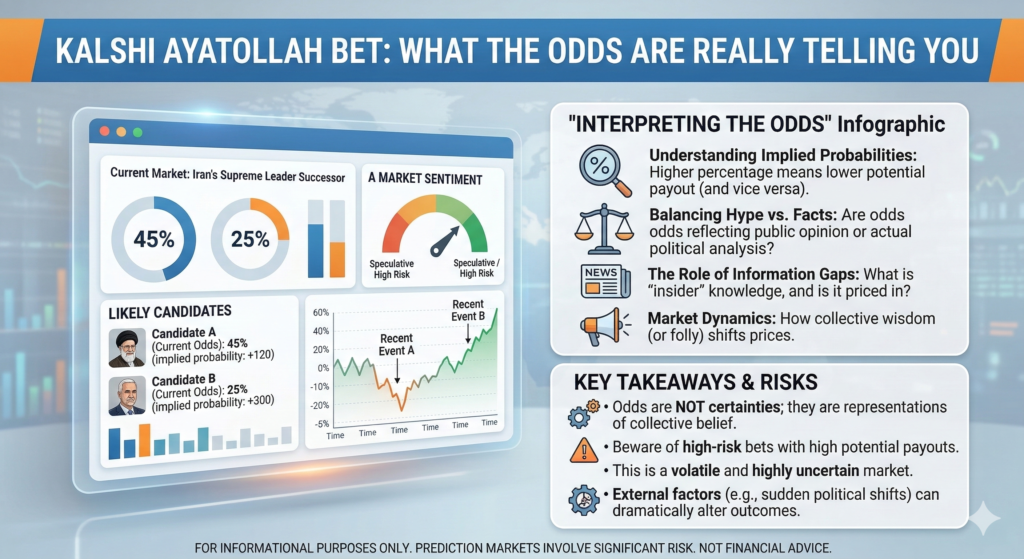
There is a certain kind of clarity you only get when people are willing to put their own money behind an opinion. Political commentary is cheap. Analysis is easy to produce. But when traders open their wallets and take positions on real-world outcomes, the resulting numbers carry a different kind of weight entirely.
That is the idea behind prediction markets — and right now, few topics on platforms like Kalshi and Polymarket are drawing more interest than events tied to Iran. Specifically, the Kalshi Ayatollah bet and its surrounding contracts have pulled in traders, geopolitical watchers, and everyday Americans who are trying to understand just how serious the situation in the Middle East actually is.
What is being priced into these markets? Who is Ali Khamenei, and why does his status matter so much to global stability? How do the Kalshi Iran strike and Kalshi Iran war contracts actually function? And what are communities on Reddit making of all this?
This guide answers every one of those questions in plain, straightforward language — whether you have traded on prediction markets before or are simply trying to make sense of headlines that seem to get more alarming by the week.
What Is the Kalshi Ayatollah Bet and Why Are People Searching for It?
At its core, the Kalshi Ayatollah bet is a shorthand term for a collection of prediction market contracts on Kalshi that are linked to events surrounding Iran’s Supreme Leader, Ali Khamenei. These contracts cover a range of possible scenarios — from questions about his continued leadership to broader developments in Iranian politics — and they attract serious attention because of how high the real-world stakes are.
To appreciate why these contracts exist, it helps to understand how prediction markets operate. Platforms like Kalshi let users buy and sell contracts tied to specific yes-or-no questions about future events. Each contract carries a price between zero and one dollar. That price, at any given moment, represents the market’s best collective estimate of the probability that the stated event will occur before a set deadline.
If a Kalshi contract tied to the Ayatollah is priced at 28 cents, the crowd is saying there is approximately a 28 percent chance the event resolves as “yes.” If that same contract climbs to 60 cents after a major news development, traders have updated their collective view — they now believe the outcome is considerably more probable than before.
This dynamic is what makes these markets so compelling to follow. They do not simply reflect what the media is saying. They reflect what people who are financially accountable for their views actually believe. For many Americans tracking the Iran situation, that distinction matters enormously.
Ali Khamenei and Iran: Understanding the Geopolitical Stakes
Before diving deeper into the specific contracts, it is worth spending a moment on the figure at the center of these markets and why his position carries so much global significance.
Who Is Ali Khamenei?
Ali Khamenei has held the position of Supreme Leader of Iran since 1989. That makes him one of the most enduring heads of government anywhere on the planet. Unlike Iran’s elected president — who operates within a more visible public role — Khamenei sits above the entire governmental structure. He exercises final authority over the country’s armed forces, its judiciary, its intelligence services, and the overall direction of its foreign policy.
His decisions reach far beyond Iran’s borders. They shape the country’s posture toward nuclear negotiations, its financial and military support for armed groups operating across the Middle East, and its relationships with major powers including Russia, China, the United States, and Israel.
Khamenei is now in his mid-eighties. Questions surrounding his health and who might eventually succeed him have been circulating in geopolitical circles for years. Any credible report about a change in his condition or a shift in the internal balance of power in Tehran tends to register immediately in market prices.
Why Iran Keeps American Traders Watching
From the perspective of someone trading on U.S.-based prediction markets, Iran occupies a uniquely important position in the global risk landscape. The country’s advancing nuclear capabilities, its documented support for proxy forces in Yemen, Iraq, Lebanon, and Gaza, its deepening ties with adversaries of the United States, and the recurring close calls between Iranian and American or Israeli military assets combine to create an environment of sustained, high-stakes tension.
When a new escalation unfolds — an attack on U.S. personnel, a diplomatic ultimatum, a statement from Israeli leadership about military options — the Kalshi Iran strike and Kalshi Iran war contracts respond almost immediately. Volume surges. Prices shift. The market, in real time, tells you how seriously sophisticated traders are taking the news.
How the Kalshi Iran Strike and Kalshi Iran War Markets Actually Work
Kalshi hosts several distinct contracts related to Iran, and two of them draw the most consistent attention: the Iran strike market and the Iran war market. They are related but not identical, and understanding the difference between them matters.
Breaking Down the Kalshi Iran Strike Contract
The Iran strike contract poses a direct question: will the United States or Israel conduct a military strike against Iran within a specific timeframe? The resolution rules are clearly written and typically require confirmation through credible, named news sources before a contract settles.
What traders find especially valuable about this contract is its sensitivity to events. The moment a fresh development emerges — whether it is an Iranian-backed attack on American bases, a breakdown in diplomatic talks, or a public ultimatum from Israeli officials — this contract’s price can shift dramatically within a matter of hours. Traders who follow these markets regularly describe the Iran strike contract as one of the most responsive geopolitical instruments available anywhere.
Breaking Down the Kalshi Iran War Contract
The Iran war contract takes a broader view. Rather than focusing on a single military action, it asks whether a sustained armed conflict involving Iran will erupt. Because outright war is seen as a far more extreme outcome than a limited strike, this contract typically trades at lower probabilities — but the potential consequences it prices are correspondingly more severe.
Taken together, these two markets offer something genuinely useful: a way to distinguish between the likelihood of a contained military exchange versus a full regional conflict. For anyone thinking seriously about what instability in that part of the world could mean for energy markets, global supply chains, or American foreign policy, the gap between those two contract prices is itself a meaningful piece of information.
Polymarket Ayatollah Contracts: How Does the Competition Stack Up?
Kalshi is not the only platform where traders can take positions on Iran-related events. Polymarket — a prediction market built on blockchain technology — has also offered Ayatollah and Iran-related contracts, and the two platforms are regularly compared by traders looking for better pricing or deeper liquidity.
The fundamental distinction between them comes down to regulatory standing. Kalshi operates as a federally licensed exchange under the direct supervision of the Commodity Futures Trading Commission. It is subject to American financial law, and its contracts are legally enforceable within the United States. Polymarket, by contrast, is built on decentralized infrastructure and officially restricts access to U.S.-based users, drawing its participant base primarily from international traders who settle positions in cryptocurrency.
For American traders, this is not a trivial difference. Kalshi represents the legitimate, regulated option. Polymarket contracts, while sometimes more liquid on certain events due to their global reach, come with a meaningfully different risk and legal profile.
Traders who monitor both platforms note that the prices on similar contracts occasionally diverge. When they do, those gaps can indicate which platform is receiving fresher information or has a more active participant pool at that particular moment. For experienced traders, tracking those divergences is itself a useful analytical exercise.
The Kalshi Founder Story and Why Regulation Changes Everything
The reason Kalshi carries the regulatory credibility it does comes directly from the vision of its founders and the years of effort they invested in building a compliant platform from the ground up.
Kalshi was founded by Tarek Mansour and Luana Lopes Lara, both graduates of MIT. Their central goal was not simply to build another prediction market — plenty of those existed already in various forms. Their ambition was to create the first prediction market exchange in the United States to receive full approval from the CFTC, the federal agency that oversees derivatives trading.
That approval, which arrived after an extended regulatory review process, marked a turning point for the entire industry. Before Kalshi cleared that hurdle, American traders interested in event-based markets had very few legitimate domestic options. Most activity took place on offshore platforms that operated in legal gray zones, or through academic markets with limited participation and no real financial stakes.
Kalshi’s regulated status means something concrete for the Ayatollah bet and every other contract on the platform. When a contract resolves, traders can be confident that the outcome will be honored and that the process followed established legal standards. That assurance — absent on unregulated alternatives — is what attracts serious traders and contributes to the quality of the pricing signals the platform generates.
Tarek Mansour has spoken publicly about his belief that well-designed prediction markets can serve as genuine information infrastructure — a mechanism for aggregating distributed knowledge into prices that reflect reality more accurately than any single analyst or institution could. The Iran and Khamenei contracts are, in that sense, exactly the kind of markets the platform was built to host.
What the Reddit Community Is Saying About Kalshi Khamenei Markets
Online communities have become an important part of the prediction market ecosystem, and several active Reddit communities — including r/Kalshi, r/PredictionMarkets, and r/geopolitics — have generated substantial discussion around the Kalshi Khamenei and Iran contracts.
Several themes come up repeatedly in those conversations. The first is price efficiency: how accurately do Kalshi prices incorporate available information, and how fast do they update when breaking news arrives? The general consensus among active traders in these communities is that Kalshi prices move ahead of mainstream media coverage surprisingly often, making them useful as an early-warning indicator rather than simply a lagging reflection of what everyone already knows.
A second ongoing discussion involves the comparison between Kalshi and Polymarket pricing. Traders regularly post side-by-side price comparisons when the same event is listed on both platforms, and the gaps that appear spark debates about which market has better information, stronger liquidity, or a more sophisticated participant base at any given time.
A third topic that generates genuine disagreement is whether it is ethically appropriate to treat contracts tied to political figures — particularly contracts related to leadership changes or conflict — as financial instruments. Some community members express discomfort with the framing, while others argue firmly that prediction markets serve a valuable informational function and that conflating them with gambling misses the point of what these platforms are designed to do.
Across all of these threads, one thing stands out: the people participating in these discussions are not casual observers. They follow geopolitics seriously, they think carefully about probabilities, and they view platforms like Kalshi as tools for understanding the world rather than simply venues for speculation.
FAQ:
Q:1. What does the Kalshi Ayatollah bet actually involve?
Ans. It covers prediction contracts tied to Iran’s Supreme Leader Ali Khamenei — his health, leadership status, or political shifts in Iran. Prices reflect live probability estimates from active traders.
Q:2. Can Americans legally trade Kalshi Iran war and strike contracts?
Ans. Yes. Kalshi is CFTC-regulated and fully legal in the U.S. American residents can trade all listed contracts, unlike Polymarket which blocks U.S. users.
Q:3. Why do Kalshi and Polymarket show different prices on the same event?
Ans. Different user bases. Kalshi attracts U.S.-regulated traders while Polymarket draws international crypto users. Each pool processes news differently, causing occasional price gaps.
Q:4. Who founded Kalshi and what makes it different?
Ans. Co-founded by Tarek Mansour and Luana Lopes Lara. Kalshi is the first CFTC-approved prediction market exchange in the U.S. — giving it legal credibility no unregulated platform can offer.
Q:5. How quickly do Kalshi Iran markets react to breaking news?
Ans. Within minutes. Algorithmic traders monitor news around the clock, so Iran strike and Ayatollah contracts move almost instantly when major developments break.
Why These Markets Are Worth Paying Attention To
The Kalshi Ayatollah bet is not a sideshow. It is a serious financial instrument that aggregates the views of informed, financially committed traders into a single, constantly updated number. The prices on the Kalshi Iran war and Kalshi Iran strike contracts do not tell you exactly what will happen — nothing can do that. What they do is give you an honest, real-time read on how people who have put real stakes behind their views are collectively assessing the situation.
For Americans trying to cut through the noise and get a clearer sense of where things stand with Iran, Ali Khamenei, and the possibility of military escalation, these markets offer something genuinely rare: accountability. Every price you see on Kalshi was set by someone willing to back their opinion with their own money.
If you want to start following these markets, visit kalshi.com and browse the current contract listings. Take time to read how each contract resolves before forming any view on what the prices mean. Whether you plan to trade or simply want to track sentiment, prediction markets are becoming one of the more reliable tools available to ordinary Americans who want a clearer picture of an unpredictable world.
Bookmark this article and return to it as the situation in Iran develops — and take a few minutes to explore what the current Kalshi contracts are pricing in today.
This article is intended for informational and educational purposes only. It does not constitute financial, investment, or legal advice. Always review the applicable terms and regulations before trading on any prediction market platform.
For More Information
Related Article
Kalshi Verification Code: What It Means and What to Do Next
Kalshi Verification Code Not Working? Here’s the Fix
Kalshi Lawsuit 2026: How One Startup Is Fighting 19 Legal Battles to Reshape American Betting
5 thoughts on “Kalshi Ayatollah Bet: What the Odds Are Really Telling You”