
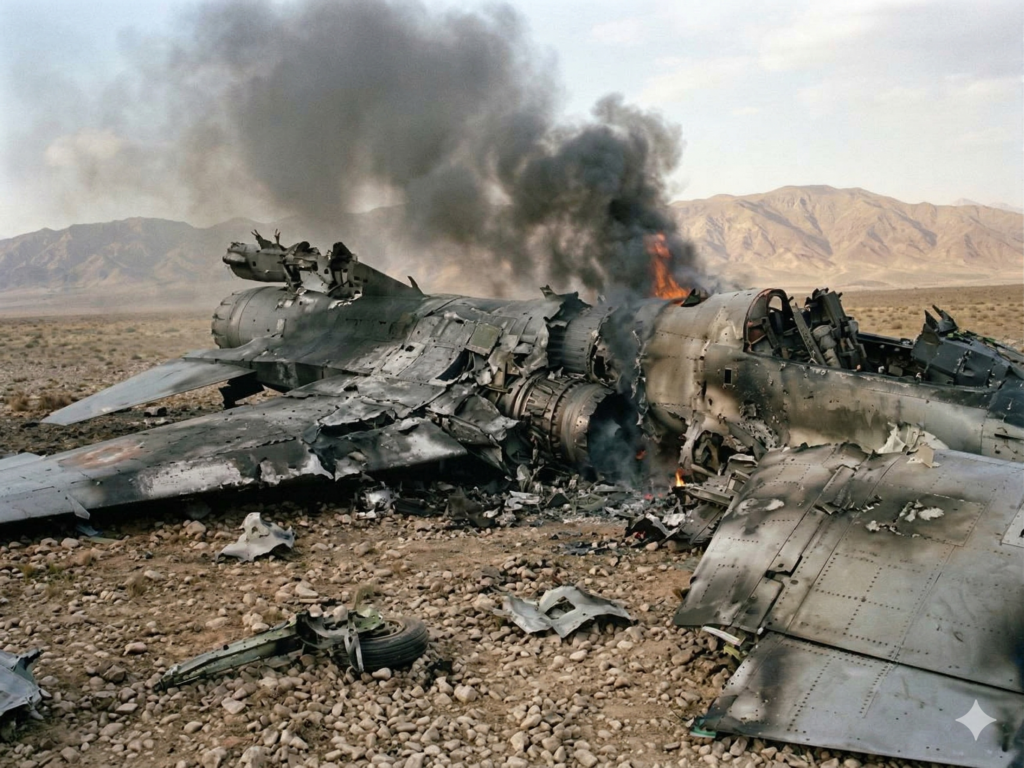
Multiple U.S. officials, Israeli intelligence sources, and reporting from CBS News and Axios all confirm the same basic sequence of events. An F-15E Strike Eagle on a strike mission over southern Iran was hit by Iranian fire and went down on the morning of April 3, 2026. The aircraft carried a standard two-person crew — a pilot in the front seat and a weapons-systems officer in the back.
Both crew members ejected safely before the jet hit the ground. U.S. special operations forces scrambled immediately, located one of the airmen alive on Iranian territory, and successfully extracted him. As of this writing, the search for the second crew member continues — Black Hawk helicopters and a C-130 Hercules transport are actively working the area.
⚡ Key Facts at a Glance
| Date | April 3, 2026 |
| Aircraft | F-15E Strike Eagle — 494th Fighter Squadron / 48th Fighter Wing (Liberty Wing) |
| Location | Southern Iran, near Qeshm Island in the Strait of Hormuz |
| Crew | Two personnel — one rescued alive by U.S. special forces; one still unaccounted for |
| Iran’s Claim | IRGC naval air defense system responsible for the shootdown |
| U.S. Response | President Trump briefed; rescue operation actively underway |
| Iran’s Move | Government offering civilians a reward to locate or capture surviving crew |
Iran Claimed an F-35 — The Wreckage Proved Otherwise
Disinformation in the Fog of War
When Iran’s Islamic Revolutionary Guard Corps first announced the shootdown, they claimed to have downed an F-35 Lightning II — one of America’s most advanced and expensive stealth fighters. The claim was almost certainly designed for propaganda value. But it fell apart fast.
Defense analysts and aviation experts reviewed footage and crash-site imagery released by Iranian state media and reached the same conclusion: the wreckage belonged to an F-15E Strike Eagle, not an F-35. Visible airframe sections, fuselage panels, and external mounting hardware all matched the Strike Eagle’s twin-engine layout. None of it was consistent with the F-35’s distinctive stealth design.
The downed jet is believed to have come from the 494th Fighter Squadron — nicknamed the “Panthers” — or the wider 48th Fighter Wing, known as the Liberty Wing, normally stationed at RAF Lakenheath northeast of London. Both are front-line strike units, built for exactly the kind of deep penetration missions being flown over Iran.
The Race to Rescue: Special Forces vs. Iranian Search Teams
One Crew Member Safe — The Hunt for the Second Is On
From the moment the jet went down, it became a race. U.S. special operations forces moved into Iranian territory and pulled one crew member out alive — a testament to years of training and pre-positioned assets ready for exactly this scenario. The goal in any downed-aircraft situation is simple: locate the crew before the enemy does.
The second crew member has not been found yet, and the clock is ticking. Iran is not sitting idle. Tehran’s state broadcaster urged civilians in the region to help locate the Americans, and the government offered a financial reward to anyone who hands over a surviving pilot. In an unusual move, Iranian armed forces simultaneously told the public not to harm any downed aircrew — a nod, perhaps, to the legal and diplomatic exposure that mistreatment would bring.
Israel, which has been sharing intelligence with U.S. forces throughout the conflict, reportedly called off its own planned strikes on Iran to avoid interfering with the rescue effort. That is a significant concession — and a clear signal of how seriously Washington and Jerusalem are taking the fate of that second airman.
What Training Do Downed Pilots Fall Back On?
F-15E crew members eject with sidearms and survival gear, but their real advantage is training. The U.S. military’s SERE program — Survival, Evasion, Resistance, and Escape — prepares aircrews extensively for exactly this kind of scenario. The playbook is straightforward: hide, make radio contact with rescuers, and avoid any confrontation with hostile forces. If captured, the Code of Conduct kicks in: name, rank, service number, and nothing more.
How Did Iran Shoot Down a US F-15?
Iran attributed the loss of the US fighter jet to what it described as an “advanced naval air defense system” — though it has not named the specific system publicly. IRGC footage released at the time shows an aircraft consistent with an F-15E maneuvering hard and popping flares, which strongly suggests the crew knew a threat was incoming and was trying to defeat it.
Throughout this conflict, Iran has been quietly building out and diversifying its air defenses. Earlier, a U.S. Air Force E-3 Sentry — an airborne early-warning aircraft valued at roughly $300 million — was destroyed when an Iranian missile struck a Saudi base where it was parked. But hitting a stationary aircraft on the ground is a fundamentally different feat than intercepting a maneuvering combat jet at altitude.
It is also worth staying skeptical. Defense analysts note that the F-15E could have sustained damage and gone down later, or Iran could be showcasing previously collected wreckage. CENTCOM had not officially confirmed the cause at the time of publication. What is confirmed is that the aircraft went down — and that the crew made it out alive.
What This Means for the US–Iran Conflict
This incident landed at the worst possible moment for an administration that has been publicly insisting Iran’s military has been gutted. President Trump had told the country that U.S. forces had “decimated” Iran’s fighting capacity. An F-15E shot down over Iranian territory is a direct and visible challenge to that narrative.
White House Press Secretary Karoline Leavitt confirmed to CNN that the President had been briefed. Meanwhile, the same day saw Iran launch missile and drone strikes that damaged oil, gas, and desalination infrastructure across the Persian Gulf, wounding at least a dozen people in the UAE. Israeli jets struck Tehran and Beirut in parallel operations. And a U.S.-attributed strike demolished major sections of Iran’s B1 Bridge near Tehran, killing at least eight civilians — a strike that international law experts have already flagged as a potential violation of humanitarian law.
Know Your Aircraft: The F-15E Strike Eagle
The F-15E Strike Eagle is one of the U.S. Air Force’s most battle-tested aircraft. Built by Boeing, it is a twin-engine, all-weather multirole fighter capable of striking ground targets deep inside defended airspace while still holding its own in air-to-air combat. It has seen action across decades and multiple wars — from the Gulf War to Afghanistan and beyond.
This is not the first time an F-15E has been lost in the current conflict. On March 2, 2026, three F-15Es were downed in a friendly fire incident when Kuwaiti air defenses mistakenly engaged American jets — a catastrophic communication breakdown that cost the Air Force three aircraft and thirteen American lives. But that was friendly fire. The April 3 loss is different. It is the first time an enemy air defense system has confirmed-ly downed a crewed U.S. combat aircraft over Iranian soil since this war began.
FAQ:
Q:1. Was it actually an F-35 or an F-15 that Iran shot down?
Ans: Iran’s IRGC initially claimed it had downed an F-35 Lightning II stealth fighter — a claim almost certainly designed for propaganda impact. But analysis of crash-site imagery released by Iranian media told a different story. Aviation experts identified airframe sections, fuselage panels, and mounting hardware that clearly matched an F-15E Strike Eagle, not an F-35. The initial F-35 claim has been widely discredited.
Q:2. How many crew members were on the jet, and what happened to them?
Ans: The F-15E flies with two crew members — a pilot and a weapons-systems officer. Both ejected safely when the jet was struck. U.S. special forces operating inside Iran located and recovered one crew member alive. The second is still missing, with an active rescue operation underway at the time of publication.
Q:3. Is Iran trying to capture or harm the downed US pilots?
Ans: Iran’s government is offering a financial reward to any civilian who locates or delivers a surviving crew member to authorities. At the same time, the Iranian armed forces publicly told civilians not to mistreat any pilots they find — an unusual step that likely reflects concern about international legal exposure. The situation for the missing second crew member remains extremely uncertain.
Q:4. How did Iran manage to shoot down such an advanced aircraft?
Ans: Iran attributes the shootdown to what it calls an ‘advanced naval air defense system,’ though it has not identified the specific weapon. IRGC footage showed the jet maneuvering and deploying flares — meaning the crew was aware of the threat and trying to evade it. How Iran’s system defeated those countermeasures remains unknown. Independent verification is not yet possible, and U.S. officials have not confirmed the precise cause of the loss.
Q:5. Where does the US–Iran conflict stand right now?
Ans: The war, which kicked off on February 28, 2026, has involved continuous strikes by U.S. and Israeli forces on Iranian military and infrastructure targets, countered by sustained Iranian missile and drone attacks across the Gulf region. The F-15E loss marks the first confirmed downing of a crewed American combat jet over Iran — a significant escalation that comes alongside fresh Iranian attacks on UAE infrastructure and a controversial U.S. strike on a civilian bridge near Tehran.
A Conflict That Refuses to Wind Down
The shooting down of a US F-15 over Iran on April 3, 2026, is a moment that cuts through the noise. Militarily significant. Deeply personal. And impossible to explain away. One American airman made it home because of a daring rescue operation. Another is somewhere inside Iran right now, relying on his training and hoping American forces reach him first.
For the American public, this is a stark reminder of what war actually costs — not in abstractions, but in people. As events move fast and official messaging grows louder, the most important thing any of us can do is stay informed with verified reporting from credible sources. Bookmark this page for live updates as the situation develops.
For More Information
Related Article
Storm Dave 2026: Live Weather Map, Latest Radar Updates & Path Forecast — April 3
29 NATO Nations Stand With Denmark After Trump’s Greenland Ultimatum — What’s Trump’s Next Move?
Blake Lively Claims Dismissed: What the Judge’s Ruling Means Before the May Trial
Gucci Mane Kidnapping Explained: Who Did It, Why It Happened, and What Comes Next
2 thoughts on “Iran Shoots Down US F-15: One Pilot Rescued, One Still Missing”