
The moment a heavy snow warning map appears across the UK, social media erupts with dramatic headlines about ‘monster snow bombs’ and ‘Arctic blizzards.’ Some of those headlines turn out to be accurate. Many do not. Caught in the middle is the average person who simply wants a clear, honest answer: is severe weather actually on the way, how serious could it be, and what steps should they take?
This guide cuts through the noise. Whether you have spotted a red alert weather warning on your phone, seen a winter storm warning scrolling across a news ticker, or simply want to understand what all those coloured zones on a live UK snow map actually mean — this is the right place to start.
By the end of this article, you will understand how weather warning levels work from yellow through to red, what a snow bomb really is and what it is not, where to find the most reliable live world snow map, and how to prepare your household before severe winter weather arrives.
How the UK Severe Weather Warning System Works
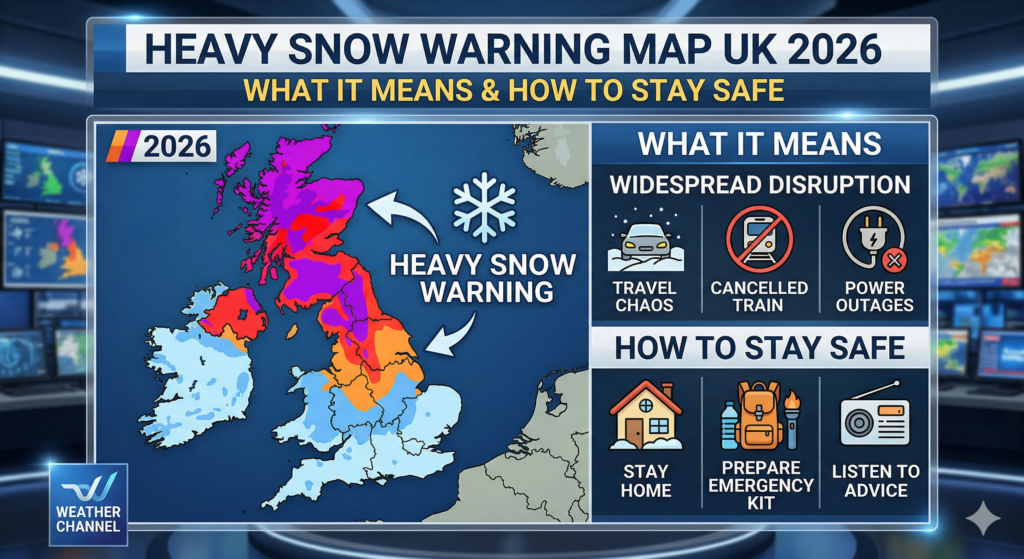
To read a heavy snow warning map accurately, it helps to first understand the three-tier colour system that the Met Office uses to communicate risk across the UK.
Yellow Warning — Be Aware
A yellow warning is the most commonly issued alert and covers a broad range of weather situations. It signals that some disruption is possible, and that you should review the details carefully before making travel plans. Roads may turn slippery, train services could face delays, and isolated power outages are possible. A yellow warning does not automatically mean conditions will be dangerous for everyone — but it does indicate that certain people in certain areas may be affected.
Amber Warning — Be Prepared
An amber warning represents a significant step up in both the likelihood and severity of impact. At this level, there is a higher probability of travel disruption, road and rail closures, and an increased risk to life — particularly for those caught in exposed conditions. If an amber warning for snow covers your region, active preparation is required, not merely monitoring. The Met Office issued amber warnings during the cold snap of January 2026, when snowfall in Tomintoul, Banffshire, reached 52 centimetres.
Red Warning — Take Action Now
A red alert weather warning is the highest level the Met Office can issue. It means that dangerous weather is expected, the risk to life is very high, and serious disruption to travel, infrastructure, and energy supplies is likely. When a red warning is in effect, the guidance is straightforward: avoid travel unless absolutely necessary, and follow all instructions from local emergency services. Red warnings for snow are relatively rare in the UK but have been issued during the most extreme Arctic events.
What Is a Snow Bomb?
If you have searched for the meaning of ‘snow bomb’ after spotting it in a newspaper headline, you are far from alone. The term surfaces repeatedly during winter months and remains one of the most misunderstood phrases in British weather reporting.
Technically, the phrase originates from the meteorological concept of a ‘weather bomb’ — an informal term for a low-pressure system whose central pressure drops by 24 millibars within 24 hours through a process called explosive cyclogenesis. When this rapid pressure fall coincides with sufficiently cold air, the result can include violent winds, heavy precipitation, and — where temperatures are low enough — substantial snowfall.
It is important to note, however, that ‘snow bomb’ is not an official term recognised or used by the Met Office in any of its published forecasts. The organisation has previously highlighted that many alarming weather headlines are based on individual weather model runs rather than verified, official projections.
In practice, many so-called snow bomb alerts circulating on social media are drawn from private forecasting model outputs — not confirmed Met Office data. Always verify any dramatic snow forecast against the official Met Office warnings page before acting on it.
Reading a Heavy Snow Warning Map: What Colours and Zones Tell You
When a heavy snow warning map is published — whether on the Met Office website, a weather app, or a live tracking platform — the coloured zones do not all carry identical meaning or urgency. Here is how to interpret what you are looking at.
Colour Zones and Coverage Areas
The coloured regions on a warning map correspond directly to the yellow, amber, and red categories described above. A critical point to understand is that a warning zone on a map does not mean every location within it will experience identical conditions. Snow accumulations can vary considerably depending on altitude, proximity to the coastline, and local geography.
During the January 2026 cold spell, all of Scotland, Northern Ireland, and northern England sat under yellow warnings for snow and ice, while an amber warning covered central Scotland. Further warnings extended across parts of eastern England, west Wales, and portions of Devon and Cornwall. Even so, official recording stations logged accumulations ranging from under two centimetres at lower elevations to more than 50 centimetres in parts of Aberdeenshire.
How to Use the UK Snow Map Live
The most authoritative source for a live UK snow map is the Met Office warnings page at weather.metoffice.gov.uk. This updates in real time as warnings are issued, upgraded, or lifted. For a more visual, radar-based view, platforms such as VeryWeather.co.uk offer live snow tracking using high-resolution data from both the Met Office and KNMI, refreshed at five-minute intervals.
When consulting any snow map, always check the valid time window displayed alongside the warning. A warning listed as active from 11pm Tuesday to 9am Wednesday does not mean snowfall will be continuous throughout that period — it defines the window during which impacts are considered possible.
Severe Weather Warning Today: What to Do When One Is Issued
Understanding the meaning of a severe weather warning is one thing. Knowing what to actually do is another. Below is a practical breakdown based on each level of warning.
If a yellow warning is in place, monitor the forecast regularly, consider whether your journey is truly necessary, allow additional travel time, and ensure your vehicle is ready for icy conditions. Check in on elderly or vulnerable neighbours who may need assistance.
If an amber warning is in place, begin actively preparing your home and travel arrangements. Stock up on essential supplies in case conditions prevent you from leaving for a day or two. Keep your devices charged in case of power outages, and prioritise reaching out to anyone in your community who may be at risk.
If a red warning is in place, avoid all non-essential travel. Follow every instruction from local authorities and emergency services. Ensure you have an emergency kit that includes warm clothing, a torch, water, food, and any necessary medications.
World Snow Map Live: Tracking Winter Storms Beyond the UK
The UK is not the only country with live snow mapping systems. For those travelling internationally during winter, or for anyone wanting to understand broader global snow patterns, several platforms offer live world snow map views.
Windy.com and Ventusky both provide global interactive weather maps displaying current snow depth, precipitation type, and surface temperature. These tools draw on data from the ECMWF and GFS global models, updated every few hours. For North American winter storm alerts, the National Weather Service at weather.gov offers the equivalent of the Met Office system, with colour-coded watches, warnings, and advisories across the United States and Canada.
As with UK snow maps, it is worth remembering that live world snow map data reflects modelling probabilities rather than confirmed conditions. On-the-ground reality can differ significantly from what any map displays, particularly in mountainous or coastal areas.
Severe Weather Meaning: Why Terminology Matters
The phrase ‘severe weather’ is used loosely in much of the media, but it carries a specific meaning within the official warning framework. Severe weather is defined as conditions that are expected to pose a genuine risk to life, cause substantial travel disruption, and potentially damage property or affect energy supplies on a widespread scale.
This distinction matters. Not every snow shower qualifies as severe weather. Not every overnight frost triggers a formal warning. The system is carefully calibrated to distinguish between inconvenient conditions and truly dangerous ones — which is why its credibility suffers when tabloid headlines apply the phrase to every cold snap in November.
Understanding what a severe weather warning actually means helps you respond in a proportionate way. A yellow warning for snow in January is a relatively routine occurrence. A red alert weather warning in March — when infrastructure is less winter-ready and temperatures are transitional — is an entirely different matter.
FAQ:
Q: What does a heavy snow warning map mean for my area?
A heavy snow warning map highlights regions where the Met Office anticipates snowfall severe enough to cause disruption. If your location falls within a yellow, amber, or red zone, review the specific details for your area carefully, as accumulations and expected impacts vary considerably even within the same warning region.
Q: What is a snow bomb, and is it a recognised meteorological term?
A snow bomb is a popular media expression derived from the concept of a weather bomb — a low-pressure system that deepens by 24 millibars within 24 hours through explosive cyclogenesis. It is not an official Met Office term, and many snow bomb alerts published in newspapers are based on private weather modelling data rather than verified official forecasts. Always consult the Met Office directly before making decisions based on any snow bomb warning you see online.
Q: What does a severe weather warning mean in the UK?
Severe weather warnings in the UK are issued by the Met Office using a three-tier system: yellow (be aware), amber (be prepared), and red (take action). Each level reflects both the likelihood of the event and its potential impact. A red alert weather warning is the most serious, indicating a very high probability of life-threatening conditions and major disruption.
Q: Where can I find the live UK snow map right now?
The most reliable source is the Met Office warnings page at weather.metoffice.gov.uk, which displays all active warnings in real time. For a radar-based visual tracker, VeryWeather.co.uk provides a live UK snow map updated at five-minute intervals using high-resolution data from the Met Office and KNMI.
Q: Is a winter storm warning the same as a red weather warning?
Not exactly. In the UK, the Met Office does not use the term ‘winter storm warning’ — it uses the yellow, amber, and red colour system instead. In the United States, a winter storm warning is issued by the National Weather Service and broadly corresponds to conditions that the UK would classify at the amber level. Always refer to the official meteorological authority in your country for the most accurate and current guidance.
Stay Informed, Stay Safe
A heavy snow warning map is one of the most practical tools available to the public during winter — but only when you know how to interpret it correctly. The difference between a yellow warning and a red alert weather warning is not merely a colour choice on a screen; it is the difference between packing an extra layer and staying home entirely.
The core takeaways from this guide are clear. Consult the Met Office directly for any current severe weather warning rather than relying on sensationalised news coverage. Understand the three warning levels and the action each one requires. Use the live UK snow map to track how conditions are evolving in real time. And if a red warning is ever issued for your area, treat it with the full seriousness it deserves.
Bookmark the Met Office warnings page, download the official app, and make checking both a habit whenever snow is in the forecast. In severe winter weather, a few minutes of preparation can make an enormous difference to your safety — and to the safety of those around you.
For More Information
Related Article
Who Wins Karolina Muchova vs Eala at Miami Open 2026? Our Full Prediction
Did Alexandra Eala Reject Elon Musk? Here’s the Truth Behind the Viral Claim
What Is Royal Gwent Hospital Used For? The Complete Newport NHS Patient Guide
Alan Ritchson Attacks Neighbor in Nashville — Police Investigation Now Underway
2 thoughts on “Heavy Snow Warning Map UK 2026: What It Means & How to Stay Safe”