


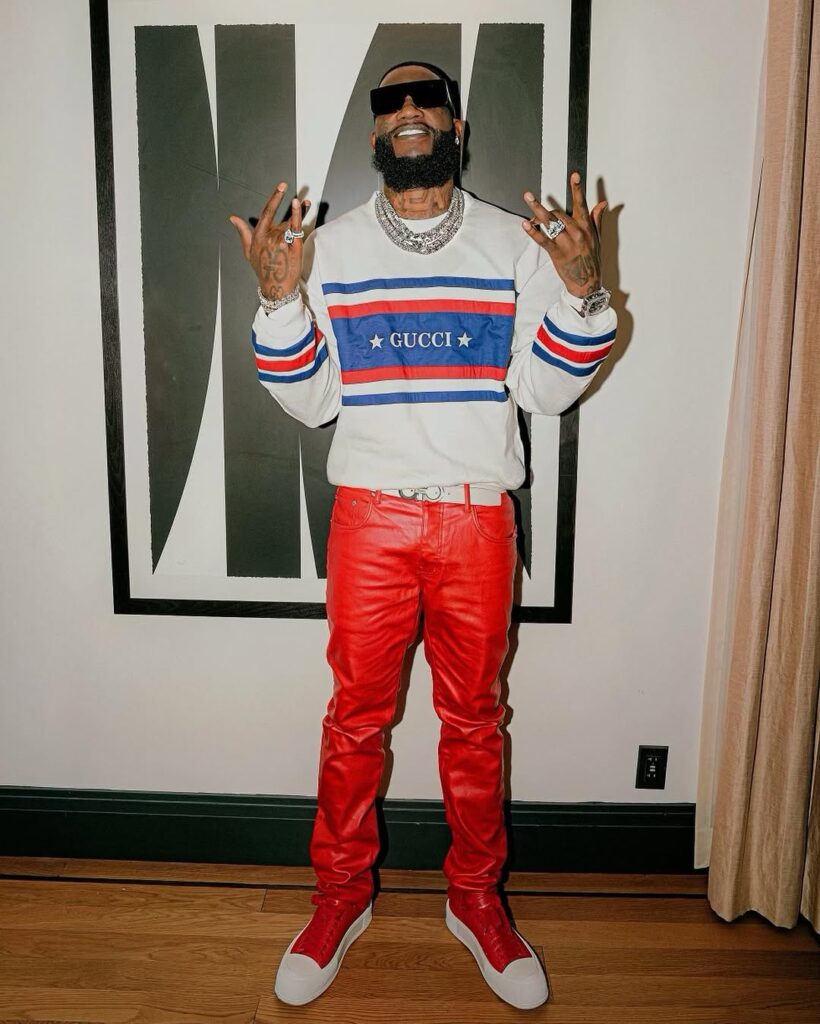
The incident unfolded on January 10, 2026, at a studio located on Dallas Parkway in Texas. According to the federal criminal complaint, Gucci Mane — whose legal name is Radric Davis and who founded and leads 1017 Records — traveled from Atlanta to Dallas alongside two other people. All three believed they were heading to a legitimate business discussion.
The meeting had been set up to address a recording contract dispute tied to Pooh Shiesty, whose real name is Lontrell Williams Jr., and who had been signed to 1017 Records for several years. That, at least, was the story. In reality, the meeting was a trap — carefully arranged to get Gucci Mane and his associates inside the studio and off guard.
Investigators say that shortly after 3:43 p.m., all nine suspects entered the building and immediately split up to separate the victims. Pooh Shiesty personally escorted Gucci Mane into a recording room, while the rest of the group herded the remaining victims into the control room.
How the Armed Robbery Played Out Inside the Studio
What happened next, according to federal prosecutors, was swift and brutal.
Inside the recording room, Pooh Shiesty allegedly produced an AK-style pistol, aimed it at Gucci Mane, and demanded that he sign documents releasing him from his recording contract with 1017 Records. With a firearm pointed at him, Gucci Mane had little choice but to comply.
At the same time, the suspects posted in the control room were carrying out a full robbery of the other victims. The federal complaint lays out some disturbing details:
- One victim was shoved onto a couch and stripped of his wallet and jewelry
- Another victim was grabbed from behind, choked to the point of near unconsciousness, and robbed of a Rolex watch along with other personal valuables
- Multiple victims collectively lost cash, Rolex watches, and high-value jewelry during the ordeal
When the dust settled, U.S. Attorney Ryan Raybould summed up what had taken place in plain terms: the defendants had used “violence and intimidation to achieve their purported business objectives.” That is, they decided that guns and force were a faster route to getting what they wanted than lawyers and negotiations.
Who Is Pooh Shiesty? His History With Gucci Mane and 1017 Records
Pooh Shiesty grew up in Memphis and built a reputation as one of the most promising young voices in rap during the early 2020s. His signing to Gucci Mane’s 1017 Records felt like a natural fit — a rising artist joining a label built by one of trap music’s true originators.
But his career took a serious turn in 2022 when he pleaded guilty to conspiring to possess firearms in connection with violent crimes and drug trafficking. He served a federal prison sentence and walked free in October 2025 — roughly three months before the Dallas studio incident took place.
Here is what makes the situation even more legally precarious for him: at the time of the alleged kidnapping, Pooh Shiesty was not a free man in the conventional sense. He was on federal home confinement, bound by conditions that strictly prohibited him from committing any new federal offense or touching a firearm. The ankle monitor he was required to wear placed him at the Dallas studio on January 10 — a digital record that directly undermines any claim that he was somewhere else.
As for the motive behind all of this, prosecutors point to his growing frustration with his recording contract. Back in October 2024, Gucci Mane had publicly announced that he would be cutting most of his 1017 roster loose — but Pooh Shiesty and one other artist remained. The contractual tension that followed apparently did not resolve itself quietly.
Who Else Was Charged in the Gucci Mane Robbery and Kidnapping?
This was far from a solo operation. The DOJ named nine defendants in total, and the list includes some notable connections:
- Lontrell Williams Jr. — Pooh Shiesty
- Lontrell Williams Sr. — Pooh Shiesty’s father, accused of both planning the kidnapping and arranging the rental vehicles used by the group
- Rodney Wright Jr. — rapper Big30, a Memphis-based artist closely associated with Shiesty
- Kedarius Waters
- Terrance Rodgers — the only suspect who had not been taken into custody as of the April 2 announcement
- Damarian Gipson
- Demarcus Glover
- Kordae Johnson
- Darrion McDaniel
Eight of the nine were apprehended in coordinated arrest operations spanning Dallas, Memphis, and Nashville. Travel records — including cell phone data, license plate readers, and even Greyhound bus logs — confirmed that several of the suspects had journeyed together from Memphis to Dallas before the crime and returned to Memphis the very next day.
The Evidence: How Investigators Pieced the Case Together
What investigators assembled here is a remarkably layered evidentiary picture. Each piece reinforces the next, and taken together, they leave very little room for reasonable doubt — at least on paper.
Electronic Monitoring Data
Pooh Shiesty’s ankle monitor, a condition of his home confinement, registered him at the Dallas studio on January 10. That single data point put him in direct violation of his home confinement terms before any of the criminal allegations even came into play.
Surveillance Footage
Cameras stationed at the studio itself, at a nearby office supply store, and at the hotel where several suspects lodged after the incident captured footage of the group’s movements before, during, and after the alleged crime.
Social Media Posts
This may be the most remarkable piece of evidence in the entire case. Within just a few hours of leaving the Dallas studio, multiple suspects took to social media and posted photos and videos showing off large stacks of cash and expensive jewelry. Law enforcement identified those items as goods taken from the victims. Screenshots from Demarcus Glover’s account, for instance, appeared to show him wearing jewelry that matched what had been reported stolen.
Fingerprint Evidence
Fingerprints lifted from red plastic cups recovered inside the studio connected several of the defendants directly to the scene.
Travel and Vehicle Records
Rental car agreements — all linked to Pooh Shiesty’s father, Lontrell Williams Sr. — placed the group’s transportation squarely in the hands of the Williams family. Combined with license plate reader data and cell tower records, investigators were able to map the coordinated movement of multiple defendants from Memphis to Dallas and back.
What Charges Are They Facing — and What Are the Potential Penalties?
Every one of the nine defendants has been charged with kidnapping and conspiracy to commit kidnapping under federal law. These are not minor charges. Federal kidnapping is among the gravest offenses in the United States criminal code, and if any of the defendants are convicted, each one faces a maximum sentence of life in federal prison.
The case is being handled by the U.S. District Court for the Northern District of Texas. At his April 2 press conference, U.S. Attorney Ryan Raybould was direct about the message this prosecution is intended to send: the victims came to Dallas for a legitimate business meeting and were met with guns and brutality. Anyone who thinks that kind of behavior goes unchecked, he made clear, is badly mistaken.
Who Is Gucci Mane?
Gucci Mane did not become a household name by accident. Born Radric Delantic Davis in Birmingham, Alabama, and raised in Atlanta, he is widely credited as one of the founding fathers of trap music — a genre that has since shaped mainstream American rap for nearly two decades.
He first broke through in the mid-2000s with “Icy” and never really slowed down, releasing a relentless stream of mixtapes and albums even during periods of legal trouble of his own. Along the way, he helped launch careers that now dominate the industry, including Young Thug. He also earned a Grammy nomination for his guest appearance on Lizzo’s “Exactly How I Feel.” His 2017 memoir, The Autobiography of Gucci Mane, gave readers an honest account of his struggles — with the legal system, with mental health, and with addiction — and his long road to stability.
FAQ:
Q.1. Was Gucci Mane physically injured during the kidnapping?
Ans: Based on what has been made public through the federal complaint, Gucci Mane was held at gunpoint and coerced into signing legal documents. The complaint specifically describes other victims being physically assaulted — one was choked nearly unconscious — but it does not confirm that Gucci Mane himself was physically harmed beyond the immediate threat of a firearm pointed at him.
Q.2. Why would Pooh Shiesty allegedly kidnap his own label head?
Ans: According to federal prosecutors, Pooh Shiesty had grown deeply unhappy with his recording contract at 1017 Records and wanted out. Rather than hire an attorney or attempt a negotiated exit, the DOJ alleges he organized a coordinated armed operation to force Gucci Mane to sign release paperwork at gunpoint. It is a shocking escalation of what would otherwise be a fairly routine industry dispute.
Q.3. Is Pooh Shiesty currently in custody?
Ans: Yes. As of April 2, 2026, he was arrested as part of the multi-city operation that also swept up seven of the other eight defendants. He now faces federal kidnapping charges that, if proven at trial, could result in a life sentence.
Q.4. How did the FBI and DOJ tie the suspects to the crime?
Ans: Investigators built their case using a combination of ankle monitoring data, surveillance camera footage, cell phone records, license plate readers, Greyhound bus logs, rental car paperwork, fingerprint analysis from items recovered at the studio, and the defendants’ own social media posts showing what appeared to be stolen goods — all published within hours of the alleged robbery.
Q.1. What happens to 1017 Records going forward?
Ans: Gucci Mane has not been accused of any wrongdoing whatsoever — he is the victim in this matter. His label and his career continue, though the legal fallout surrounding Pooh Shiesty and Big30 will inevitably reshape certain business relationships and the roster going forward. The long-term impact on 1017 Records is still unfolding.
Conclusion
The Gucci Mane kidnapping is one of the most jarring events to shake the American music industry in years. At its core, this is a story about what happens when a business dispute stops being handled like a business dispute — when someone trades lawyers and phone calls for firearms and coercion. What allegedly began as frustration over a recording contract ended with a gun pressed into a situation that now carries potential life sentences for nine people.
As of April 2026, eight of the nine defendants are behind bars, federal charges are on the books, and the case is working its way through the Northern District of Texas court system. Given the volume and variety of evidence prosecutors say they have — from ankle monitor data to the suspects’ own social media confessions — this is a case that will be closely watched by the music industry and the public alike.
For More Information

Related Article
Hired to Kill: Inside the US Special Forces Mercenary Killing Unit Lawsuit and the UAE Connection
Texas Firefighter Child Abuse Case: 3 Howe Volunteers Arrested in 2026 Scandal
No Exit, No Deal: Inside America’s Crumbling U.S.-Iran Conflict Strategy
Braylon Mullins Net Worth 2026: NIL Deals, College Earnings & NBA Draft Breakdown