
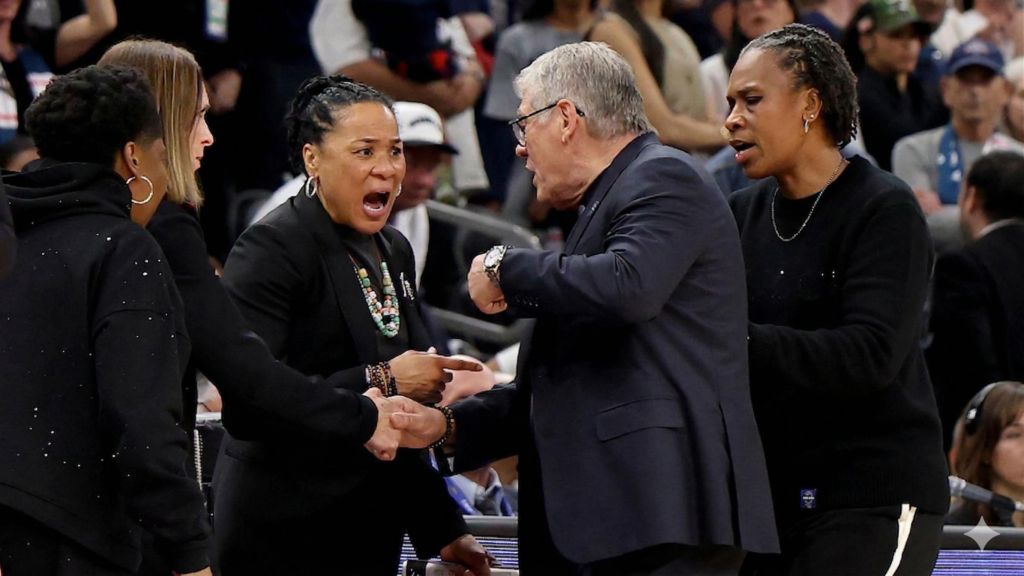
With barely a second remaining on the clock and South Carolina well ahead, Geno Auriemma left his bench and walked toward Dawn Staley’s side of the court. To most watching, it looked like the beginning of a routine postgame handshake. It was anything but.
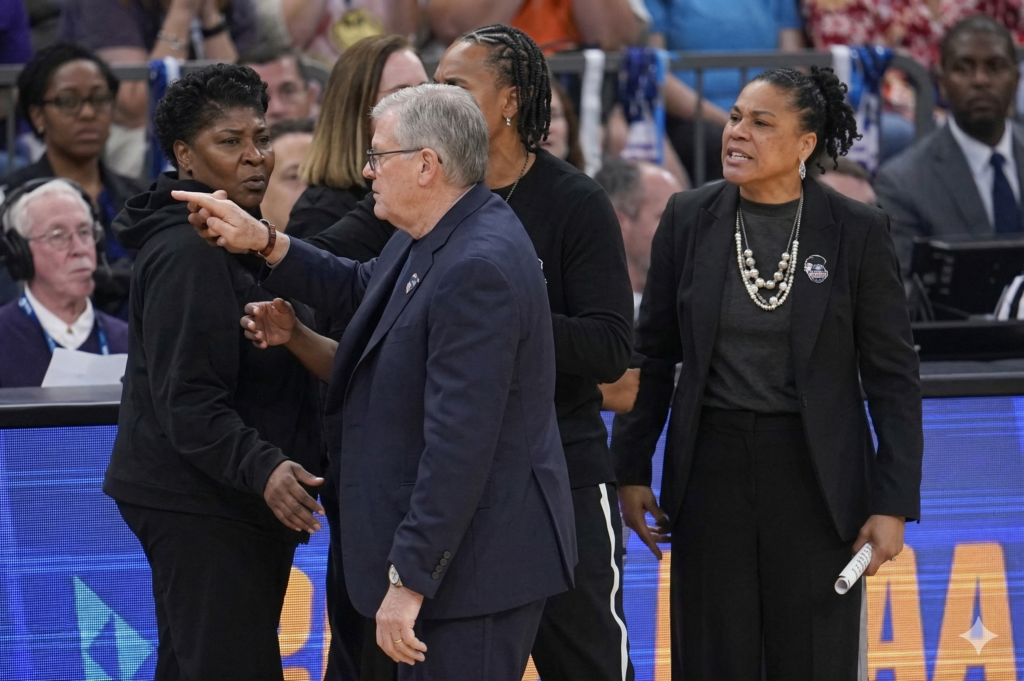
Auriemma reportedly approached Staley and made a comment that did not land well — not at all. Within moments, the exchange between the two coaches had escalated into a full shouting match, visible to everyone inside the Mortgage Matchup Center. Staff members and officials rushed to step between them. Staley continued directing words toward the UConn bench even as members of her own coaching staff circled around her. Auriemma, meanwhile, turned and walked straight off the court and into the tunnel — skipping the handshake line entirely, which is a significant breach of postgame protocol at any level of college basketball.
Courtside video captured by ESPN reporter Kareem Copeland appeared to show Staley saying, “I will beat Geno’s ass,” after the two were separated. Given the sequence of events, though, it read less like a threat and more like the raw, unfiltered response of someone who had just been blindsided by a confrontation she did not initiate.
What Geno Auriemma Said — Before and After the Game
Auriemma’s frustration did not appear out of thin air at the final buzzer. It had been simmering throughout the second half, and it came pouring out on live television well before the clock ran out.
The In-Game Interview That Set the Tone
Going into the fourth quarter, ESPN’s Holly Rowe spoke with Auriemma in a sideline interview. What followed was one of the sharper public outbursts from a major college coach in years. Auriemma trained his frustration on the officiating — specifically a foul disparity he saw as wildly imbalanced — and he did not shy away from calling out Staley by implication.
He labeled the foul situation “ridiculous,” noting that all six fouls whistled during the third quarter had gone against UConn. He also brought up an incident involving Huskies star Sarah Strong, whose jersey was torn during play without any foul being called. He alleged that Staley was loudly working the officials throughout the game in ways that were not being penalized. UConn finished the game with 17 total fouls against them; South Carolina was charged with just 8. That number clearly sat with him throughout the second half and well into the postgame.
Auriemma’s Comments After the Final Buzzer
When reporters asked Auriemma to explain what he said to Staley during their confrontation, he gave very little away. “I said what I said, and obviously she didn’t like it,” he told reporters. “I just told the truth.”
He also raised what he described as a pregame protocol issue. According to Auriemma, the standard custom at NCAA tournament games requires both head coaches to meet at half-court before tip-off for a handshake that gets announced over the loudspeaker. He claimed he stood there waiting for roughly three minutes before the game started, and Staley never showed. “For 41 years I’ve been coaching, and I don’t know, 25 Final Fours. That’s just what you do,” he said. When asked whether he regretted his on-air comments to Holly Rowe, Auriemma was unmoved. “Why would I?” he replied.
How Dawn Staley Responded to Geno Auriemma’s Criticism
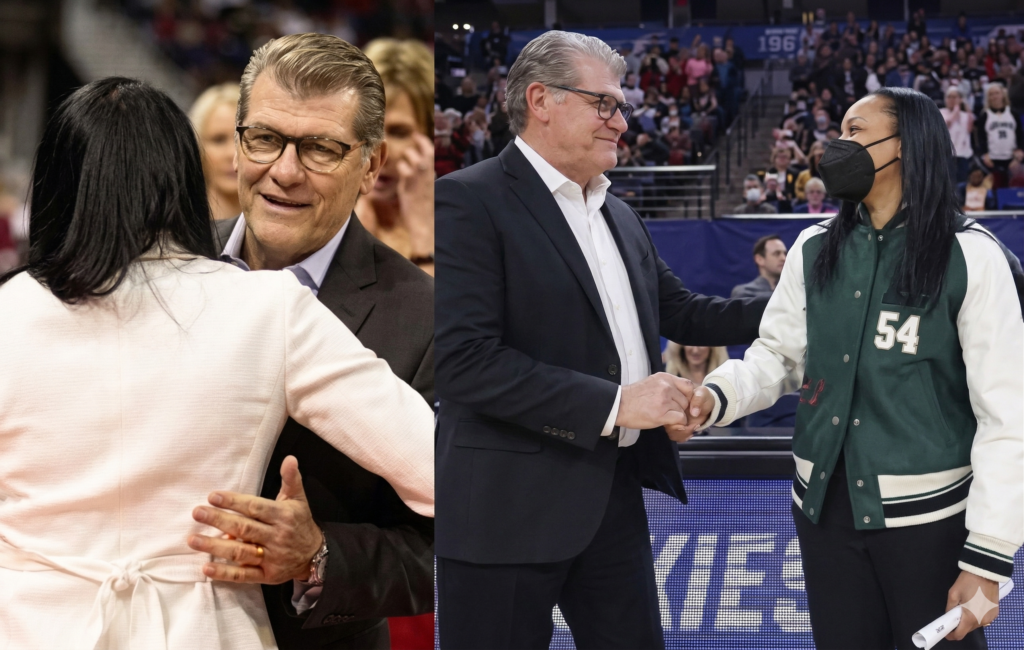
Staley’s First Reaction on the Sideline
There was nothing calm about the moment itself — Staley was visibly fired up. But the second a microphone was in her face, she shifted into a completely different gear. She was poised, clear-headed, and careful not to let the incident steal the spotlight from what her team had just accomplished.
Speaking with Holly Rowe for ESPN immediately after the game, Staley said she genuinely did not understand what had triggered Auriemma. She addressed his pregame handshake grievance head-on, explaining that she had gone to UConn’s bench before the game and personally greeted every member of his staff. If she had missed a specific half-court ceremony that Auriemma expected, she was unaware of it.
“I have no idea,” Staley told Rowe. “I’m of integrity. I’m of integrity. So if I did something wrong to Geno, I had no idea what I did. I guess he thought I didn’t shake his hand at the beginning of the game. I went down there pregame and shook everybody on his staff’s hand. I don’t know what happened after the game. But hey — sometimes things get heated. We move on.”
Staley’s Press Conference: Taking the High Road
At her formal postgame press conference, Staley made a deliberate choice. She redirected all questions about the confrontation straight back to Auriemma, refusing to get drawn into a back-and-forth. “You can ask Geno the question,” she said plainly. “He’s the one who initiated the conversation. I don’t want what happened there to dampen what we were able to accomplish today.”
Her focus stayed on her players — on Ta’Niya Latson’s double-double of 16 points and 11 rebounds, on a team that outscored UConn in the third quarter and then held the Huskies scoreless for over four consecutive minutes to pull away for good. “I’m super proud of our kids,” she said. “I’m not going to let any incident take away from the performance on the floor.”
The Sports World Reacts: A Double Standard Nobody Could Ignore
The loudest public response to the Staley Auriemma postgame comments came from ESPN’s Stephen A. Smith, who went straight to X, formerly known as Twitter, with a take that quickly became the most widely shared reaction to the incident.
Smith was direct: Auriemma had been outcoached that night, and instead of being gracious in defeat, he chose to get in Staley’s face. Smith’s most pointed observation, though, was about fairness. He argued that if the roles had been reversed — if Staley had been the one to initiate a confrontation after losing — the public and media backlash aimed at her would have been far more intense and far less forgiving. That point struck a chord with a lot of people, and it spread quickly.
The broader social media reaction followed the same current. The overwhelming majority of fans and commentators were critical of Auriemma, calling for him to publicly apologize to Staley and acknowledge that his behavior — from the live broadcast criticism to the sideline confrontation — had fallen well below the standard his reputation demands.
A smaller group offered some perspective on Auriemma’s side, noting that a coach who has dedicated over four decades to the sport could reasonably be emotional when he believes his players were treated unfairly. That view, while legitimate, did not gain much traction given how the sequence of events unfolded.
The History Behind the Rivalry: This Was Never Two Strangers
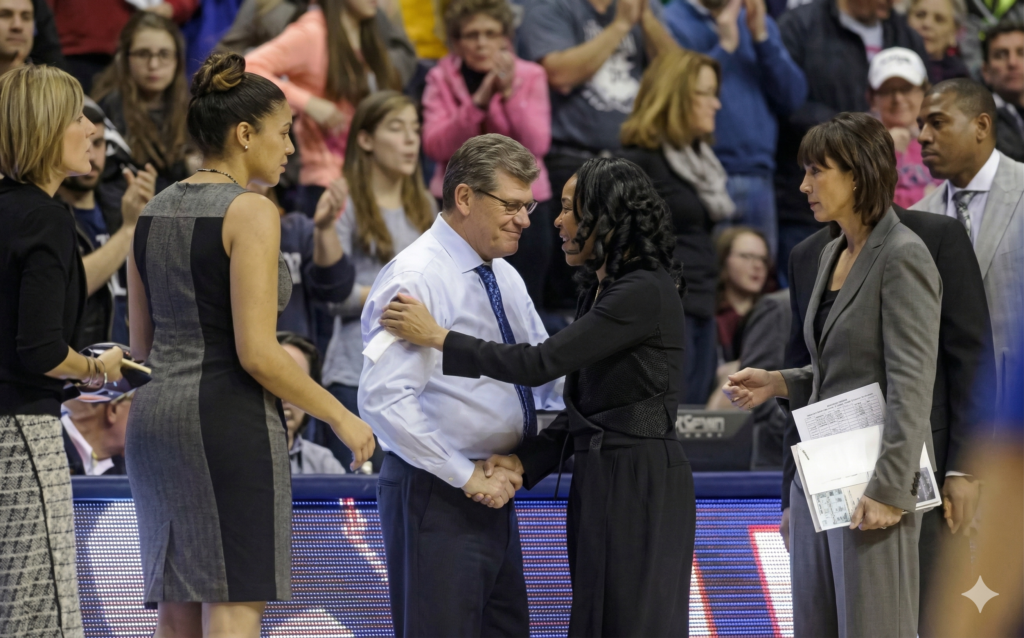
Part of what made the Dawn Staley Geno Auriemma feud so jarring was the relationship that existed before it. These two coaches were not meeting for the first time on a hostile court. They have a shared history that goes back years, and it has not always been adversarial.
Staley worked directly under Auriemma as an assistant coach on the U.S. Women’s Olympic Basketball team at the 2016 Rio Games, where Team USA took home the gold medal. Since then, their programs have met repeatedly on the sport’s biggest stages. UConn defeated South Carolina in last year’s national championship game — making Friday night’s Final Four rematch particularly loaded with emotion before anyone had even tipped off.
To his credit, Auriemma did acknowledge Staley’s achievements in his postgame remarks, recognizing what she has built at South Carolina — a program that has now reached six straight Final Fours and captured three national titles. That acknowledgment, unfortunately, was buried beneath everything else that happened that night.
What Comes Next: Potential Consequences and the Bigger Picture
With South Carolina advancing to face UCLA in the national championship game on Sunday, April 6, the NCAA women’s basketball coach rivalry controversy is not going anywhere.
The question of whether Auriemma will face any formal discipline from the NCAA or the Big East is now part of the conversation. Coaches can and do face fines and other sanctions for sideline conduct, and the visibility of this incident — broadcast nationally, captured on multiple cameras, and now viral across every platform — makes it difficult to treat as a minor footnote.
The deeper question, though, is the one that lingers beyond any formal process. When coaches of this stature conduct themselves this way in full public view, what message does it send? Women’s basketball is at the peak of its cultural moment. The coaches who lead its biggest programs carry a responsibility that extends beyond wins and losses.
FAQ:
Q: What exactly happened between Dawn Staley and Geno Auriemma at the 2026 Women’s Final Four? As South Carolina’s 62–48 victory over UConn was coming to a close, Auriemma walked toward Staley on the sideline. He made a comment that escalated immediately into a shouting match. Coaches and officials had to step in to separate them, and Auriemma left the court without going through the handshake line.
Q: Why was Geno Auriemma so upset with Dawn Staley? Auriemma pointed to two main issues. First, he felt the officiating was heavily skewed against UConn — his team was called for 17 fouls compared to South Carolina’s 8. Second, he claimed Staley did not show up for the traditional pregame half-court handshake, which he said he waited at for about three minutes.
Q: How did Dawn Staley handle the situation after the game? Staley was composed and measured in both her immediate interview and her press conference. She said she was unaware of doing anything wrong, noted that she had greeted Auriemma’s entire staff before the game, and made clear that she wanted the focus to remain on her team’s performance rather than the confrontation.
Q: What was Stephen A. Smith’s reaction to the Geno Auriemma and Dawn Staley incident? Smith criticized Auriemma publicly, describing his conduct as classless and arguing that he simply lost to a better-coached team that night. He also pointed out that Staley would have faced far greater criticism had she been the one to initiate the confrontation — raising a question about the unequal standards often applied to coaches based on race and gender.
Q: Could Geno Auriemma face punishment from the NCAA over this incident? It is a real possibility. His in-game broadcast criticism of the referees and Dawn Staley, combined with his conduct at the final buzzer and his decision not to complete the handshake line, could all be subject to review. As of April 4, 2026, no formal action has been announced.
Two Legends, One Night, and a Line That Got Crossed
The Dawn Staley vs Geno Auriemma controversy is about more than a heated moment between two coaches. It reflects the enormous pressure that lives inside elite competition, and it raises honest questions about sportsmanship, accountability, and the standards we hold coaching legends to — especially when the cameras are on.
Both of these coaches have earned their place among the greatest in the history of the sport. But Friday night in Phoenix, the postgame story belonged to Staley — not just because her team won on the scoreboard, but because she handled everything that followed with far more composure than the situation called for.
For More Information
Related Article
Blake Lively Claims Dismissed: What the Judge’s Ruling Means Before the May Trial
3 thoughts on “Dawn Staley vs Geno Auriemma Controversy: What Really Happened at the 2026 Women’s Final Four”