


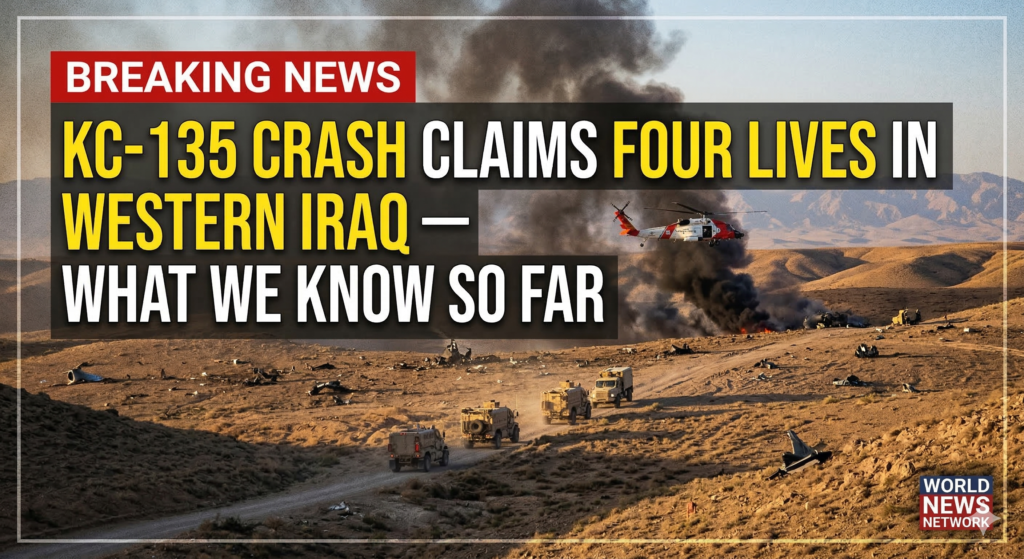
On March 12, 2026, a U.S. Air Force KC-135 Stratotanker — arguably the most vital aerial refueling platform in the American military arsenal — plunged into the desert of western Iraq. Four crew members did not survive. The incident reverberated across the military aviation world and prompted urgent scrutiny of the dangers facing U.S. tanker aircraft in active theaters of war.
This article covers everything you need to know: where the aircraft originated from, the mission it was assigned to, what investigators have determined so far, and the long — often tragic — history of KC-135 incidents that predates this event by nearly seven decades. Whether you are tracking the latest news or looking for broader context on this storied aircraft, read on.
The KC-135 Crash in Iraq: What Unfolded on March 12, 2026
U.S. Central Command (CENTCOM) officially acknowledged the loss of a KC-135 Stratotanker during Operation Epic Fury — the U.S. military’s ongoing air campaign against Iran. The aircraft went down at roughly 2:00 p.m. Eastern Time on Thursday, March 12, in a remote stretch of the western Iraqi desert.
Notably, two KC-135s were linked to the incident. While one crashed, a second declared a 7700 in-flight emergency — the universally recognized distress code in aviation — and diverted to Ben Gurion Airport in Israel, where it landed without further casualties. From the outset, CENTCOM made its position clear: neither hostile fire nor enemy action caused the crash.
By the morning of March 13, the Pentagon confirmed that four of the six crew members aboard the downed tanker had been killed. Rescue teams were actively searching for the remaining two. In keeping with standard protocol, the military withheld the names of all personnel involved until at least 24 hours after their families had been personally notified.
Where Did the KC-135 That Crashed Come From?
Aircraft tail markings photographed by Israeli media pointed to Beale Air Force Base in California, home of the Air Force Reserve Command’s 940th Air Refueling Wing. That said, during Operation Epic Fury, the U.S. military has forward-deployed tanker assets to numerous locations throughout the Middle East — including bases in Israel — to sustain the high operational tempo of the campaign.
What Is the KC-135 Stratotanker ?

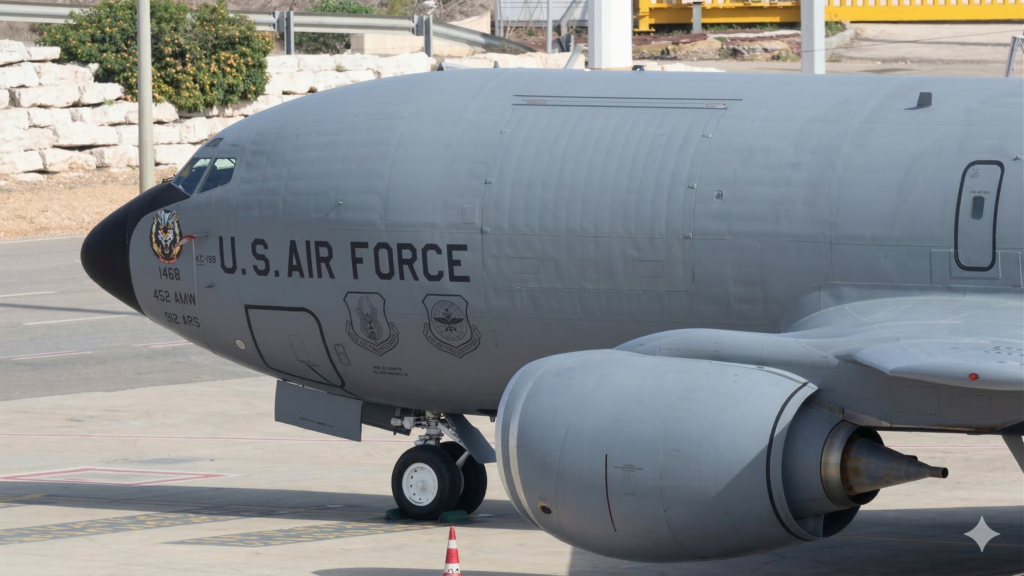
The Boeing KC-135 Stratotanker has anchored U.S. airpower for close to seven decades. It entered active service in 1957, during the Eisenhower administration, and quickly became indispensable. Put simply, it functions as an airborne filling station — extending the range and endurance of fighters, bombers, and reconnaissance aircraft that would otherwise be grounded by fuel limitations.
A few key facts put the aircraft in perspective:
The KC-135 is derived from the commercial Boeing 707 and is powered by four jet engines, with a wingspan of 130 feet. As of recent congressional assessments, 376 units remain on active duty. Its minimum operating crew consists of three personnel: a pilot, a co-pilot, and a boom operator who physically manages the refueling connection. The aircraft transfers fuel at an exceptionally high rate using its signature “flying boom” system. Because the final delivery of a new KC-135 occurred in 1965, the average active airframe is now more than 66 years old.
Despite its advancing age, the Stratotanker has been continuously modernized and is expected to remain operational until at least 2050. The Air Force is actively transitioning to the Boeing KC-46 Pegasus as its long-term replacement, though that program is still working through its own development and delivery challenges.
The KC-135 in Iraq: Understanding Operation Epic Fury
To grasp the full weight of this KC-135 crash, some context about the broader military situation is essential. Operation Epic Fury is the official designation for the U.S. military’s air campaign against Iran, launched on February 28, 2026. Throughout this operation, aerial refueling tankers have been pushed to their limits, continuously fueling strike packages composed of fighters, bombers, and support aircraft conducting long-range missions against Iranian targets.
The operational tempo has placed the tanker fleet under significant strain. KC-135s have been dispersed across the theater — from Israel to Gulf state airfields — working around the clock to keep aircraft fueled and mission-ready. It is worth noting that the Stratotanker, while immensely capable, is large and not designed to operate in contested airspace. Typically, it holds well back from conflict zones, with receiving aircraft flying out to meet it.
The March 12 incident marked the fourth loss of a manned U.S. aircraft during Operation Epic Fury. Earlier that month, three F-15E Strike Eagles were brought down over Kuwait in a friendly fire incident involving Kuwaiti F/A-18 jets, though all six crew members ejected and survived. Additionally, at least ten MQ-9 Reaper drones have been destroyed. What sets this KC-135 loss apart is that it is the first to result in confirmed crew fatalities since the campaign began.
What Caused the Crash?
Military investigators have eliminated both hostile fire and friendly fire as contributing factors. That finding considerably narrows the range of plausible causes. Given that two KC-135s appear to have been involved simultaneously — one going down, the other declaring an in-flight emergency — aviation analysts have speculated the incident may have stemmed from a midair collision, a structural issue, or a critical mechanical failure during a refueling operation.
The crash site sits in a remote, arid stretch of western Iraq. The sparse population of the area has complicated search and rescue efforts, though it also helped to minimize any civilian impact. CENTCOM has committed to releasing further information as the investigation progresses.
Separately, the Islamic Resistance of Iraq — an Iran-backed militant network — publicly claimed credit for shooting down the aircraft. CENTCOM directly refuted this assertion, reaffirming that there is no evidence of enemy fire being involved in the crash.
A History of KC-135 Crashes
The 2026 Iraq crash is not an isolated chapter — it is the latest entry in a long record of KC-135 accidents spanning nearly seven decades. More than 50 fatal crashes have been documented since the Stratotanker entered service. The following incidents stand out as the most significant.
Key KC-135 Crash Events From 1965 to 2013
1965 — Wichita, Kansas: A KC-135 carrying 31,000 gallons of jet fuel failed to gain altitude after takeoff and plowed into a residential neighborhood. Seven airmen and 23 civilians perished, and the resulting fire destroyed scores of homes. It remains the deadliest aviation accident in the history of Kansas.
1965 — Loma Hill, California: A separate crash that same year killed 12 crew members and 72 passengers when the aircraft collided with a hillside. In terms of total lives lost, this remains the most catastrophic single event in KC-135 operational history.
1966 — Spain: During an aerial refueling operation, a KC-135 collided with a B-52 bomber in midair over Spanish territory, killing four crew members aboard the tanker.
1982 — Illinois: A catastrophic in-flight explosion during a training exercise brought down a KC-135 near Greenwood, Illinois. All 27 crew members on board lost their lives.
1987 — Fairchild AFB, Washington: Six airmen and one civilian spectator died when a KC-135 participating in an airshow rehearsal flew into the wake turbulence generated by a preceding B-52 and lost control.
2013 — Kyrgyzstan: A KC-135 assigned to Fairchild AFB broke apart shortly after takeoff while supporting operations in Afghanistan, killing all three crew members. This accident represented the last confirmed KC-135 crash before the March 2026 Iraq incident — a gap of 13 years.
KC-135 Crew Size, Price, and Strategic Value
To appreciate the full magnitude of what was lost in this crash, it helps to understand what the KC-135 represents in both human and material terms.
Crew Size: A fully operational KC-135 requires a minimum of three crew members — a pilot, a co-pilot, and a boom operator responsible for managing the physical refueling connection. The aircraft that crashed on March 12 had six individuals aboard, reflecting the additional personnel that some mission profiles demand.
Price: When the KC-135 first rolled off the assembly line in the late 1950s, each aircraft cost roughly $3.7 million — equivalent to approximately $40 million in today’s dollars after adjusting for inflation. Given the extensive modifications and upgrades applied over six decades, the true operational value of each surviving airframe far exceeds that figure. By comparison, its replacement — the Boeing KC-46 Pegasus — carries a price tag of around $250 million per unit.
Strategic Importance: Aerial refueling is not an optional feature of U.S. military power — it is the foundation of it. Every global strike mission, every long-distance fighter deployment, every extended bomber patrol depends on tankers like the KC-135 to reach its objective. Losing even a single airframe in an active theater carries real consequences that extend well beyond the aircraft itself.
FAQ:
Q:1 Was the KC-135 shot down over Iraq?
Ans: No. U.S. Central Command confirmed the crash was not caused by hostile or friendly fire, directly disputing claims made by the Iran-aligned Islamic Resistance of Iraq.
Q:2. How large is the KC-135 crew?
Ans: The KC-135 typically flies with a three-person crew. The aircraft involved in the March 12, 2026 crash carried six crew members — four were killed and two remained missing.
Q:3. When did the last KC-135 crash occur before 2026?
Ans: The previous fatal KC-135 crash occurred in May 2013 in Kyrgyzstan, killing all three crew members. The 2026 Iraq crash marks the first KC-135 loss in over 13 years.
Q:4. Where was the KC-135 that crashed in Iraq based?
Ans: Tail markings identified the aircraft as assigned to Beale Air Force Base, California, home of the 940th Air Refueling Wing, with units forward-deployed across the Middle East for Operation Epic Fury.
Q:5. How many KC-135 crashes have there been in total?
Ans: Over nearly seven decades of service, more than 50 KC-135 aircraft have been involved in fatal accidents, claiming hundreds of lives. The March 2026 Iraq crash is the most recent.
The Human and Strategic Toll of the 2026 KC-135 Crash
The KC-135 crash in western Iraq on March 12, 2026 is far more than a military news story. It is a stark reminder that behind every aircraft in service, there are real people — pilots, operators, and crew members — who accept enormous personal risk every time they climb aboard.
Four of those individuals did not come home. They were flying a mission that has quietly underpinned American air supremacy for generations. The investigation into what brought their aircraft down will be critical — not just for accountability, but for protecting the lives of every airman who still flies the aging Stratotanker.
With Operation Epic Fury still active and the tanker fleet under relentless pressure, understanding this crash matters. The questions it raises — about aircraft age, operational tempo, and crew safety — deserve honest answers.
Bookmark this page for updates as the investigation develops, and explore our related coverage on U.S. military operations, aviation safety, and the ongoing conflict with Iran.
For More Information

Related Article
Wisconsin vs Washington Prediction: Big Ten Tournament Odds, Team News & Score Forecast
Panathinaikos FC vs Real Betis Prediction: Europa League First Leg Odds, Team News & Score Forecast
Temple Israel West Bloomfield Stands as Michigan’s Most Enduring Jewish Community
Gunman Opens Fire at Old Dominion University, Two Critically Injured and Shooter Dead